Lightweight and Durable: Reinventing UAVs with HP 3D Printing



For engineers designing unmanned aerial vehicles (UAVs), every gram matters. Weight, durability, and design flexibility are critical to achieving longer flight times, more agile maneuverability, and reliable performance—especially in remote or rugged environments. These priorities are driving a growing shift toward additive manufacturing as a core strategy in drone development.
A recent example is The Eye Above, a drone developed with real-world conservation and environmental monitoring missions in mind. By integrating HP’s Multi Jet Fusion (MJF) 3D printing technology and PA 12 material, The Eye Above was built from the ground up to operate in demanding conditions—without sacrificing performance or speed to market.
A UAV Born from Necessity
“Some game warden friends wanted to put a drone up to help with their poaching problem,” says The Eye Above founder Robert Miller. “I went to all the experts, looking for an existing drone that could work. I realized very quickly that what was out there wasn’t going to meet our needs.”
What followed was a collaborative development effort between The Eye Above and HP’s drone and Professional Services teams. The goal: engineer a drone that was lightweight, structurally strong, fast to iterate, and adaptable enough to serve a wide range of conservation and inspection missions.
Additive Advantages: Lightweight Structure, Heavyweight Capability
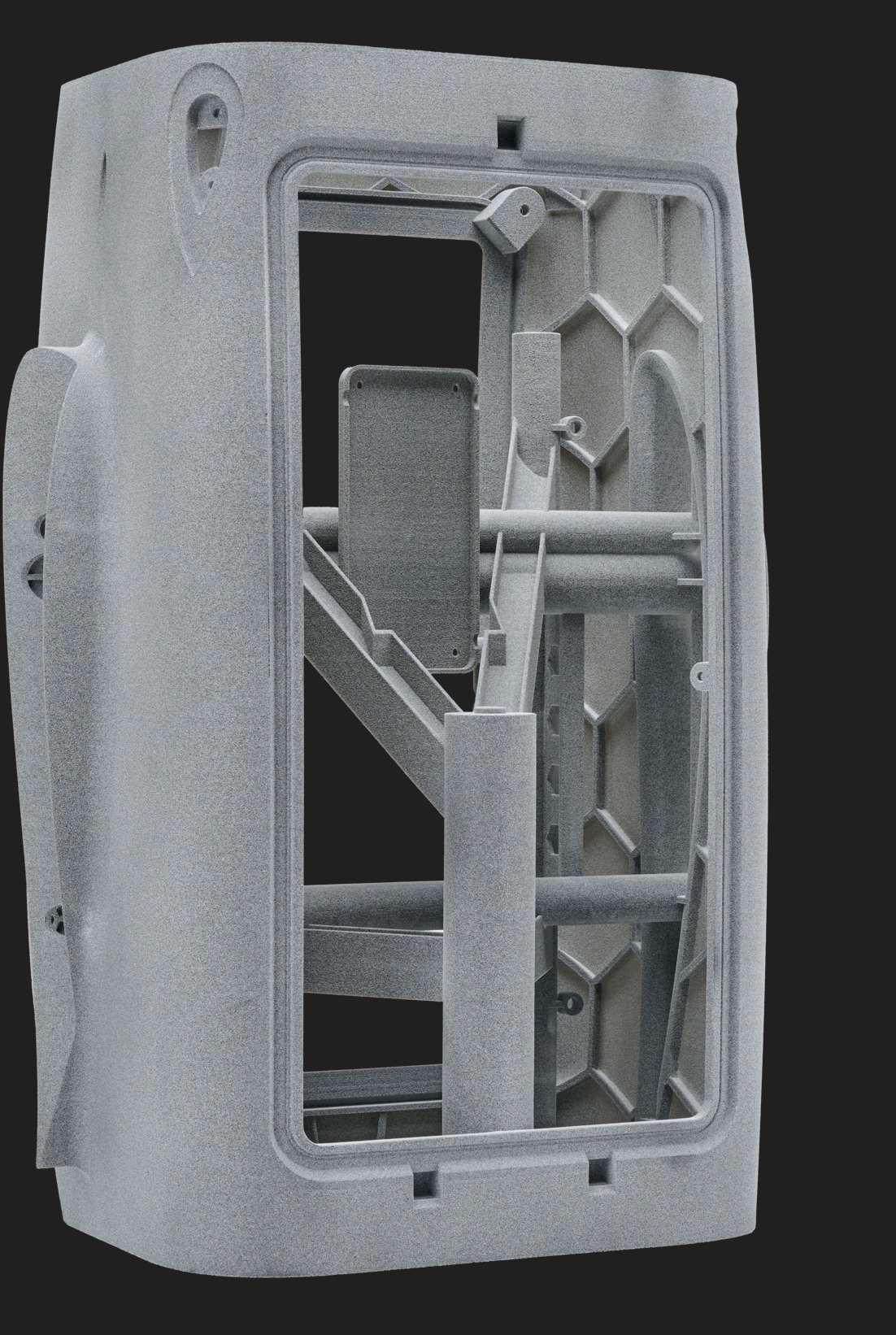
Traditional methods of drone manufacturing often can’t deliver the strength-to-weight ratios needed for optimal flight performance. In contrast, 3D printing enables engineers to produce parts with internal lattice structures, hollow reinforcements, and geometry-driven weight reductions that are difficult—or impossible—to achieve with conventional techniques.
HP’s Jet Fusion 5600 Series printer gave Miller and his team the tools to do just that. “The first airframes that came off the 5600 were actually usable,” he says. “It was quite revolutionary.”
From structural frames to sensor housings and propeller mounts, every part of The Eye Above was designed for strength and minimal mass—allowing it to operate with precision in the world’s toughest skies.

HP Jet Fusion 5600 Series. Image courtesy of HP.
High-Performance Materials: Why PA 12 Matters
HP’s 3D High Reusability PA 12 material played a key role in enabling both strength and durability. Known for its excellent mechanical properties, PA 12 offers a high strength-to-weight ratio and excellent chemical resistance—making it an ideal choice for drone components that need to perform in extreme temperatures, rough terrain, and variable weather conditions.
Its fine resolution and surface finish also make it suitable for parts with tight tolerances and complex shapes, helping engineers meet stringent design requirements while keeping weight low.
Faster Development, Lower Cost
The benefits of additive manufacturing extend far beyond weight savings. According to Miller, HP’s MJF technology helped accelerate The Eye Above’s development timeline by 12 to 14 months. “There’s absolutely no way we could have done this with any other solution,” he says.
Because MJF requires no tooling, the team was able to prototype, test, and refine designs in days rather than weeks—avoiding supply chain bottlenecks and costly delays.
“We’ve probably saved $60,000–$80,000 in tooling alone, and close to half a million total in R&D time, product development, prototyping, and part production.”
Conservation at Work
Beyond the technology, The Eye Above has a clear mission: to protect wildlife and support rangers working in the field. Equipped with radar sensors and high-resolution imaging, the drone is capable of locating dangerous wire snare traps used by poachers—without putting people or animals at risk.
“What took a ranger a week to do on foot can now be accomplished in 15 minutes,” says Miller.
In collaboration with the International Crane Foundation, the drone will be used to survey wetlands, track wildlife movements, and identify threats—all while minimizing human disturbance in delicate ecosystems.

3D printed drone. Image courtesy of HP/The Eye Above.
Looking Ahead
“HP’s MJF technology is uniquely suited to solving the problems we have in aerospace right now,” says Miller. “Anyone developing new aircraft—especially start-ups—should leverage it.”
The Eye Above demonstrates what’s possible when additive manufacturing and bold design meet a mission-driven purpose. With MJF, the team delivered a UAV that is strong, agile, lightweight, and designed for real-world impact—all without compromising speed or cost-efficiency.
As drone technologies evolve and applications expand, additive manufacturing will play a growing role in shaping UAV innovation—from conservation and public safety to industrial inspection and beyond.
Stay tuned for HP’s upcoming webinar, where we’ll explore how 3D printing is advancing UAV development and helping drone engineers bring big ideas to life.
Subscribe to Our Email Newsletter
Stay up-to-date on all the latest news from the 3D printing industry and receive information and offers from third party vendors.
Print Services
Upload your 3D Models and get them printed quickly and efficiently.













You May Also Like
3D Printing News Briefs, September 5, 2026: Electronic Skin, Cartilage, Cookies, & More
We’re starting with standards in this weekend’s 3D Printing News Briefs, as ASTM has re-launched its Advanced Manufacturing Division as the Critical and Emerging Technologies (CET) Division. Then we’ll move...
The Formlabs Shuffle
For the latest development on 8/31/26, please see an update at the end of this article. Formlabs is doing a management shuffle, pointing the firm even more surely towards an...
3D Printing News Briefs, August 29, 2026: Prosthetics, Pelvic Implants, Capillaries, & More
In this weekend’s 3D Printing News Briefs, America Makes announced the winner of its GOTHAAM Project Call. Then it’s all about healthcare 3D printing news, with Stratasys and Limbitless Solutions...
Deakin Researchers 3D Print Rotary Kirigami Cylinders
We’ve long had a passion at 3DPrint.com for Kirigami shapes, be it in the form of bandages, nano fabrication, or sensors. We also wrote a lot about metamaterials and, more...