Photocentric Spins Out CosmicMaker to Pursue In-Space Manufacturing

UK-based 3D printing company Photocentric has spun out its space manufacturing activities into a separate business called CosmicMaker, after the successful demonstration of its 3D printing technology aboard a series of parabolic flights designed to simulate microgravity.
The spinout follows a series of test flights in April aboard Novespace’s Airbus A310 Zero G aircraft, during which three CosmicMaker 3D printers produced parts while the aircraft cycled between roughly 22-second periods of microgravity and higher-gravity periods ranging from 0g to 2g.
According to the company, all three printers functioned throughout the flights and successfully produced parts using four different materials, including silicon carbide, alumina, and two thermoset polymers. The resulting components were reported to be “dimensionally accurate.”
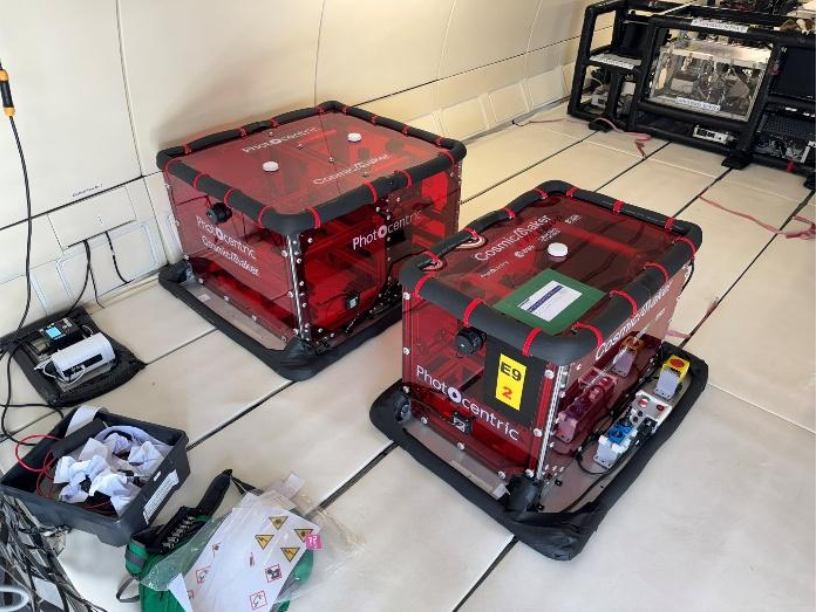
Two Large boxes containing three CosmicMaker printers on the Novespace parabolic flight. Image courtesy of Photocentric.
Perhaps the most surprising result involved the ceramic materials, silicon carbide and alumina. CosmicMaker said those materials actually printed better during the microgravity portions of the flight. Without gravity pulling heavier particles downward, the ceramic mixtures remained more evenly distributed throughout the printing process. During the higher-gravity phases, those particles were more likely to separate from the surrounding slurry.
Unlike many 3D printing systems, CosmicMaker’s process keeps parts surrounded by liquid material as they are being built. That means the printed object remains supported throughout the process, eliminating the need for additional support structures in microgravity. That characteristic could make the technology particularly attractive for future off-Earth manufacturing applications. While many additive manufacturing systems must be adapted to operate in space, CosmicMaker says its process may perform better in microgravity than on Earth.
The company says one of the biggest advantages of the system is that it is built on a technology with a long track record on Earth. According to Photocentric, its LCD-based printing systems have already produced tens of millions of parts. The platform is also designed to work with a range of materials, including plastics, ceramics, metals, and composites, while keeping weight and power consumption relatively low—two factors that become especially important when equipment is headed to space.
Space manufacturing has been part of Photocentric’s plans for several years. In 2020, the company patented a 3D printing process designed for use in space and later received multiple grants through the European Space Agency‘s (ESA) Business Applications and Space Solutions program to help develop and validate the technology. Photocentric, founded in 2002, is best known for helping pioneer LCD-based 3D printing.
-
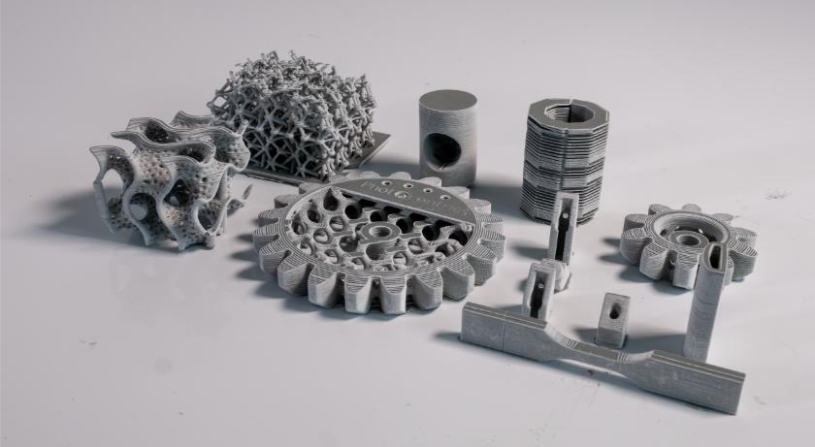
- A platform of silicon carbide parts printed onboard the Novespace parabolic flight. Image courtesy of Photocentric.
-
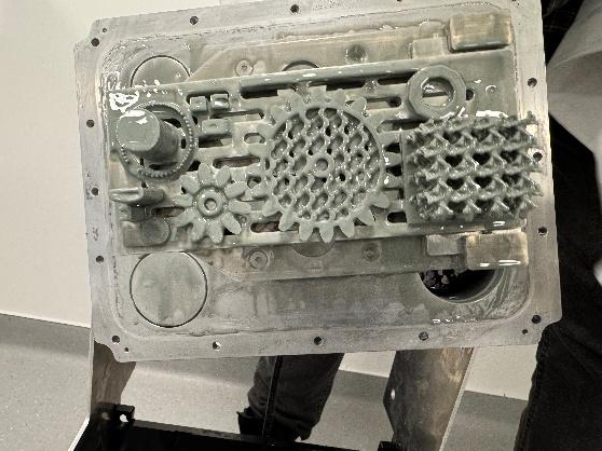
- A platform of silicon carbide parts printed onboard the Novespace parabolic flight. Image courtesy of Photocentric.
By spinning CosmicMaker out into its own company, Photocentric is betting that manufacturing beyond Earth could become a genuine business opportunity. Photocentric believes there could eventually be demand for manufacturing systems that allow astronauts and future lunar crews to make parts where they are needed rather than shipping everything from Earth. That’s their long-term vision. But for now, the next steps include adding centrifugal resin recovery systems and increasing automation so that astronauts would no longer need to participate directly in the printing process.
Just a few years ago, manufacturing on the Moon sounded largely theoretical. Today, with lunar programs accelerating and commercial space stations moving closer to reality, companies are beginning to test the technologies that could make that notion possible. CosmicMaker’s latest flight campaign is one small example of how that work is starting to move from concept to hardware.
Subscribe to Our Email Newsletter
Stay up-to-date on all the latest news from the 3D printing industry and receive information and offers from third party vendors.
Print Services
Upload your 3D Models and get them printed quickly and efficiently.













You May Also Like
Stratasys Showcases 3D Printed Automotive Applications & New Printer at IMTS 2026
Just ahead of last week’s International Manufacturing Technology Show (IMTS) in Chicago, Stratasys launched the F870, a new large-format, production-grade FDM 3D printing platform designed to drive industrial manufacturing at...
3D Printing Financials: $28M in China, U.S. Deals and a Metal AM Comeback
Money continues to go into additive manufacturing (AM). From a $30 million raise for a Chinese metal 3D printing company to new funding for naval AM and a European company...
Stratasys Wins $27.6M in Patent Case Against Bambu Lab; Bambu Challenges Verdict
Update, September 21, 2026: This article has been updated with a statement from Bambu Lab responding to the verdict, along with additional information about the company’s ongoing patent challenges against...
AMAsia Pulse: AM Investment Picks Up Across Asia-Pacific
The first half of September brought fresh investment and expansion activity across Asia-Pacific’s additive manufacturing sector. China’s Xinjinghe secured funding for an aerospace AM hub, South Korea’s Lincsolution outlined plans...