SwissTo12 Buys Hanwha Phasor’s Antenna Assets and IP

Swiss 3D printing satellite component manufacturer SWISSto12 has bought IP and assets from Hanwha Phasor, a steered antenna manufacturer based in the UK and the US. Phasor had been a subsidiary of Hanwha Systems and Hanwha Aerospace, both part of Korea’s defense giant Hanwha (KRX: 000880).
Hanwha Systems is the group’s radar, fire control, and cybersecurity arm, while Hanwha Aerospace covers hydrogen fuel cells, artillery, and space launch. Hanwha itself manufactures howitzers, infantry fighting vehicles, and aero-engines. Hanwha is a key part of Korea’s defense industry and an important player globally. The company is also a hodgepodge of acquisitions. For a while, there seemed to be doing every single defense thing imaginable, becoming like an L3 Harris, Lockheed Martin, GE Aerospace, General Dynamics Land Systems, United Launch Alliance, all rolled into one. Due to increased global instability, Hanwha’s stock has been on a bit of a tear, tipping over the past two years. So on the one hand, the shutting down of its phased array subsidiary looks unnecessary, while it can also be seen as a kind of corporate tidying up.
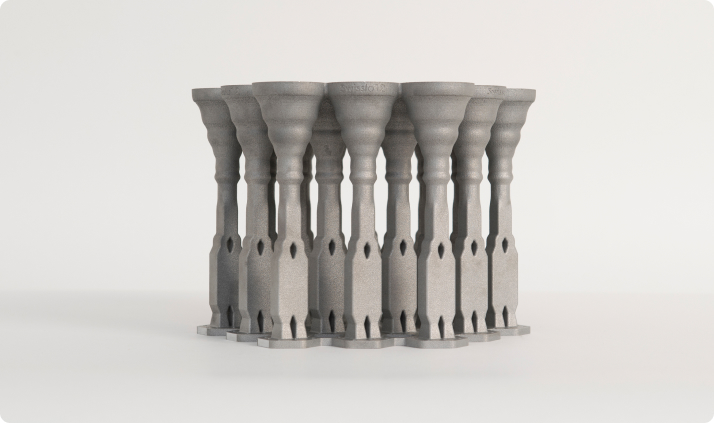
Ka GEO multibeam cluster. Image courtesy of SWISSto12.
Phasor had been developing an Active Electronically Steered Array (AESA), which was flat and used a continuous signal. That type of design could enable easy integration into many land, sea, and air vehicles with truly global connectivity, making the opportunity a very attractive proposition indeed.
Phased array antennas are individual elements that make up an electronically steered array. Through beamforming, better, more redundant signals can be had from a more compact antenna. This kind of technology is crucial to delivering internet globally, but it also has a lot of defense applications. UK-based Phasor was acquired by Hanwha in 2020 with the goal of enabling internet on board aircraft. However, the company was never able to ship a commercially successful product and decided to exit the market in 2024.
Phased arrays seem like an amazing business, but even technically formidable firms struggle to make them work. Now, SWISSto12 has stepped in to acquire select assets, including Ku-band AESA patents, which it plans to use for its own terminal solutions. Already active in SatCom terminals, SWISSto12 sees a lot of promise in integrating these technologies into high-performance, cost-competitive products.
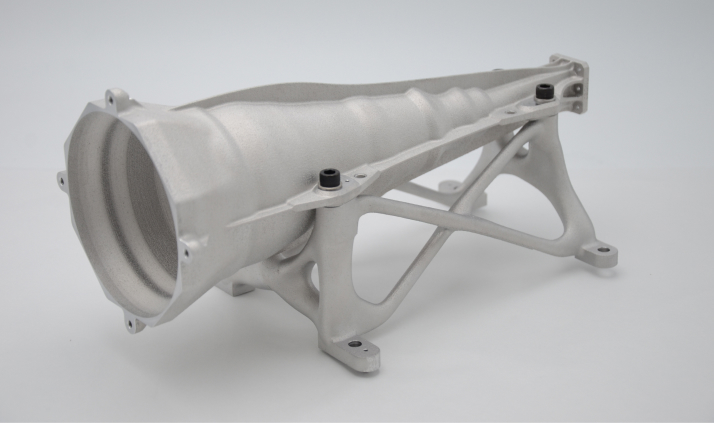
Global horn and bracket. Image courtesy of SWISSto12.
SWISSto12 CEO Emile de Rijk said,
“Bolstered by our proprietary 3D printing technology for RF structures, the acquisition of these key assets and IP will allow SWISSto12 to further enhance these satellite user terminals by delivering high-performing and cost-competitive products to a large and growing market. Adding these assets to our product line is another milestone in our roadmap as we continue to provide customers with best-in-class SatCom solutions and accelerate our growth worldwide.”
With its expertise in Additive Manufacturing, SWISSto12 can create compact yet highly functional structures. Design and feature integration can see a lot of components or surfaces do double duty and make for very efficient components. Coupled with part count reduction, optimization, and easier manufacturing, the Additive and Ku band, along with other antennas, are a match made in heaven. For a complex thing like an actively steerable antenna, such expertise could make a significant difference. SWISSto12 has been working on an actively steerable antenna since at least 2023, working together with Thales, on a global satcom terminal solution. On the Thales project, the company used additively manufactured miniature horn antennas, described as “3D-printed apertures with higher efficiency and overall performance (gain, axial ratio, and bandwidth over scan volume) than patch antennas.”
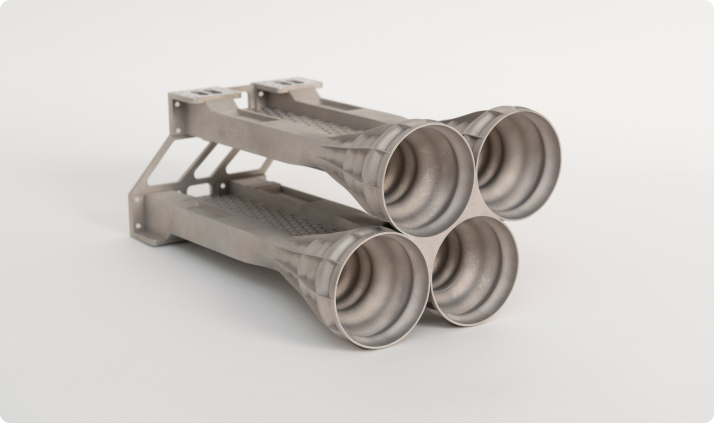
X GEO multibeam cluster. Image courtesy of SWISSto12.
Additionally, advances by SWISSto12 in horn or patch steerable arrays could make many more solutions possible. The same AESA antenna also has a lot of uses in missile defense, fighter aircraft, and Electronic Warfare (which, along with 3D printing, is a crucial technology in Ukraine). Indeed, AESA radar is in and of itself a crucial technology powering fire control systems on board fighter jets. This was probably Hanwha’s problem in playing for business in Europe and the US. AESA radar is some of the most secret stuff out there, as are surveillance technologies powered by these kinds of radars. A lot of systems that people are looking at, from drone defense to missile defense against high-speed missiles, are powered by AESA or similar systems as well.
SWISSto12 will have to remain very Swiss and very neutral to be trusted by the US (where it has Lockheed and Northrop Grumman as clients) and in Europe, where it works with Airbus and Cobham (now part of Thales). In this case, traditional Swiss neutrality could be the key to the emergence of a new crucial player in space and satellite communications.
Subscribe to Our Email Newsletter
Stay up-to-date on all the latest news from the 3D printing industry and receive information and offers from third party vendors.
Print Services
Upload your 3D Models and get them printed quickly and efficiently.











You May Also Like
Post-Printing at RAPID 2026: PostProcess Technologies & Mass Finishing
The whole 3D printing workflow was on display in Boston at RAPID+TCT last week, from design software and 3D printing hardware all the way to post-processing and finishing solutions. For...
RAPID Roundup 2026: New Machines and Market Moves
RAPID + TCT 2026 wrapped up yesterday, but the show floor proved there’s a lot happening across the additive manufacturing (AM) space, especially when it comes to new hardware and...
trinckle’s Tool Design Software Lands in Stratasys GrabCAD Print
I’m a fan of trinckle, the German startup that offers super easy-to-use tools for creating customized jigs, fixtures, and other 3D printed products. With trinckle, it’s not just designers who...
Farsoon’s Fine Laser Spot 3D Printing Gives China a Thermal Management Edge
Metal additive manufacturing (AM) systems generally utilize lasers with spot sizes that fall into a range of 80 micrometers (μm) to 100μm, although dynamic beam shaping may soon lead to...