University Student Helps Build COBOD Construction 3D Printers Around the World During Internship

Recently, Denmark-based additive construction (AC) company COBOD International announced that it had installed its BODXL system in Doha, Qatar. The massive 50 x 30 x 15m machine—about the size of a Boeing 737 hangar and likely the largest construction 3D printer in the world—was deployed by UCC Holding and the Qatari Public Works Authority (Ashghal) to build the first of two 3D printed public schools. The setup for this giant system is not easy or quick, as Northeastern University student Fernando Escobar can tell you. He recently finished an internship with COBOD, and was on-site in Doha to help assemble the BODXL.
A rising fifth-year student at the Massachusetts research university, Escobar has completed three co-ops during his time at school. Majoring in mechanical engineering and history, his first co-op was at Vicarious Surgical Inc., where he had the chance to see how healthcare is being reshaped through the help of surgical robots. During his ACS Industries internship, he worked with a team of full-time engineers to refine hydrogen for energy storage. But Escobar says that his co-op with COBOD, though challenging, might have been his favorite.
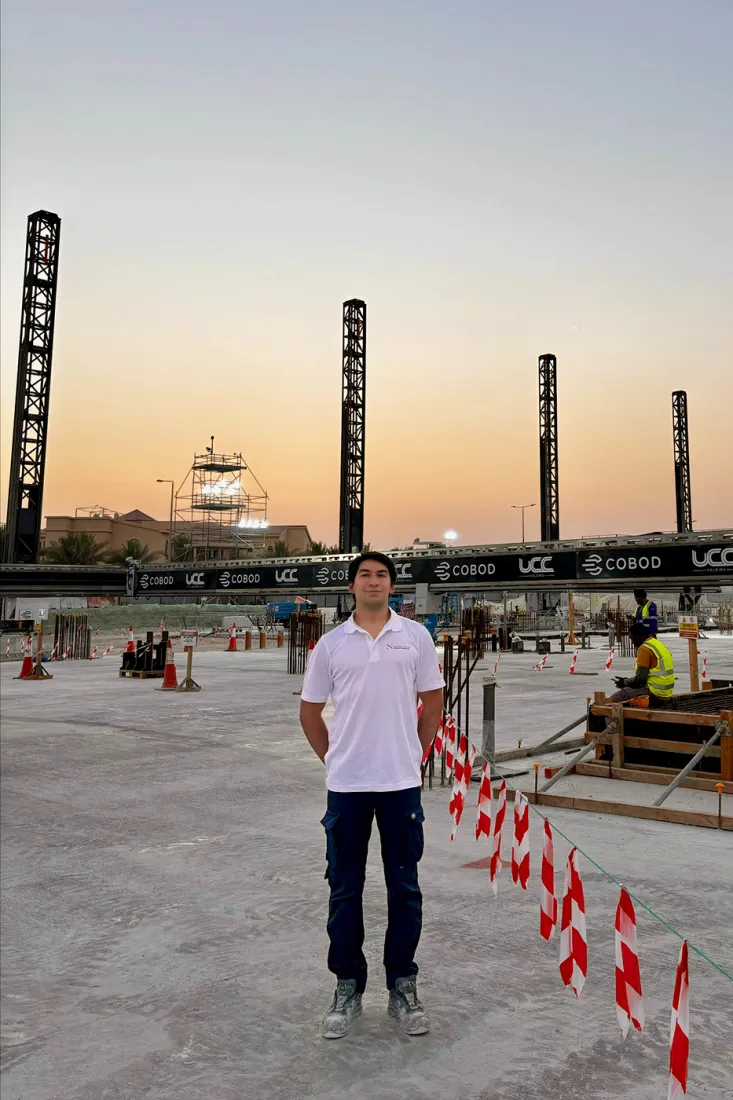
Fernando Escobar was a field engineering intern at COBOD International.
Serving as a field engineering intern for the AC leader, Escobar had the amazing opportunity to travel the world over a period of several months, visiting parts of the Middle East and Europe to help COBOD customers set up their large-scale construction 3D printers, like the huge BODXL and the popular, but slightly smaller, BOD2. The latter has been used to construct everything from social housing and data centers to chemical storage facilities and even a Starbucks.
Just a few short months ago, Escobar was with the COBOD team in Qatar, helping to assemble the giant BODXL so it could start building the school. There is nothing plug-and-play about these printers—the robotic gantry system has a modular design, so it can fit the specific needs of each customer. In order to ensure optimal implementation and performance, each COBOD machine, which is able to extrude materials at up to 500 millimeters per second, requires several weeks of on-site training, assembly, and calibration.
“The first week is about setting up the machine, putting everything in the right place and making sure the machine starts moving around. The second week is heavier on the materials side,” Escobar explained.
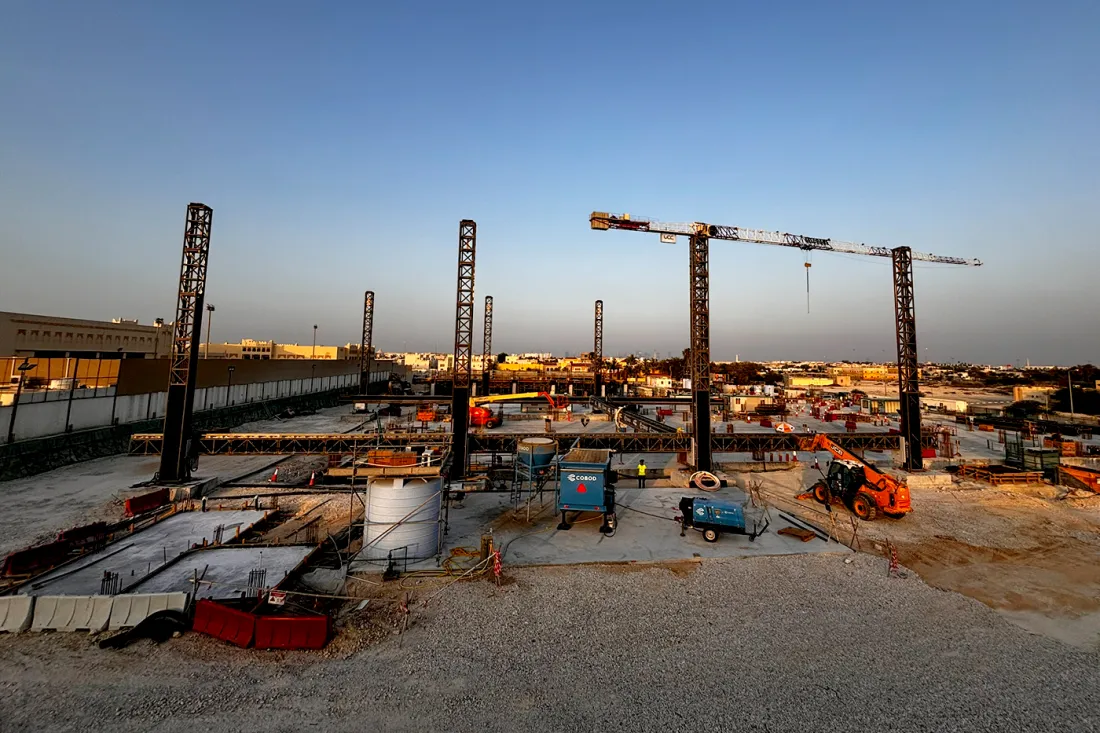
As part of his co-op, Fernando Escobar was in Qatar this May helping set up a large 3D printers that will be used to build schools.
You might think this would be intimidating, but more and more often these days, college students are learning about this technology in their courses. Plus, having worked as a luxury car mechanic when he was growing up, Escobar has even more of an edge. He also says that all of his classes at Northeastern, but especially fluid mechanics, have given him what he needs to succeed.
“I’m not actually doing calculus 3 every day at my job, but it certainly gives you context as to the physics behind why some decisions are made. It gives you context and a framework to problem solve and understand how the world works in a different way than most people,” Escobar said.
In addition to setting up the BODXL in Qatar, Escobar also spent two weeks at a customer site on the Spanish island of Tenerife, off the coast of Morocco, helping to set up the BOD2 so it could be used to print a house and condo unit building.
The more I hear about university, high school, and even elementary students learning about additive in school, the less I worry about the future of our workforce.
Subscribe to Our Email Newsletter
Stay up-to-date on all the latest news from the 3D printing industry and receive information and offers from third party vendors.
Print Services
Upload your 3D Models and get them printed quickly and efficiently.













You May Also Like
Kickstarter is Testing the Next Wave of Desktop 3D Printing
3D printers are raising serious money again…on Kickstarter, that is. Over the last few months, a new group of 3D printer campaigns has attracted millions of dollars and thousands of...
Stratasys vs. Bambu Lab: What’s Really Behind the $27.6M Patent Verdict?
Editor’s note: This is Part 1 of a two-part series by Xu Fanglei examining the technology and patent issues behind the Stratasys-Bambu Lab dispute. Part 1 looks at the U.S....
Bambu Lab and SUSAN FANG 3D Print for London Fashion Week
At London Fashion Week, some of the more unusual pieces on the runway came from 3D printers. Chinese fashion designer SUSAN FANG presented her Spring/Summer 2027 Air-Illusion collection at the...
Stratasys Wins $27.6M in Patent Case Against Bambu Lab; Bambu Challenges Verdict
Update, September 21, 2026: This article has been updated with a statement from Bambu Lab responding to the verdict, along with additional information about the company’s ongoing patent challenges against...