COBOD Installs BODXL Construction 3D Printer in Qatar to Build School for Public Works Authority

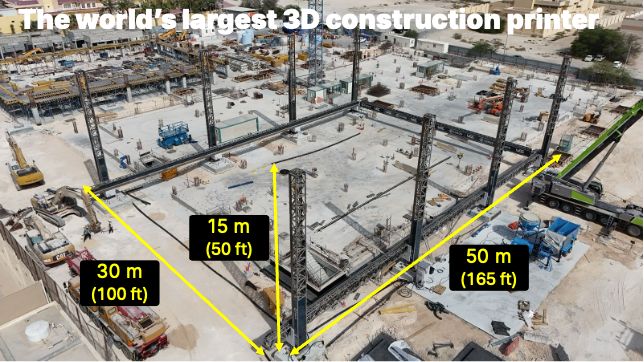
COBOD founder said on LinkedIn that the school will be the world’s largest 3D printed building once completed, stating,
“The school building project will be the world’s largest construction #automation and #innovation project and will pave the way for more groundbreaking projects in the future. With this visionary project, 3D construction printing is entering a new era, where grand scale is more than possible. We are not only proud to be part of this journey, but also to be at the forefront of driving the technological improvements that make it possible.”
COBOD has deployed its BOD3 printers around the world, and is working on projects in energy, residential construction, and infrastructure. Saudi firm Al Arkan is using COBOD machines to make energy infrastructure and luxury villas, while Abyan used them for storage tanks, and PERI 3D printed a Starbucks and a data center with COBOD printers.
Others in automated construction are surging ahead as well. Most of the press and hype have been in residential construction, and of course media will see more value in relatable stories of 3D printing your next home. But I see much more potential in construction across remote areas and in austere environments. Indeed, we’re seeing a lot of interest in automated construction from places like Saudi Arabia, Qatar, and India. If it were just Dubai, I’d be a bit worried, since there has been a lot of noise and very little substance coming from countries exclaiming mantras of the world’s biggest all the time. And yes, this could be in part PR-motivated. But, in ordering two machines and given the enormous budget on offer, there could also be a lot of substance here.
Remote infrastructure in difficult-to-access or hard-to-work-in areas are key drivers in automated construction adoption. The fallout of the human cost of the Qatar World Cup was widespread. Under these conditions, automated construction will save lives by exposing fewer workers to the harsh conditions on offer. Cost in terms of lives and money will be felt acutely in Qatar now, recently successful with the professional football club it owns, Paris Saint-Germain (PSG), winning the Champions League. The country has spent hundreds of millions marketing itself, and billions more building an airline and hub system. It is also not doing this in isolation, but in a rivalry with neighbors Saudi Arabia and UAE. Qatar is one of the wealthiest countries in the world on a GDP per capita basis, but oil and natural gas are 85% of export earnings. The country is engaged in a race to spend its money effectively and wisely so that it can secure a future for itself as a wealthy state independent of oil and gas earnings. If COBOD plays only a tiny role in helping the country secure this future, then the company will do very well off this engagement.
Subscribe to Our Email Newsletter
Stay up-to-date on all the latest news from the 3D printing industry and receive information and offers from third party vendors.
Print Services
Upload your 3D Models and get them printed quickly and efficiently.













You May Also Like
10 Years of Multi Jet Fusion: Onsite at HP’s Vancouver, Washington Facility
At this year’s RAPID event in Boston, HP Additive Manufacturing Solutions celebrated ten years in the additive manufacturing (AM) market. The company ushered in the milestone with several innovations, including...
These 3D Printed Lattices Can Sense Damage Before Failure
A new paper, “Full-Field Damage Monitoring in Architected Lattices Using In situ Electrical Impedance Tomography,” points to lattices being able to detect damage. This could really help composites in critical...
3D Printing News Briefs, October 3, 2026: Hypersonics, Hotends, & More
We’re starting off with defense in this weekend’s 3D Printing News Briefs, as Titomic was awarded a $5 million U.S. defense contract, and VulcanForms announced a partnership with Specter Aerospace...
3D Printing News Briefs, October 1, 2026: Defense, Enclosures, & More
In today’s 3D Printing News Briefs, we’re starting with defense news, first from Massivit and then from AML3D. Then we’ll move on to U.S. manufacturing of a new large-format LPBF...