Creality Quietly Gauging Interest in a Desktop Filament Recycler


Creality is testing the waters on a desktop filament recycling system suitable for home use. The Creality Filament Maker M1 and Shredder R1 are in the engineering stage and can be found on a Creality-branded crowdfunding site. I reached out to Creality, and they confirmed the system is a functional prototype. It is not ready for reviewers yet, so we’ll have to wait a bit longer to take it for a spin.
The filament system is positioned as closed-loop. It will be able to grind and dry 3D printing waste, then extrude it into usable, spooled filament. It also aims to allow users to mix in virgin pellets, natural fill (like coffee grounds), and scented materials. With a little patience, users could also craft rainbow color gradients.
There are no pricing details or launch timelines available yet. If you volunteer your email for more information, you are taken to a brief survey and quizzed on your 3D printing experience, pain points, and how much you’d pay for such a system.
How the System Works
The system consists of two primary components, the Shredder R1 and the Filament Maker M1. These machines are shown to be roughly the size of a large Core XY 3D printer, with a height of 560 mm and a combined side-by-side length just under a meter.
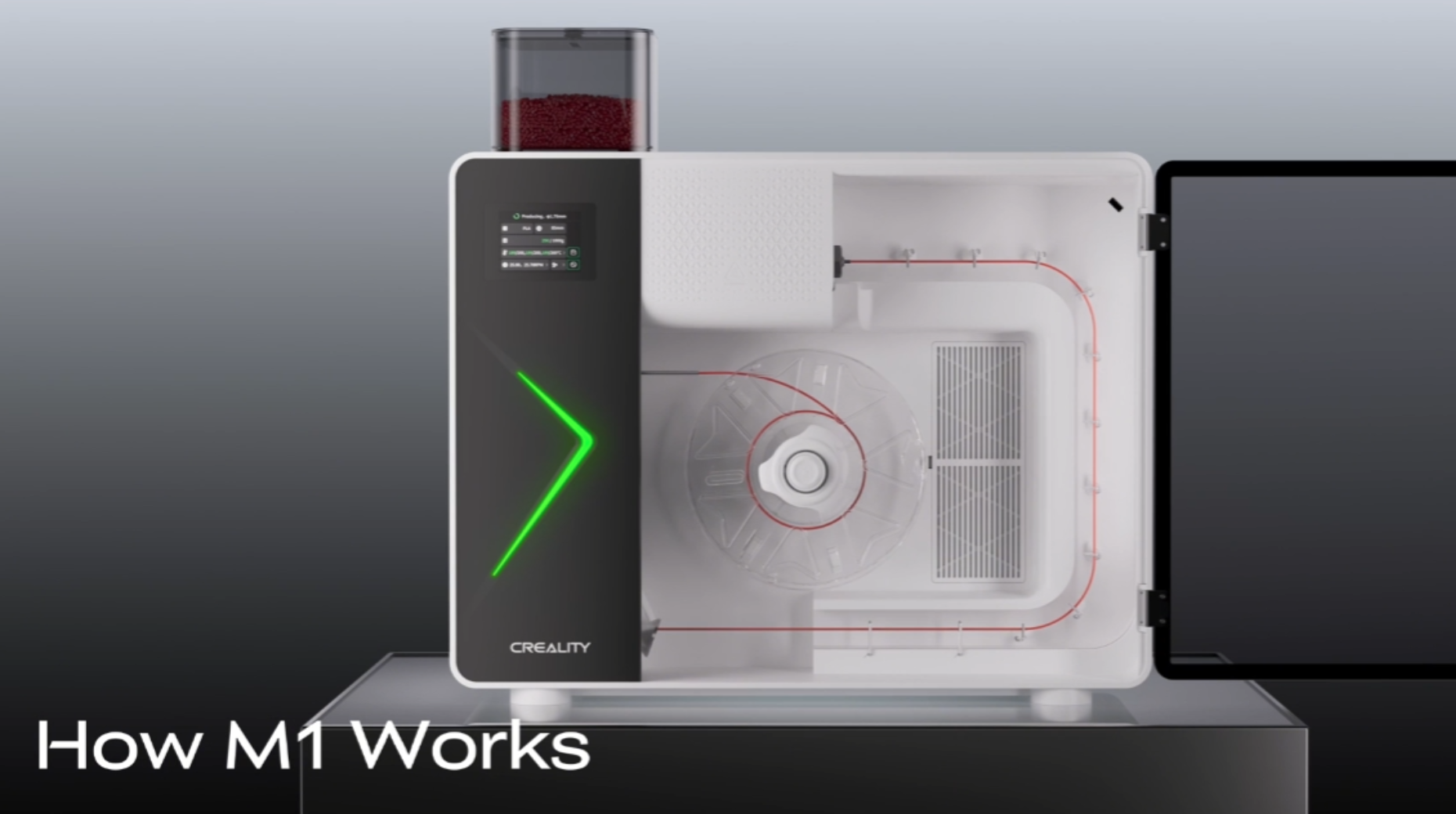
The shredder will grind and dry failed prints into uniform ≤4mm plastic particles. These are removed by hand and added to a hopper on the filament maker, which melts it down and extrudes it into filament. A carriage pulls the emerging strand across several cooling points to lower the plastic to a stable temperature. The carriage rides on a set of rails, and is shown with a handle, suggesting it may need to be manually drawn through the path and then inserted into the spool by hand to start.
Creality says its system would be able to produce one kilogram spools per hour, with a ±0.05mm diameter tolerance when using virgin pellets and a ±0.1mm tolerance for recycled grind. A 0.1mm tolerance is a little dicey, but should work on a well-maintained 3D printer.
Creality claims its system would be compatible with eight different materials: PLA, PETG, ABS, ASA, PA, PC, TPU and PET. PLA and PETG are widely considered the easiest to recycle professionally into filament.
For comparison, professionally made filament has a minimum standard of ±0.05mm diameter tolerance, with manufacturers like Prusa Research narrowing it down to ±0.02mm with the help of laser measurement. Professional systems can take up 75 feet of factory floor and use a series of long water baths to cool the filament gently. These machines can typically produce a one kilogram spool every five minutes.
Recycling filament is nothing new, with several manufacturers recycling their own waste. At ProtoPasta, manufacturing waste is gathered, sorted by color, ground up, melted down, extruded, and then ground a second time before being loaded into the extrusion lines. This is to make sure that filament scraps are perfectly and smoothly blended.
The problem manufacturers face with recycling filament is contamination, which is why big companies are often reluctant to accept consumer-sourced scrap. One bit of random ABS in a box of PLA can ruin an entire batch by causing lumps that don’t melt properly and clog your nozzle. Perhaps once it gets past the prototype stage, Creality’s new system can help solve this issue.
Subscribe to Our Email Newsletter
Stay up-to-date on all the latest news from the 3D printing industry and receive information and offers from third party vendors.
Print Services
Upload your 3D Models and get them printed quickly and efficiently.













You May Also Like
Founded After Class: Unlayered 3D Co-Founders Philip Pounds & Alex Stedman on Starting a 5-Axis Desktop OEM in College
When he showed up on Google Meet for our interview, I could see that Philip Pounds, co-founder of Unlayered 3D, was seated shotgun in a moving car. I wasn’t sure...
Prusa Upgrades Its Lineup with CORE One+ (Gen 2), CORE One L+, and XL+
Prusa Research has updated its high-end desktop 3D printer lineup. The company is offering new and improved versions of the machines it targets at industrial and power users, with the...
IMDEA Materials & Lawrence Berkeley National Laboratory Work on Making 3D Printers Print in Unison
Spain’s IMDEA Materials Institute has worked with Lawrence Berkeley National Laboratory to detect and identify differences in different 3D printers. This could be important in eliminating run-to-run differences in prints and...
EOS, HP, Prusa, and Stratasys Sponsor UAS Additive Strategies Webcast on June 30
3DPrint.com and AM Research will present a live webcast, UAS Additive Strategies, on June 30, from 11 AM to 2:30 PM Eastern, and you can register here. The event is...