ATO and Dynamism Partner to Expand Metal Powder Production in the U.S., Announced at AMS 2026

ATO Technology is expanding its presence in the United States through a new partnership with Dynamism, a well-known distributor of advanced manufacturing technologies. The collaboration was announced during the Additive Manufacturing Strategies (AMS) 2026 conference in New York, where both companies were sponsors of the event.
Under the agreement, Dynamism will serve as ATO’s official sales partner in the United States, helping bring the company’s ultrasonic metal powder production systems to a wider range of customers across the country.
The partnership is aimed at making ATO’s technology more accessible to research institutions, advanced manufacturing labs, and industrial users interested in developing new materials for additive manufacturing.
In a LinkedIn post announcing the partnership, ATO said the collaboration represents “an important step in expanding access to ultrasonic metal powder production across the US market.”
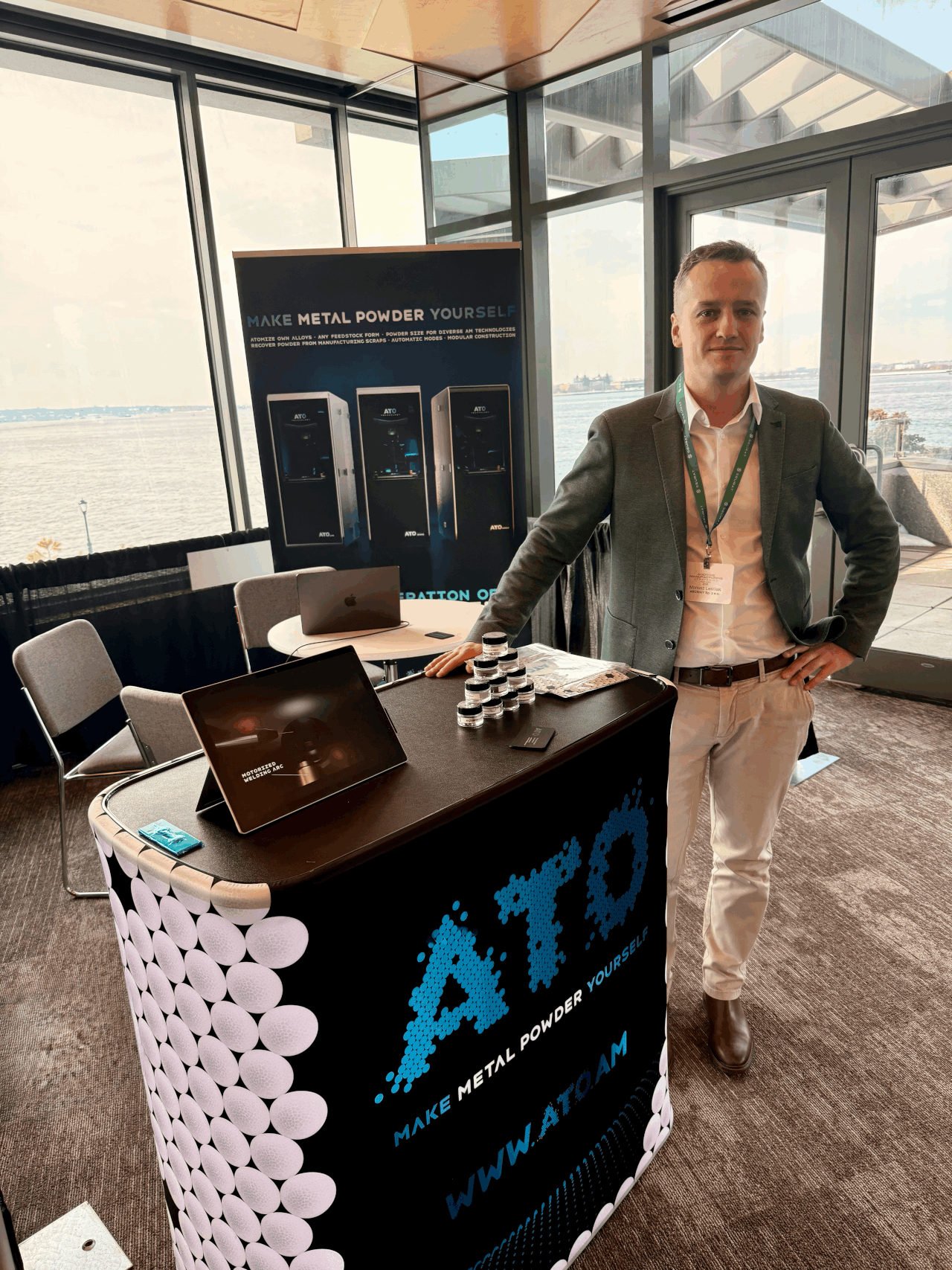
Mariusz Lesniak at AMS 2026. Image courtesy of Mariusz Lesniak.
A Focus on Powder Production
For companies working with metal additive manufacturing, powder quality is widely recognized as a critical factor. For example, research from the National Institute of Standards and Technology notes that controlling material characteristics in processes such as laser powder bed fusion is essential for achieving the desired microstructure and mechanical properties in printed metal parts.
ATO focuses specifically on ultrasonic atomization systems, a technology designed to produce highly controlled metal powders. The process uses ultrasonic vibrations to break molten metal into tiny droplets, which then solidify into spherical particles suitable for additive manufacturing.
This approach can help produce powders with tight particle-size distributions and high purity, two factors that researchers and manufacturers often seek when developing new materials or qualifying parts for demanding applications.
According to ATO, its systems are designed to give users greater control over powder production while enabling smaller-scale and more flexible material development. The new partnership with Dynamism is meant to expand the reach of these systems.
Making Advanced Systems More Accessible
Dynamism has built a reputation over the years as a distributor of advanced manufacturing technologies, particularly in areas such as 3D printing, digital manufacturing, and design tools. The company works with universities, research labs, and businesses that are looking to adopt new technologies.
By partnering with Dynamism, ATO hopes to make its powder production systems easier for organizations across the U.S. to access.
The companies say the collaboration will help support localized research and development in metal additive manufacturing, especially as more institutions look to develop custom materials and powders tailored to specific applications.
ATO also notes that its platforms include AI-enabled capabilities designed to help monitor and optimize powder production processes.
Growing Interest in Custom Metal Powders
Interest in advanced powder production has been growing in recent years as additive manufacturing moves toward more specialized materials and applications.
Many researchers and companies are looking for ways to create custom alloys, experimental materials, and powders designed for specific uses. Being able to produce small batches of metal powder in-house can make that process quicker and easier.
ATO’s ultrasonic atomization systems have been gaining attention among research institutions working on advanced materials development. In an article published earlier this year, the company highlighted how controlled powder production can play an important role in materials research and experimental additive manufacturing projects.
Systems like these allow researchers to explore new alloys without relying entirely on large commercial powder suppliers, which can be costly or difficult to access for small experimental runs.
ATO’s Technology in the AM Ecosystem
ATO has been gaining more attention in the additive manufacturing industry. Its ultrasonic atomization systems, including those used in the ARCWAY platform we covered previously, allow users to produce their own metal powders and experiment with new materials.
This type of technology can be particularly valuable in research environments, where scientists and engineers often need to iterate quickly when developing new materials or printing processes. Through this partnership with Dynamism, ATO hopes to reach more users across the U.S.

ATO atomizers use ultrasonic vibrations to break molten metal into droplets. Image courtesy of ATO.
The partnership comes as the additive manufacturing industry continues to focus on improving materials, supply chains, and production processes. While printers often get most of the attention, other parts of the ecosystem (like powder production) are becoming increasingly important as the industry grows.
ATO and Dynamism say they plan to work together to expand metal additive manufacturing in the United States by making advanced powder production systems more accessible to researchers and manufacturers.
Subscribe to Our Email Newsletter
Stay up-to-date on all the latest news from the 3D printing industry and receive information and offers from third party vendors.
Print Services
Upload your 3D Models and get them printed quickly and efficiently.













You May Also Like
AM Investment Strategies 2026 Sets the Stage for AMS 2027
AM Investment Strategies 2026 Nov. 5 · 12 p.m. ET · Free online event RESERVE YOUR SPOT ↗ A one-hour online discussion featuring some of the biggest names in 3D...
With Its Latest $200M Round, ICON May Be Running Away With the 3D Printed Construction Market
I used to view ICON, the Austin-based additive construction (AC) firm, as one of a handful of companies that could realistically consider itself the leader of the 3D printed construction...
Deals, Dollars and 3D Printing: What’s Moving in AM
There’s been plenty of business activity in additive manufacturing (AM) lately, with new deals, partnerships and investments in production. One of the bigger moves comes from Sweden, where investment firm...
Oerlikon Adds ATLIX’s xBUILD 5000, Plans More for 2027
Oerlikon has installed a new ATLIX xBUILD 5000 metal 3D printer at its facility in Huntersville, North Carolina, marking the first production deployment of the system worldwide. The machine will...