ValCUN Enters U.S. Market with Minerva Metal 3D Printer Installation at Johns Hopkins University


Belgian metal 3D printing startup ValCUN now has a Minerva metal 3D printer installed at Baltimore’s Johns Hopkins University. The Molten Metal Deposition (MMD) system, which was released in 2023, will be used for research by the materials and manufacturing departments at the university. The Minerva has previously been used for research purposes, but this is the first time the ValCUN printer has been installed in the U.S.
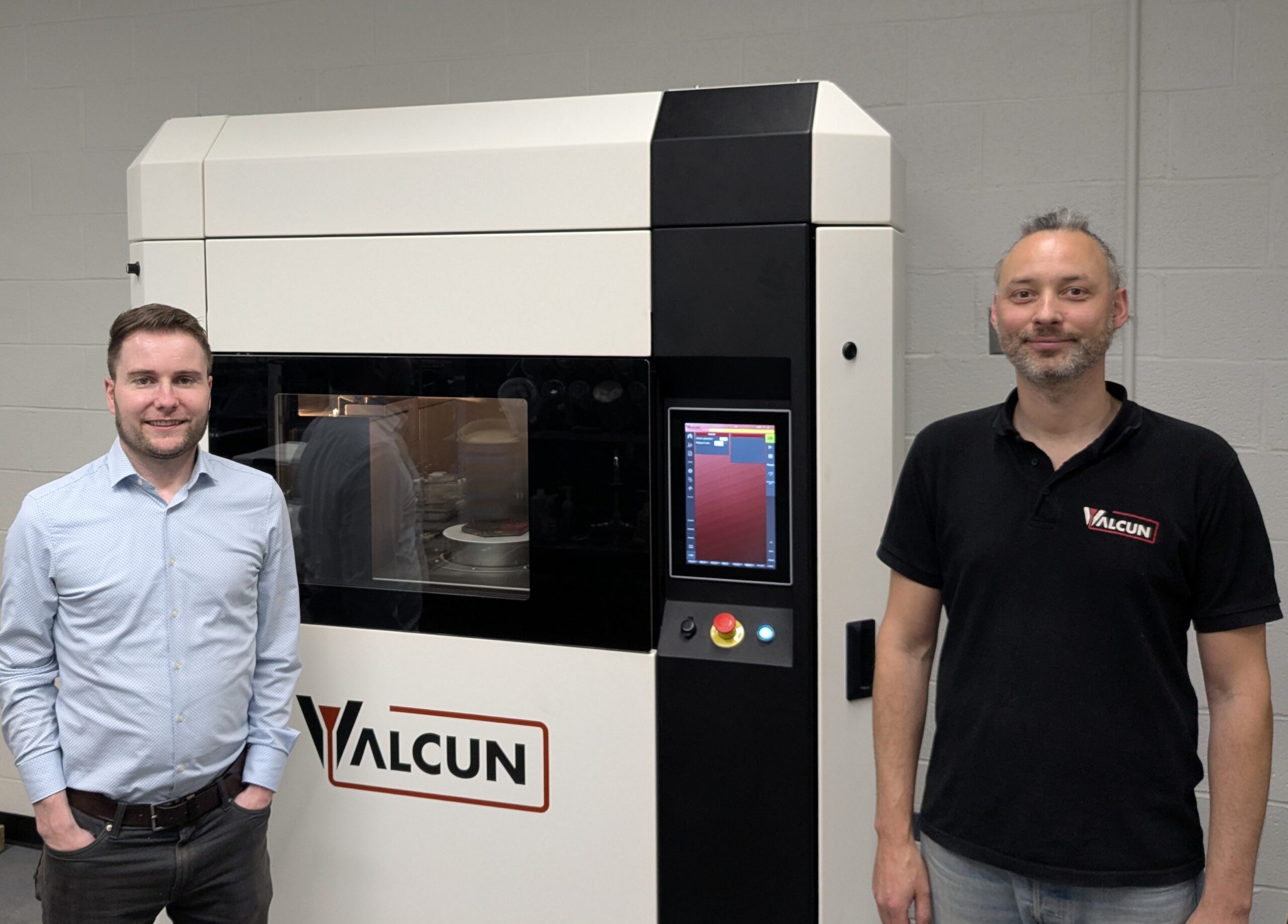
Johns Hopkins’ Jochen Muller, Assistant Professor of the Department of Civil and Systems Engineering, stated that,
“We are excited to partner with ValCUN on their cutting-edge 3D printing technology, unlocking new possibilities for directly printing aluminum alloys and advancing research in medical devices and more.”
ValCUN’s CEO Jonas Galle said,
“Installing our first Minerva system in the U.S. at an institution like Johns Hopkins’ calibre is a significant milestone. It affirms the value of our approach and supports our broader mission: to make metal additive manufacturing more accessible, scalable, and suited to real-world applications.”
ValCUN hopes that the system will be more inexpensive and easier to use than traditional metal systems. There is, of course, less danger because the wire-fed system doesn’t use powder and lasers. The printer also plugs into a standard outlet. The printer is also open, and the startup thinks that printing “overhangs up to 70° without support structures and handling large bridges,” as well as quicker materials and part changes, will also be important features.

ValCUN has a low-cost, potentially high-volume technology, which it alone is really shepherding today. A wire-based droplet system could do very interesting gradient parts, or make thousands of parts for only a few dollars per part. In heat sinking, meta materials, and industrial components, ValCUN promises a completely different path to end-use products. LPBF is difficult and expensive for initial parts, while being scalable for industrial high-value ones. Meanwhile, DED is good for very specific applications and parts. WAAM, for example, is really making progress in pressure vessels, but is hardly used outside the energy industry. Binder jetting is great for press releases, but tricky on the factory floor. But ValCUN’s MMD technology hasn’t yet found a specific fertile application. The technology is cheap in running costs and up-front investment, and easier in terms of getting to a first part than binder jet and LPBF. However, it’s limited in size when compared to DED, and limited in detail in comparison to LPBF and binder jet. It prints aluminum well, which is tricky to do with the light and heat-based AM processes. If you look at an example like cold plates or heat exchange, generally, ValCUN seems perfect. Lots of little droplets could make up great heat distribution components. What’s more, it’s easy to see how this could actually become a process at scale. But to validate controlling the process, and get it to perform to spec, may be complicated.
If we think of ValCUN as a material company that uses a specific metal, then the whole thing becomes easier. And if a car company, for example, needed a certain geometry heat exchange solution, then ValCUN could actually meet their scale and cost level. But, since all of the heat exchange work is being done with LPBF, it’s hard to see how they would come to the conclusion that ValCUN could work for them. Worse still, if BMW continues to think in LPBF, then heat exchange for cars will be possible but too expensive for BMW. A look at ValCUN would change this. So it’s a great move to install the system at Johns Hopkins University, where a lot of researchers and partners could get to know the technology.
It will be hard for ValCUN to move the additive industry over to its camp. For them, it is perhaps a better bet that a young researcher will invent the future on its machine because it is in reach and inexpensive to use. That seems like a long shot, but it is how computer games were invented, when university researchers got access to mainframes and super computers at night to do whatever they wished. So there’s still hope for ValCUN yet.
Images courtesy of ValCUN
Subscribe to Our Email Newsletter
Stay up-to-date on all the latest news from the 3D printing industry and receive information and offers from third party vendors.
Print Services
Upload your 3D Models and get them printed quickly and efficiently.













You May Also Like
3D Printing Financials: Xometry Sets New Record in Q2
Xometry (Nasdaq: XMTR) has reported its best-ever quarterly results, with strong growth across its online manufacturing marketplace. The company saw gains in revenue, profit margins, and customer activity, pointing to...
South Korean 3D Printing Industry Sounds Alarm Over Data Leakage
An article recently published in BusinessKorea has highlighted that small and medium-sized enterprises (SMEs) utilizing additive manufacturing (AM) in South Korea are increasingly worried about the threat of leaking intellectual...
3D Printing News Briefs, May 31, 2025: Project Call, Consortium, Certification, & More
We’re starting with the latest America Makes Project Call in today’s 3D Printing News Briefs, and a consortium to promote the adoption of additive manufacturing has been founded in Spain....
Burloak and MDA Space: 8 Years of Transforming Aerospace with Metal 3D Printing
Burloak Technologies, Canada’s largest contract manufacturer specializing in metal 3D printing and post-processing for flight applications, recently celebrated 8 years of partnership with MDA Space, Canada’s largest space technology company....