
ValCUN Sells First Molten Metal 3D Printer to Belgian Research Group Sirris

ValCUN, an innovative Belgian startup, has the potential to shake up the 3D printing landscape with its unique method of melting metals through a crucible. This Molten Metal Deposition (MMD) technology stands in stark contrast to traditional laser-powered and binder/sinter-based processes. By using commodity wire as its primary material, the startup aims to keep costs low. Although MMD may not replace many parts produced using typical powder bed fusion methods, it has the potential to open new doors in the 3D printing industry. After securing $1.5 million in funding, ValCUN developed a machine named Minerva, which has recently been acquired by Sirris, a leading Belgian research organization.
Specializing in 3D printing, innovation, and product development, Sirris employs over 150 experts across eight locations. The acquisition of the Minerva machine gives Sirris advanced access to a potentially disruptive technology, further solidifying its leadership in the field. For ValCUN, having a machine on site at an actual client’s facility offers invaluable insights into further product development and improvements. The company claims that its technology can produce parts that are 75% cheaper than other metal technologies. However, the question remains as to which parts and applications could truly benefit from this cost-saving technology. This is where Sirris can play a crucial role, helping ValCUN and prospective clients make MMD technology scalable.
“We are thrilled to announce this collaboration with Sirris. Their expertise in technological research and development perfectly complements the groundbreaking capabilities of our Minerva Printer and its MMD technology. Together, we aim to push the boundaries of what’s achievable in the world of Advanced Manufacturing,” ValCUN CEO Jonas Galle said.
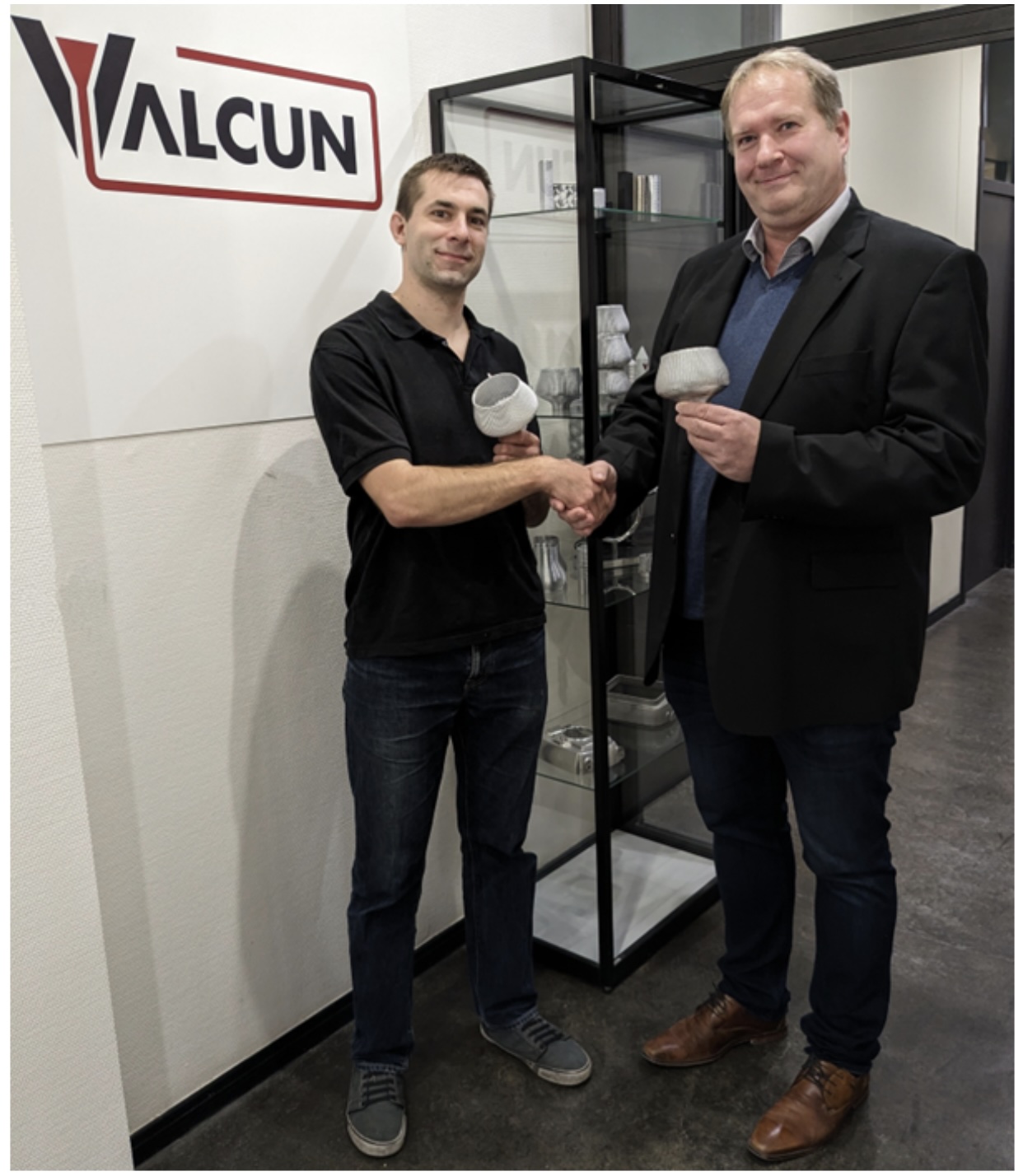
ValCUN CEO Jonas Galle with Walter Auwers, Business Unit Manager Advanced Manufacturing at Sirris
ValCUN aims for its user-friendly Minerva 3D printer to be employed in crafting structural components, heat exchangers, manifolds, and other industrial aluminum parts. This technology stands apart from existing methods, bearing some resemblance to the ElemX technology—first developed by Vader Systems, before it was bought by Xerox and ultimately sold to ADDiTEC. While there are continuous improvements expected in established technologies like directed energy deposition and binder jetting, the molten metal technique introduced by ValCUN could lead to unexpected innovations. For instance, imagine using this technology to create stochastic composite armor for tanks or heat sink layers that double as housing in machine tools. Such innovations could redefine what’s possible in 3D printing, and ValCUN’s entrance into this space is a development that deserves widespread acclaim.
ValCUN is set to unveil its the Minerva Printer, along with the Minerva Print Head that drives it, at Formnext 2023. The Minerva Print Head is capable of being implemented in various systems from robotic arms to production lines. ValCUN’s experts will be present at the trade show to discuss potential applications and use-cases for this potentially disruptive technology.
Subscribe to Our Email Newsletter
Stay up-to-date on all the latest news from the 3D printing industry and receive information and offers from third party vendors.
Print Services
Upload your 3D Models and get them printed quickly and efficiently.













You May Also Like
Solid Rocket Motors: the First Big Scaling Test for AM in the US Defense Sector
The additive manufacturing (AM) industry has become obsessed with the opportunity for drones, and there’s certainly good reason for that. But before drones, the big focal point in AM for...
Why the AM Industry Should Pay Attention to Schneider Electric’s $22.6B PTC Acquisition
By late 2024, there was already enough signaling of the additive manufacturing (AM) industry opportunity in the data center infrastructure market for AM Research to write a report on the...
AM Demand Signals: Reshoring the Robotics Supply Chain
The Federal Communications Commission (FCC) recently banned the sale in the US of “almost all” new mobile robots sourced from foreign countries. IEEE Spectrum (the link in the first sentence)...
3D Printing Financials: $28M in China, U.S. Deals and a Metal AM Comeback
Money continues to go into additive manufacturing (AM). From a $30 million raise for a Chinese metal 3D printing company to new funding for naval AM and a European company...

























































