HP Webinar Explores How 3D Printing Is Restoring Mobility to Kids in Kenya


In a small clinic in Kenya, five children recently took their first steps—again. Each one wore a custom-made prosthetic leg, perfectly fitted to their bodies and designed not in a traditional workshop, but through a digital workflow powered by 3D printing.
These new limbs were the result of a partnership between HP, the Limb Kind Foundation, and two U.S.-based companies, Macy Orthotics and Prosthetics (O&P) and ABCorp. Together, they brought cutting-edge technology and compassionate care across continents to change lives.
And now, the team behind this mission is inviting the world to hear their story.
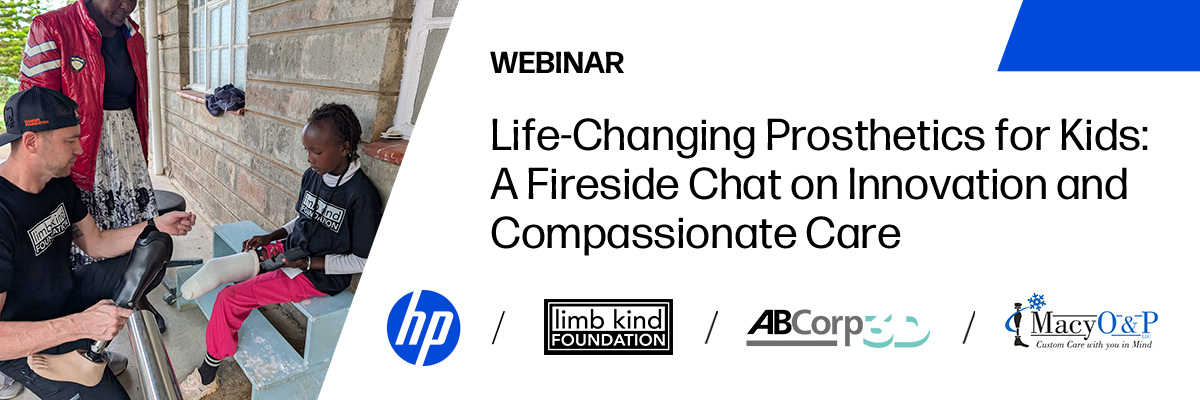
On July 29 at 11 AM ET, HP will host a free webinar titled “Life-Changing Prosthetics for Kids: A Fireside Chat on Innovation and Compassionate Care.” It’s a behind-the-scenes look at how a nonprofit, passionate engineers, and 3D printing came together to provide mobility to children who might otherwise never receive the help they need.

Bridging Innovation
The story began with the Limb Kind Foundation, a New York-based nonprofit that travels the world helping children with limb differences access prosthetic care. In Kenya, they recognized a growing need, not just for prosthetics, but also for a more scalable, affordable, and faster way to make them. They found a solution in HP’s Multi Jet Fusion (MJF) 3D printing technology.
Instead of relying on traditional fabrication, which can take a long time and may not always work well in remote settings, the team used a fully digital process. The children were scanned, then their sockets were designed digitally at Macy O&P. The parts were printed and finished back in the U.S. using HP’s industrial-grade 3D printers and ABCorp’s production expertise.
The webinar will feature Rob Schulman, founder of the Limb Kind Foundation, alongside Neil Glazebrook from ABCorp, Paul Macy of Macy O&P—whose team designed the custom sockets—and David Soriano from HP. They’ll share the technical side of the project, including how they shifted to digital design and what it took to coordinate across countries, as well as talking about the people they served.
Why It Matters
 Access to prosthetic care is severely limited worldwide. According to the World Health Organization, as few as 3% of people in low-income countries have access to the assistive products they need, while around 90% in high-income countries do. Globally, roughly 35 to 40 million people require prosthetic or orthotic services, but only a fraction receive them.
For children, the barriers include long waiting lists, high costs, and limited local expertise, which can mean they never receive the mobility aids that would allow them to walk, run, or go to school. In some remote or conflict-affected regions, fitting a prosthetic limb can take up to ten years. That’s why this HP-led project is proving to be a game changer. By using a fully digital 3D printing workflow, the team has made it possible to bypass traditional barriers, speeding up production, lowering costs, and delivering tailor-made prosthetics to children who would otherwise remain without any device. It’s a powerful example of how smart technology, combined with a compassionate mission, can start to close one of the world’s widest accessibility gaps.
If you’re curious about how 3D printing is transforming healthcare and changing real lives, you can register for the free webinar here.
Subscribe to Our Email Newsletter
Stay up-to-date on all the latest news from the 3D printing industry and receive information and offers from third party vendors.
Print Services
Upload your 3D Models and get them printed quickly and efficiently.











You May Also Like
From Geometry Bottlenecks to Design Velocity: How AI-Generated 3D Assets Are Reshaping Additive Manufacturing
For much of additive manufacturing’s history, progress has been constrained by both printing hardware and geometry — often in different ways and at different stages of adoption. Hardware limitations around...
Palette 300 Launches at CES 2026: AtomForm Debuts Its 12-Nozzle, 36-Color 3D Printer
Las Vegas’s Consumer Electronics Show (CES) 2026 is officially in session (January 6-9). As desktop 3D printers are arguably as important to the additive manufacturing (AM) industry today as at...
2026: The Year of the Low Cost Print Farm
The rise of high-speed, reliable desktop Material Extrusion and Vat Polymerization systems by Creality, Bambu, Elegoo, and Prusa Research, the onward march of Formlabs in Pro LPBF and VP, as...
Will Growth in Robotics Spawn More 3D Printing?
The bankruptcy of Roomba contains within it a story of value engineering, relentless innovation by Chinese firms, and a novel segment that became ho-hum. At the same time, robot lawn...