2026: The Year of the Low Cost Print Farm

The rise of high-speed, reliable desktop Material Extrusion and Vat Polymerization systems by Creality, Bambu, Elegoo, and Prusa Research, the onward march of Formlabs in Pro LPBF and VP, as well as low-cost metal LPBF systems, and robot-based medium and large format extrusion systems, are spawning a quiet revolution. In fields, warehouses, and small office buildings across the world, print farms are emerging. Some are well-known, such as Slant3D, which is a service bureau that advertises its services through great YouTube content, while others operate to make lamps, like 1000 Printer Farm, Gantri, and the smaller 15,000 lamps a year selling Wooj. Others use 3,100 desktop systems to make small kids’ toys, like Wigglitz. But there are many hundreds of happy little twisty dragon shops selling their wares on Etsy, Amazon, and beyond as well, with just a few printers. Others abhor the limelight but use 700 desktop systems to print electronics housings in Shenzhen, use over 800 systems to print orthotics in Europe, or use 300 systems to print PA12 GF components for industry. Some are specialized engineering shops, like Gramm, that design and iterate to produce the right parts for customers. Some are more systems integrators, while others print whatever they can to make money. Some are commodity shops, while some specialize in high-temperature materials or have a niche. Some are super focused, while others, like Printerior, are a mix of large-format, low-cost desktop systems, filament manufacturing, and design services.
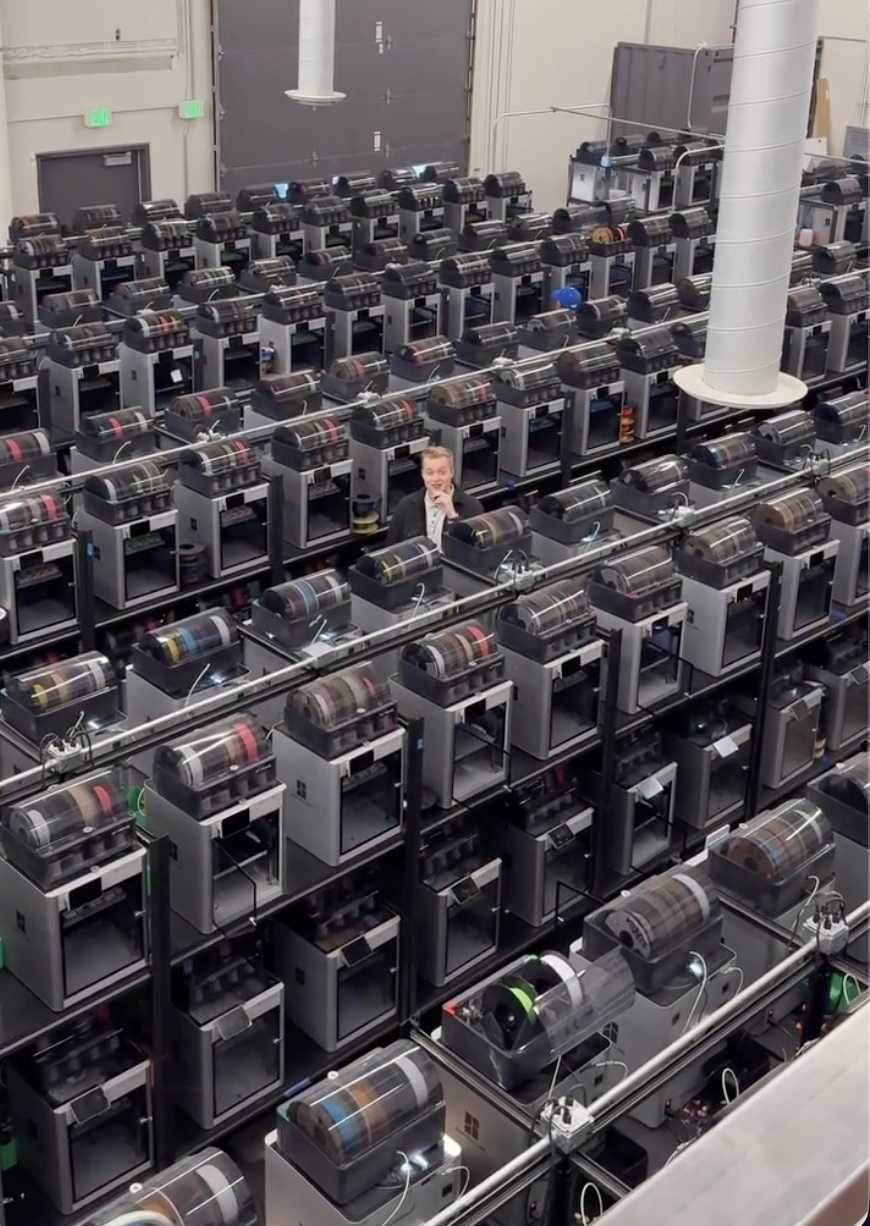
3D printing farm at Wigglitz. Image courtesy of Wigglitz via Instagram.
Many of these shops use desktop Material Extrusion 3D printers. There is very little automation with these guys, who prefer to work hard on their own or throw people at the problem when they scale. The guys that don’t automate seem to have a higher survival rate. Nearly none run cobot-enabled print bed changes, scanning, or conveyancing. Few run resurfacing or tumbling. QA is often done by eye. A lot are looking at using resin pellets, while increasingly these shops are buying their own, often Chinese, extrusion lines to save money on filament. Often, they then sell filament as well. A lot of these guys explain exactly what they’re doing, publicly socializing their entrepreneurship. Below, Redo3D explains that they expect to make 400 kilos across 2 years to pay back the system while making 7 to 8 kilos an hour.
Dancyn, who at times looks so tired he may very well dissuade people from running a print farm, talks us through the costs of running his $130,000, 178 printer setup below. This seems like a solo-preneur shop, while others employ 200 people.
Almost all are switching from Artillery MK3 systems and the like to Bambu or Creality sensor-enabled models. Others are getting machines for free to talk about running them on their farm, using the content to drive sales and revenue directly.
But others run hundreds of low-cost desktop VP systems for dental labs, or dozens of Formlabs systems to make hearing aids, dental intermediates, or mouth guards. Large-format Material Extrusion shops make mascots, signs, jacuzzis, huge jigs, molds, and vehicle bodies. Others use a few low-cost LPBF machines to make suppressors or defense parts.
Other people have an integrated content maker, design, product storytelling, print farm, and product business, which is very compelling. Lamps for Wooj and Nerf gun modding, out of Darts, but also off-road vehicle bump stops. Simultaneously, a few things are happening:
- Better low-cost 3D printers, Pro models, and low-cost LPBF or large Material Extrusion machines are becoming more reliable and more repeatable.
- The part cost has been lowered considerably while yields have improved, and a lot of uncertainty has been reduced, making this a more viable business.
- By building their own software, switches, and filament Lazy Susans, they’re innovating where it matters.
- People are selling directly, wholesaling, getting products into Walmart, having their own brands, expanding into many products, and specializing all at once.
- Best practices are being openly shared, which is accelerating collective development, something that does not really happen often with traditional service bureaus.
- People are winning through very specialized DfAM for Material Extrusion production at scale.
- People are looking at making their own filament, recycling failed prints, or commissioning their very own materials from compounders.
- Generally, these businesses are funded from growth and profits, with maybe some personal capital thrown in at the start.
- Polymer is the most prevalent, with PETG, ABS, PA and PLA being popular, but companies are starting to use bound filament for metal components and ceramics.
- These farms can be cheaper than prototyping in-house with industrial machines.
- These farms, in some small part, do compete with the traditional service bureau market. But, they are really opening up new parts, applications, and customers for additive.
- While print farms run predominantly Desktop Material Extrusion systems, also growing are desktop VP systems, Pro VP and LPBF systems, and low-cost metal LPBF systems. Less used but also growing are DED and large- and medium-format extrusion.
- These services are some of the most aggressive, agile, and efficient businesses that we’ve ever seen in 3D printing.
- They could become a significant slice of the overall additive market in the coming years.
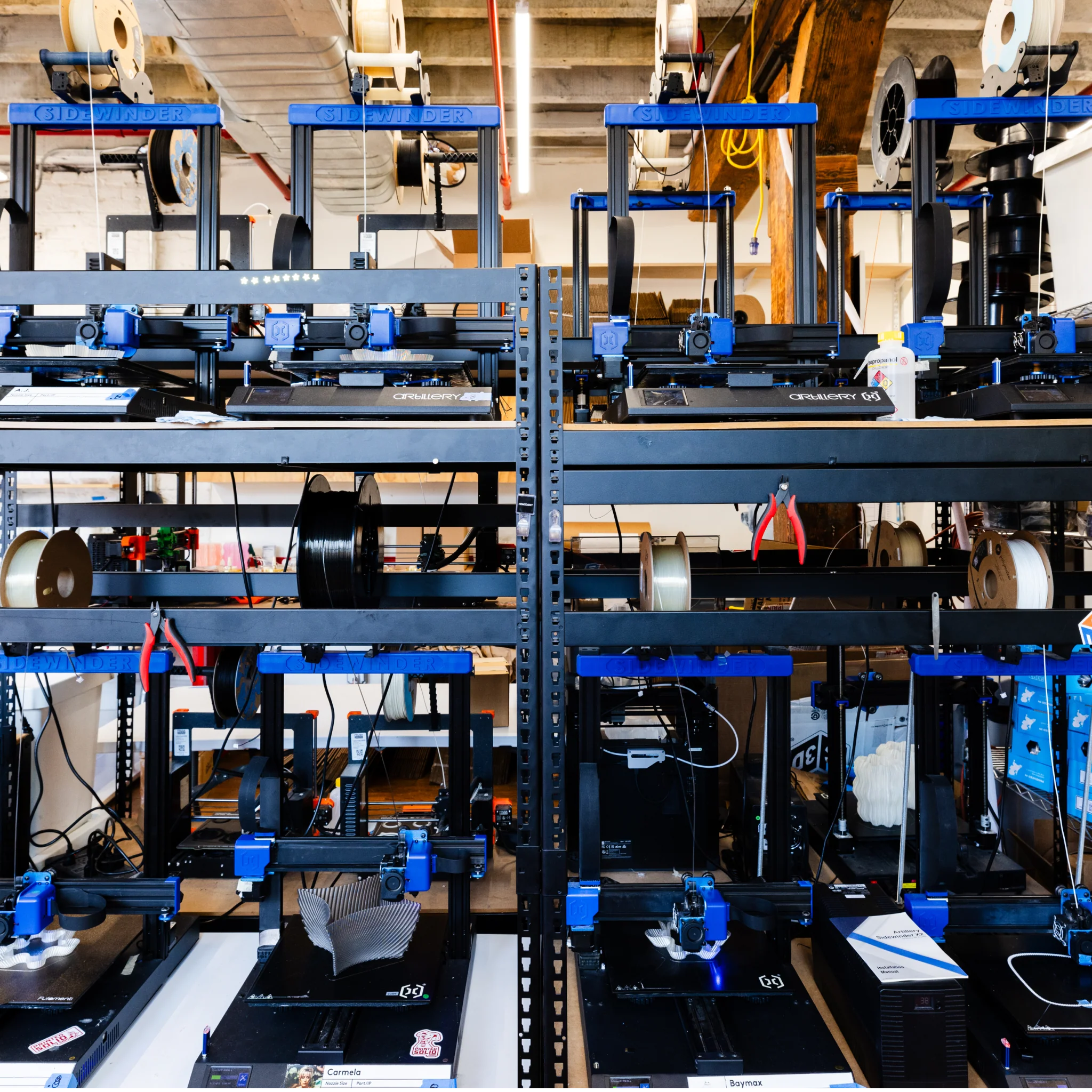
Wooj 3D print farm in Brooklyn. Image courtesy of Wooj.
This development could vastly accelerate the adoption of additive worldwide. Yes, at the moment, a lot of it is in fidget toys. And this, on the face of it, is silly. But it’s also a real business, with real profits, in a hyper-competitive market that you wouldn’t be able to survive in with existing industrial machines. By enabling new parts and new businesses, print farms will be the single most significant growth area in additive in the near term. And these farms will go beyond desktop Material Extrusion to new technologies and new materials to open up an entirely new world to additive.
Subscribe to Our Email Newsletter
Stay up-to-date on all the latest news from the 3D printing industry and receive information and offers from third party vendors.
Print Services
Upload your 3D Models and get them printed quickly and efficiently.













You May Also Like
UniFormation S10 Heads to Kickstarter with an Integrated Resin Printing and Post-Processing System
UniFormation will launch its S10 desktop resin 3D printer on Kickstarter on October 22, 2026, with pledges starting at $999. The S10 integrates printing, washing, and drying, allowing a print...
Creality Goes Pro with Sermoon P1S 3D Scanner
From making millions of value-engineered Prusa clones, Creality really has aggressively pivoted to more complex machines. The company has made strides forward in software, and the Ender’s of yore is...
Stratasys Showcases 3D Printed Automotive Applications & New Printer at IMTS 2026
Just ahead of last week’s International Manufacturing Technology Show (IMTS) in Chicago, Stratasys launched the F870, a new large-format, production-grade FDM 3D printing platform designed to drive industrial manufacturing at...
Creality Launches SPARKX i8 on Indiegogo, Bringing Fastest, No-Purge-Waste Printing
Creality announces the launch of the multi-color 3D printer SPARKX i8 on Indiegogo, at an early-bird price of $309 (MSRP $399) starting from Sept. 21. Designed for ultimate user experience,...