Comau’s Robotic Systems Take on 3D Printing Applications

Lately, Comau, the Italy-based manufacturer of robotic systems owned by One Equity Partners and automaker Stellantis, has formed a growing number of partnerships with companies in the additive manufacturing (AM) space, highlighting the increasing role that robotic arm systems are playing in AM hardware. An especially noteworthy aspect of Comau’s heightened attention to the AM market is the diversity of the applications that the automation firm is impacting.
Through its partnership with CEAD, a Dutch manufacturer of large-format composite 3D printers, Comau has helped disrupt the maritime industry, with CEAD’s printers being used to print drone boats and, most recently, workboat hulls. The company has also partnered with Germany’s KraussMaffei, a major manufacturer of plastic extrusion systems (among other things), which are used for everything from consumer goods to construction projects.
As for metal parts, Comau has made significant inroads with companies that utilize coating materials to repair and produce parts. Its collaboration with Prima Additive, recently acquired by major machine tool supplier Sodick, has supported Prima’s development of a more sustainable process for coating brake discs for the automotive industry. And Comau’s partnership with Australian cold spray AM OEM Titomic has contributed to the latter’s ability to pursue its own ambitious global growth strategy surrounding its cultivation of a network of key partners.
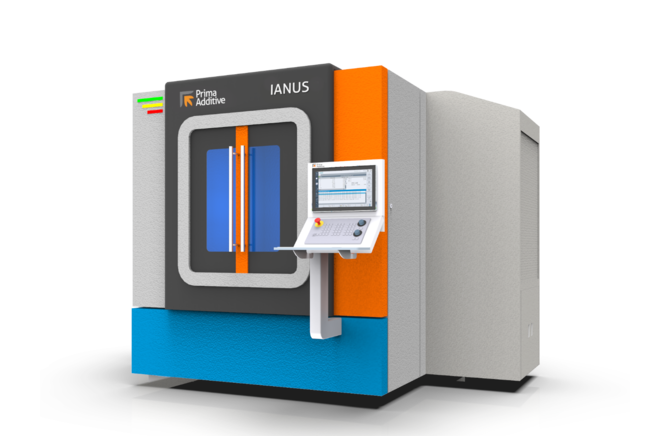
The IANUS cell. Image courtesy of Prima Additive
In a press release about Comau’s multidimensional penetration of the AM industry, the company’s Chief Customer Management Officer, Giacomo Del Panta, said, “Comau’s strategy of entering new market sectors to meet increased demand for advanced manufacturing technologies is being accelerated through a series of important collaborations with leading partners and customers across various industries. This approach exemplifies our dedication to innovation and marks an important step in our broader journey toward global growth.”
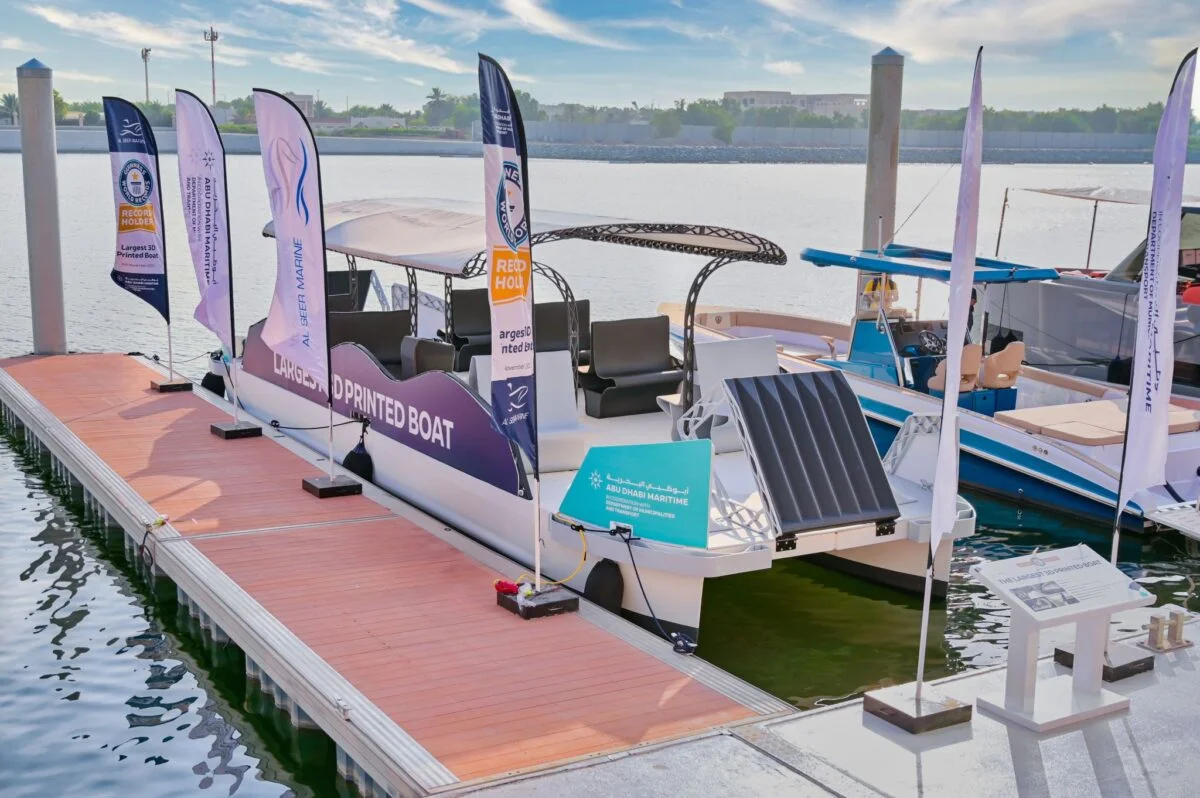
3D printed boat at Abu Dhabi Maritime. Image courtesy of Al Seer Marine via CEAD
Particularly in an environment of persistent and proliferating supply chain challenges, the AM industry and robot manufacturers have virtually endless potential for synergy. Above all, this is the case when it comes to large-scale parts, for which printers based on robotic arm systems have a serious advantage in production.
Along these lines, given how disproportionately affected automakers are by the tariff madness that the White House has unleashed on the planet, Comau’s success at targeting automotive applications — alongside the fact that Stellantis is one of the major stakeholders in the robotics OEM — may hint at the increased role that robotic arm 3D printers could take on in the reshoring of car part supply chains. In the short run, that would be a huge boon to localized production of spare parts, which could help slow the rise in costs that have plagued both suppliers and consumers.
In the long run, a rise in the auto industry’s familiarity with robotic arm 3D printers could be transformational for the process of auto design, which may be most beneficial to the West’s attempts to catch up to China in the EV/hybrid race. These are certainly a lot of “ifs”, but at the very least, it is reassuring to know that a major player in the robotics industry sees such broad-sweeping demand signals for AM hardware.
Subscribe to Our Email Newsletter
Stay up-to-date on all the latest news from the 3D printing industry and receive information and offers from third party vendors.
Print Services
Upload your 3D Models and get them printed quickly and efficiently.













You May Also Like
The Manufacturing Race Behind the Drone Revolution
We are in the middle of a major manufacturing shift focused on the production speed and payload capacity of uncrewed aerial systems (UAS), or drones. A recent Manufacturing Dive article...
ADDMAN to Buy Up to $10.8M in Nickel 718 Powder from 6K Additive Over 30 Months
After years of buildup, we’re finally starting to see what the US metal additive manufacturing (AM) market could look like at scale. To be sure, it’s still not quite there,...
Metal AM in a Multipolar World, Part 2: How PBF and DED Could Change by 2035
The first decades of PBF development were heavily shaped by machine capability: more power, more lasers, larger build volumes, better recoating, and improved process monitoring. These developments will continue, but...
Advanced Manufacturing at IMTS 2026: 3D Printing and AI and Drones, Oh My!
Last week’s International Manufacturing Technology Snow (IMTS) in Chicago welcomed over 90,000 attendees to the jungle that is McCormick Place. With over 1.17 million square feet of exhibit space, and...