Al Seer Marine Debuts First 3D Printed Drone Boat

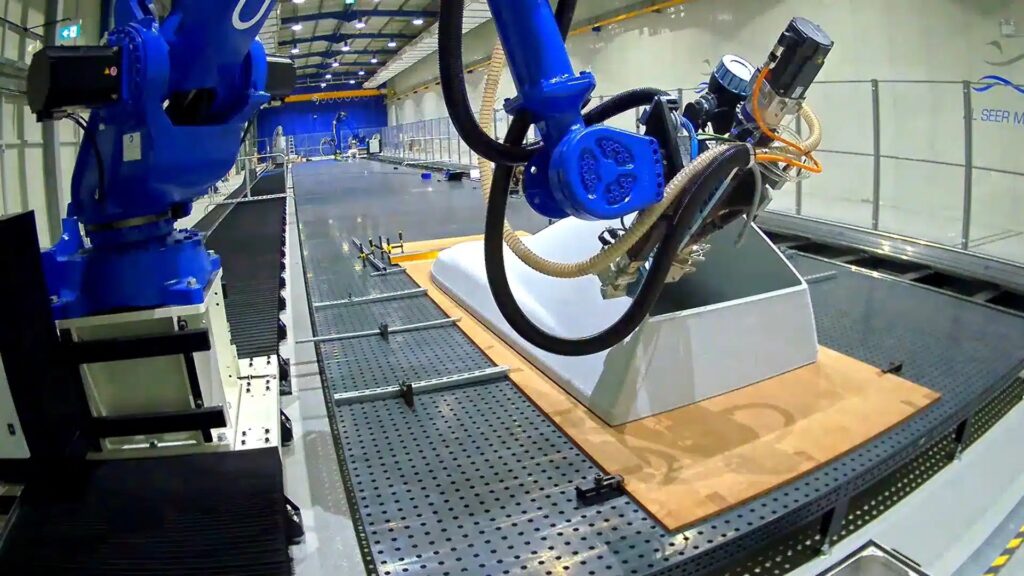
Al Seer Marine, a maritime equipment manufacturer and services provider based in Abu Dhabi, has unveiled HYDRA, which the company is claiming is the world’s first 3D printed unmanned surface vessel (USV), or drone boat. HYDRA was printed using a composite-based system made by Dutch original equipment manufacturer (OEM) CEAD, which touts the machine as the world’s largest robotic-arm 3D printer.
Al Seer displayed HYDRA, which is purely a concept vessel so far, at NAVDEX (Naval Defense & Maritime Security Exhibition) 2023, in Abu Dhabi (February 19-24). Al Seer is currently developing another version USV with a greater number of 3D printed parts, with the primary objective of lightweighting.

The concept version of the five meter long drone boat is 345 kg (about 760 pounds), and took about five days to print. According to Al Seer, the company is also planning on printing an integrated mast for HYDRA. When the functioning vessel is completed, it will initially be used for intelligence, surveillance, and reconnaissance (ISR) missions.
Drone boats drew significant attention in October, 2022, when a video of a fleet of Ukrainian USVs attacking the Russian Black Sea Fleet went viral. However, as noted by the Bulletin of the Atomic Scientists — which recently called drone boats “overhyped” — the “Ukrainian drone boats did little damage…”
Nevertheless, drone boats could potentially have more value in the long run as intelligence gathering tools, than they will as robotic kamikazes. In this sense, it seems relevant that, in addition to the fact that Al Seer is a UAE company with ties to that nation’s defense minister, the US military is also working on drone boats specifically for use in the Persian Gulf.
The connection between a demand for greater maritime surveillance and the Persian Gulf is the rapid increase in the number of dark shipments and ship to ship transfers of petroleum that has taken place since Russia’s invasion of Ukraine. That trend is only bound to accelerate as the sanctions regime against Russian fuel products becomes more entrenched.
Beyond that, there are of course plenty of other long-term considerations, particularly those involving the tracking of climate change, that could eventually make useful instruments out of the at first rather pointless sounding concept of drone boats. It is especially intriguing that the USVs seem to be being combined with sails, since any successful version of that concept could theoretically be a candidate for use in larger vessels. But generally, I maintain firm in my stance that every drone idea doesn’t need to be turned into a reality.
Images courtesy of Naval News and Al Seer Marine
Subscribe to Our Email Newsletter
Stay up-to-date on all the latest news from the 3D printing industry and receive information and offers from third party vendors.
Print Services
Upload your 3D Models and get them printed quickly and efficiently.













You May Also Like
3D Printing News Briefs, August 22, 2026: Polymers for CubeSats, Animal Mobility Devices, & More
We’re starting with defense news in this weekend’s 3D Printing News Briefs, before moving on to polymers for CubeSats and 3D printed prosthetics. We’ll end with a story about engineering...
Pusan National University & ORNL Develop Elastomeric Liquid Crystal Actuators
Researchers from Korea’s Pusan National University and Oak Ridge National Laboratory (ORNL) have developed 3D printed elastomeric actuators. In a paper published in Nature, the team used elastomeric liquid crystal...
Scientists Use BMF to 3D Print Seal Whiskers That Track Prey Long After It’s Gone
Seals use their whiskers to hunt. Not Navy Seals, although they may in some way also, but this article is about lowercase seals. Not Seal the musician either; as far...
Harvard’s Jennifer Lewis Lab Is 3D Printing Artificial Muscles That Twist and Bend on Demand
Researchers at Harvard John A. Paulson School of Engineering and Applied Sciences (SEAS) have developed a new way to 3D print materials that can move on their own, bending, twisting,...