Parallax Volumetric Additive Manufacturing Debuts at RAPID via Manifest Technologies

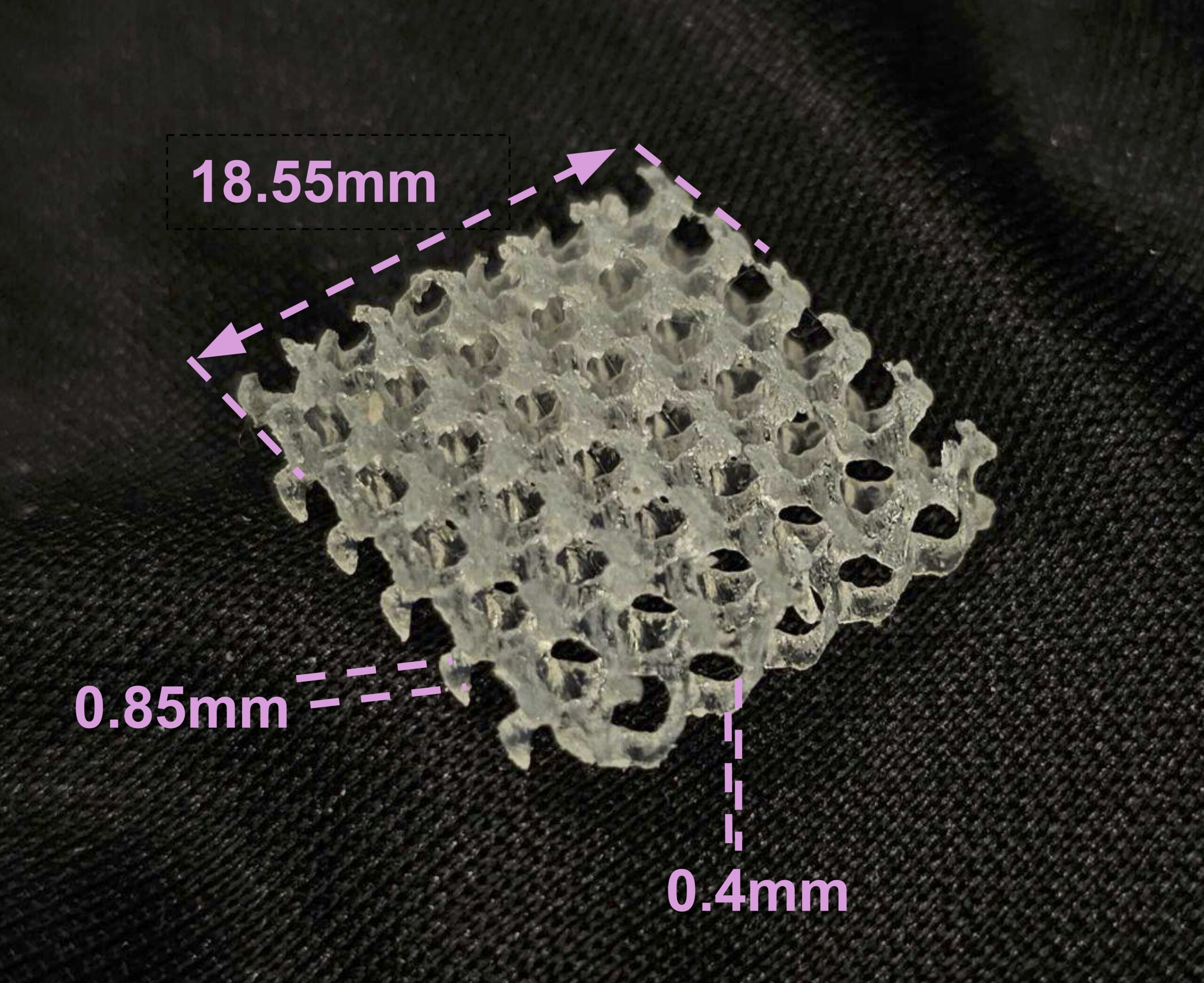
Manifest Technologies is showcasing its take on volumetric additive manufacturing at this year’s RAPID+TCT event, this week in Detroit, Michigan. Manifest, formerly known as Vitro3D, spun out of the University of Colorado in 2020 with a volumetric 3D printing technology, which uses multiple rods to hold several light sources, enabling volumetric printing. The company now refers to this as Parallax Volumetric Additive Manufacturing (P-VAM).
¨We founded Manifest to fundamentally reimagine additive manufacturing—moving beyond layer-by-layer printing to instant, multidimensional formation of solid parts using precisely controlled beams of light. At a time when the more mature additive technologies are beginning to stagnate, we view the debut of our P-VAM evaluation kit at RAPID as an invitation to forward-thinking partners to join us and manifest different,” said CEO Camila Uzcategui.
Manifest will offer the P-VAM evaluation kit to interested firms. The company believes that the advantages of P-VAM include layerless manufacturing, which can be up to 100 times faster than other 3D printing methods, the embedding of components such as electronics within prints, and compatibility with a wide range of materials. Manifest maintains that the technology is infinitely scalable in the XY plane, enabling potential use cases involving very long or large objects, or machines tailored to specific parts or part families. For instance, one could imagine a one-meter-by-one-meter printer for producing aligners, or a meter-long printer that is one aligner wide.
Manifest hopes to attract materials firms, researchers, and industrial partners to bring its technology to fruition through an open platform model. The company believes it has a true manufacturing solution that can be integrated alongside mass production lines. I really appreciate the compact form factor this solution offers compared to a wall of Asigas or a large SLA system. A streamlined, one-aligner-wide setup could be efficiently integrated with post-processing equipment, with all components designed to fit seamlessly. This approach enables a high-capacity setup within a minimal footprint.
Manifest will demonstrate the solution at their RAPID booth (#3443), where visitors can view printed parts and discuss relevant use cases. In addition to the evaluation kit, the company is offering an early adopter program for those interested in helping commercialize P-VAM. P-VAM holds real potential as a manufacturing technology; for certain part families, the process could be exceptionally fast. Moreover, the reduction of supports could lead to significant savings in conveyancing and labor.
Volumetric 3D printing has been demonstrated for soft medical robotics devices, circuits, and bioprinting. Aligners and hearing aids have been discussed as potential targets for this technology, as have optics. Devices such as Xolo’s have been on the market for several years, and the technology has been steadily maturing. Investors and startups are clearly eager to develop it further. However, just because something is conceptually faster doesn’t mean the real-life economics will hold up. Entrants like Manifest will need to demonstrate maturity, reliability, and success through real-world customers and use cases. While the current market is primarily focused on researchers, concrete business cases will eventually need to be established. This won’t be easy. But by offering the kit and pursuing an open approach, the company is taking a very sensible path. Researchers and firms alike are likely to appreciate transparency. An open model, free of black box limitations, is more likely to encourage investment of time and resources.
We don’t yet know what the ideal product-market fit is for this technology, nor do we know which applications and industries it’s best suited for. The era of selling a revolution with a PowerPoint is over. Companies now must work hard to build relationships and get partners to put skin in the game. Manifest appears to be off to a solid start in engaging prospective partners with a newfangled technology that could change the game.
Subscribe to Our Email Newsletter
Stay up-to-date on all the latest news from the 3D printing industry and receive information and offers from third party vendors.
Print Services
Upload your 3D Models and get them printed quickly and efficiently.












You May Also Like
Reinventing Reindustrialization: Why NAVWAR Project Manager Spencer Koroly Invented a Made-in-America 3D Printer
It has become virtually impossible to regularly follow additive manufacturing (AM) industry news and not stumble across the term “defense industrial base” (DIB), a concept encompassing all the many diverse...
Inside The Barnes Global Advisors’ Vision for a Stronger AM Ecosystem
As additive manufacturing (AM) continues to revolutionize the industrial landscape, Pittsburgh-based consultancy The Barnes Global Advisors (TBGA) is helping shape what that future looks like. As the largest independent AM...
Ruggedized: How USMC Innovation Officer Matt Pine Navigates 3D Printing in the Military
Disclaimer: Matt Pine’s views are not the views of the Department of Defense nor the U.S. Marine Corps Throughout this decade thus far, the military’s adoption of additive manufacturing (AM)...
U.S. Congress Calls Out 3D Printing in Proposal for Commercial Reserve Manufacturing Network
Last week, the U.S. House of Representatives’ Appropriations Committee moved the FY 2026 defense bill forward to the House floor. Included in the legislation is a $131 million proposal for...