Puerto Rico University Gets $1.3M for Aluminum 3D Printing in Space

University of Puerto Rico, Mayagüez Campus (also known as Recinto Universitario de Mayagüez, or RUM), has received a $1.3 million grant from the U.S. Air Force through America Makes to advance aluminum for space applications. Partnering with the University of Texas at El Paso, the university will collaborate on the $3 million Joint Aluminum Manufacturing Maturation (JAMM) project. As part of the initiative, new alloys will be developed and evaluated.
“This represents a significant milestone for our university and promises to drive innovation and leadership in this key area. We’re thrilled with the trust placed in us by the Air Force and America Makes. Students will first gain experience working with a metal printer, ensuring parts can withstand mechanical stresses regardless of environmental conditions,” Professor Ricky Valentín-Rullán stated.
“Puerto Rico provides a unique environment to study how these highly additive materials react under prolonged exposure to corrosion,” said Jason Thomas, a project engineer at the National Center for Defense Manufacturing and Machining (NCDMM), the parent organization of America Makes.
Previously, RUM, received a $300,000 grant from NASA as part of the $6 million NASA MOSAICS program, which supports space research in collaboration with non-traditional NASA partners. This grant involves joint efforts with NASA Glenn and Purdue University. Additionally, a Department of Defense grant and funding from the Puerto Rico Science, Technology and Research Trust enabled the establishment of a new laboratory in Puerto Rico at the end of 2024. The lab features polymer and composite 3D printing capabilities, along with a Renishaw AM 400 system.
The Renishaw AM 400 will play a central role in the project, offering local students valuable hands-on experience with cutting-edge research. Although the AM 400 dates back to around 2018 and a more modern system might have offered additional capabilities, the type of qualification and testing work planned remains highly relevant and in demand globally. For students, participating in this initiative could open doors to careers in additive manufacturing, making the project a cost-effective investment by America Makes and the Department of Defense.
Supporting newer, smaller labs like this one complements the work done at larger U.S. research institutions, expanding access to meaningful, high-impact research. Funding emerging universities not only broadens the talent pipeline but also welcomes eager new contributors to the national space and defense sectors. With new labs come opportunities to recruit fresh researchers and staff, meeting the growing demand for skilled professionals in these strategic industries.
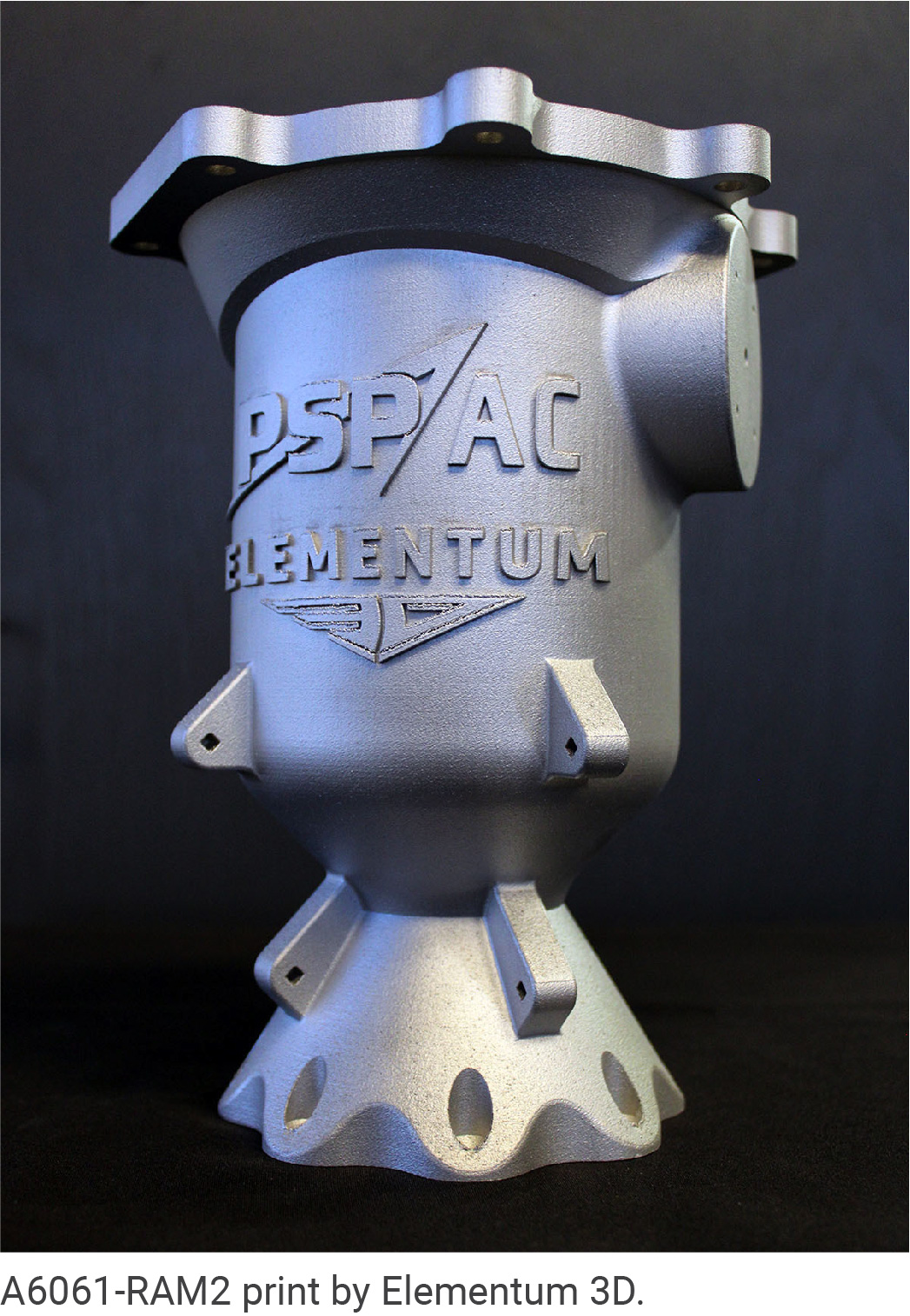
NASA Marshall has previously worked on HRL’s 7A77 aluminum alloy and led the Reactive Additive Manufacturing for the Fourth Industrial Revolution (RAMFIRE) project in 2023. In collaboration with Elementum 3D, the team developed a specialized aluminum material used to produce a rocket nozzle via Directed Energy Deposition (DED) 3D printing. Spearheaded by Paul Gradl, the RAMFIRE project garnered significant attention for its technical advancements.
The aerospace nozzle created through RAMFIRE featured complex internal channels and was printed as a single piece by RPM Innovations. RPM has pioneered blown powder DED systems capable of producing parts up to two meters tall, while allowing for intricate features, such as 1 mm internal channels and 1.5 mm wall thicknesses, achieved using a tilted table setup paired with a five-axis arm.
NASA also collaborated with Elementum 3D on the development of the aluminum Broadsword rocket engine, a 25,000 lbf thrust upper-stage engine created by Masten Space Systems with funding from DARPA. Remarkably constructed from just three parts, the Broadsword engine served as a powerful demonstration of the potential for aluminum in rocket propulsion. Hot fire tested in 2016 and developed over a 13-month period, the project helped catalyze interest in aluminum alloys for engine components.
Printed using an EOS system with Elementum’s 6061-RAM2 aluminum alloy, the engine highlighted the performance and manufacturability advantages of advanced additive aluminum. Elementum has been working with NASA since 2014, and the Broadsword marked a significant milestone in that collaboration. Masten, the company behind the engine, was later acquired by Astrobotic, a firm focused on lunar landers and space exploration technologies such as rovers.
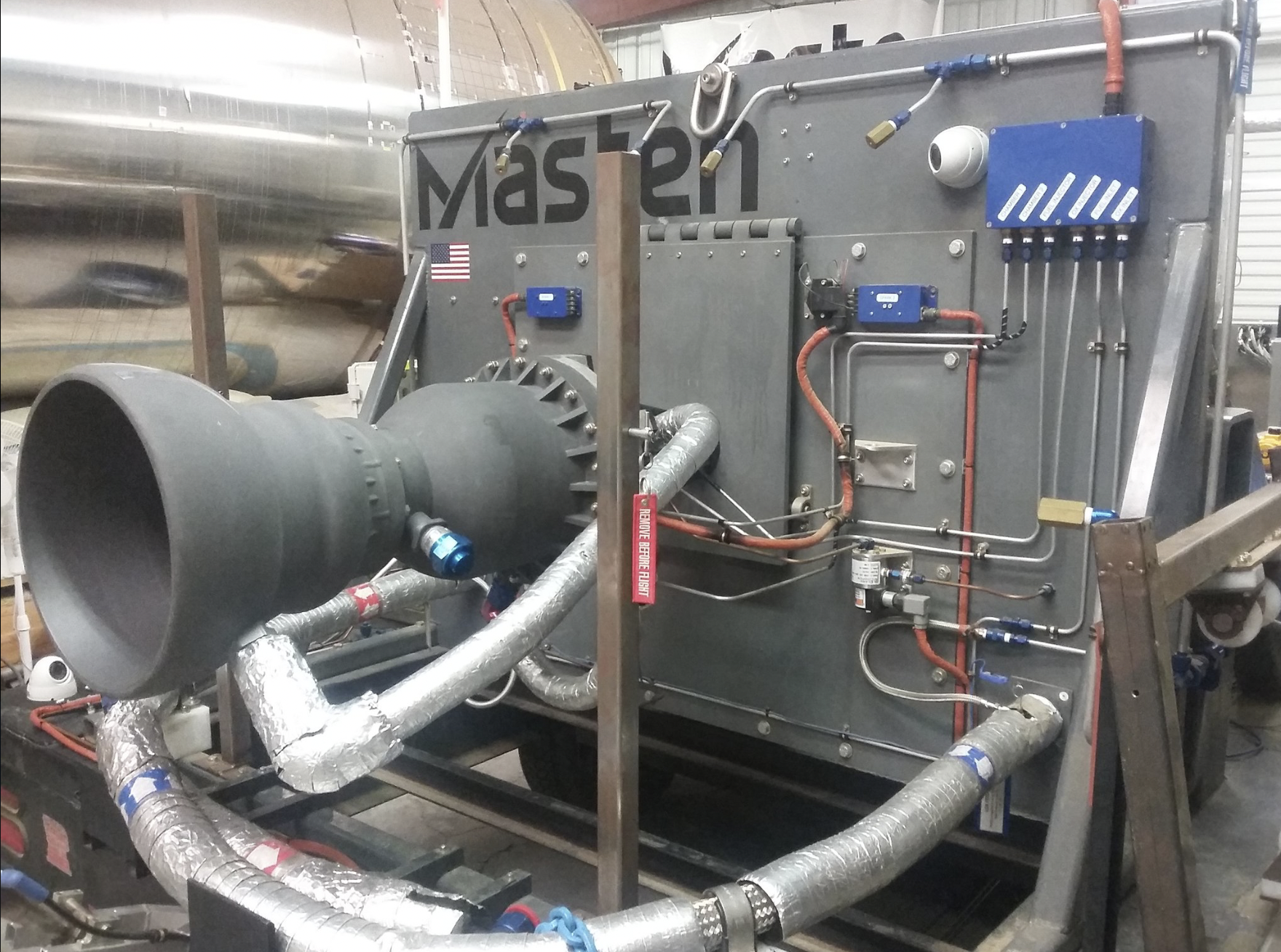
The Broadsword engine was also notable for its lightweight design and for being tested as a liquid methane rocket engine under an AFRL Tipping Point contract. Liquid methane, used in engines like SpaceX, Blue Origin, LandSpace, and Relativity Space, is gaining traction in modern rocketry. It offers a compelling balance between performance and efficiency—achieving high specific impulse while requiring smaller, denser fuel tanks compared to hydrogen. For some applications, liquid methane is seen as the “Goldilocks” rocket fuel for its potential for in-situ production on Mars, enabling long-duration missions and return trips through locally sourced fuel. This makes aluminum-based additive manufacturing methods like DED and LPBF particularly appealing to the New Space community.
Of course, while many exciting materials exist for space applications, there’s another key reason the off-planet community is so focused on aluminum. The Molten Aluminum Generation for Manufacturing Additively project, led by the Colorado School of Mines and other research partners, is exploring how to extract and melt aluminum from lunar regolith. This would make it significantly easier to construct structures on the Moon and beyond, and even enable the production of spacecraft designed to explore deeper into space—directly from off-Earth resources. In this context, the recent grant to RUM could be a launchpad for students into the future of space manufacturing.
Subscribe to Our Email Newsletter
Stay up-to-date on all the latest news from the 3D printing industry and receive information and offers from third party vendors.
Print Services
Upload your 3D Models and get them printed quickly and efficiently.











You May Also Like
Printing Money Episode 36: Recent 3DP/AM Deals and More with John Barnes (TBGA & MPW)
Welcome to Printing Money Episode 36! For this episode Danny is joined by a new guest, John Barnes (Founder and President, The Barnes Global Advisors, Founder and CEO, Metal Powder...
Friendshoring and Additive Manufacturing: Turning Australia’s Research Strength into Commercial Impact
Global supply chains are being re-written. After decades of globalisation driven primarily by cost efficiency, geopolitical tensions, trade disputes and pandemic-era disruptions have exposed the risks of concentrating manufacturing and...
Velo3D’s $32.6M Defense Contract Highlights Why U.S.-Made 3D Printing Is Suddenly Critical
When the U.S. government talks about supply chain security, it’s no longer theoretical. It’s now written directly into law and into defense contracts. That detail matters for Velo3D, which this...
Northrop Grumman & Titomic Achieve Successful Hot Fire Test with 3D Printed Thrust Chamber
Back in April, leading Australian cold spray additive manufacturing (CSAM) original equipment manufacturer (OEM) Titomic announced that the company was partnering with defense giant Northrop Grumman to test the use...