No More Needles? Carbon Founder’s 3D Printed Patch Gets Backing

Forget needles—this 3D printed patch just launched with serious backing. Stanford University professor and Carbon co-founder Dr. Joseph DeSimone has officially launched PinPrint, a new startup developing 3D printed microneedle patches that deliver drugs and vaccines through the skin—no syringe required. Built on research from Stanford, the University of North Carolina (UNC) at Chapel Hill, and Carbon, PinPrint aims to shake up how treatments are given across medicine and cosmetics.
That vision is now getting a boost from Continuity Biosciences. The Florida-based drug delivery company is backing the launch with a new investment, giving it access to a non-invasive method for delivering treatments, this time through the skin instead of implants. Until now, Continuity has focused on long-term implantable drug systems developed with researchers in Houston. With PinPrint, it’s stepping into a next-generation needle-free approach.

Joseph DeSimone, Founder of Carbon and PinPrint. Image courtesy of Stanford University.
PinPrint was founded around a technology developed by DeSimone, a professor of chemical engineering and radiology at Stanford. He is also the co-founder and current board member of Carbon, where he served as CEO from 2013 to 2019. His team addressed a critical challenge in 3D printing—resin over-curing in tiny spaces—by developing the injection Continuous Liquid Interface Production (iCLIP) method. This innovation enables the creation of ultra-precise microneedles and microfluidic channels essential for advanced medical devices.
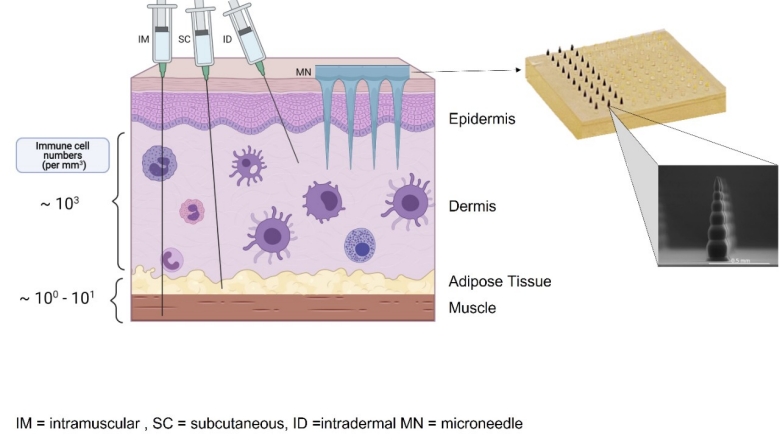
The company’s lead product is a microneedle patch designed to deliver drugs directly into the skin without a syringe, offering a simple, pain-free alternative. As highlighted in a 2025 Stanford Magazine profile, DeSimone’s latest work focuses on microneedle patches that not only deliver vaccines more effectively, but also simplify storage and self-administration. By targeting the dermis, where immune cells are concentrated, these patches could make vaccines more potent, easier to distribute, and less dependent on cold-chain logistics.
Beyond drug delivery, the team behind PinPrint sees potential in using the same microneedle platforms for diagnostics. By collecting interstitial fluid—a clear liquid that surrounds cells in the body—the patches could one day monitor things like glucose levels or immune responses, all without breaking the skin. These kinds of capabilities hint at a future where healthcare is not only “less invasive but also more continuous and personalized.”
The broader implications of PinPrint’s work and Continuity Biosciences’ expansion into non-invasive treatment platforms point to a growing shift in how drugs and data might move through the body. Instead of relying on cold storage, needles, or doctor visits, the next wave of medicine could be delivered like a sticker: basically simple, scalable, and precisely engineered through 3D printing, and most importantly, to patients: pain-free.
This idea lines up with a broad vision shared by futurists and longevity experts like physician and entrepreneur Peter H. Diamandis, founder and chairman of the XPRIZE Foundation. In a recent Future Medicine blog post, Diamandis argued that the coming decade could bring radical changes in healthcare, powered by AI and smarter delivery systems. He advises staying healthy long enough to benefit from what’s coming.
3D printing microneedles with complex geometries. Image courtesy of Stanford University.
“We humans have 100 to 1,000 times more immune cells in the dermis of our skin than we do in our muscle,” DeSimone said in his Stanford Magazine interview. “If you could effectively target this middle layer of skin, he says the benefits would range from requiring a fraction of the typical dose—crucial in epidemics, like the recent mpox outbreak, so there’s enough to go around—to enticing needlephobes to get vaccinated. The largest manufacturer of vaccines has told me the biggest inhibitor for getting a seasonal vaccine trifecta of influenzas, COVID, and RSV is that people hate needles.”
DeSimone’s work has shaped both the chemistry lab and the factory floor. As a professor at UNC, he helped pioneer safer, greener technologies, from an eco-friendly way to make Teflon to a bioabsorbable heart stent. However, it was in the world of 3D printing that DeSimone made his biggest mark. In 2013, he co-founded Carbon, the company behind the high-speed resin printing process CLIP. Carbon helped turn 3D printing into a true manufacturing tool, most famously through its ongoing partnership with Adidas, which in 2025 released a new fully 3D printed shoe. Now with PinPrint, DeSimone is bringing that same mix of science and commercial impact to healthcare.
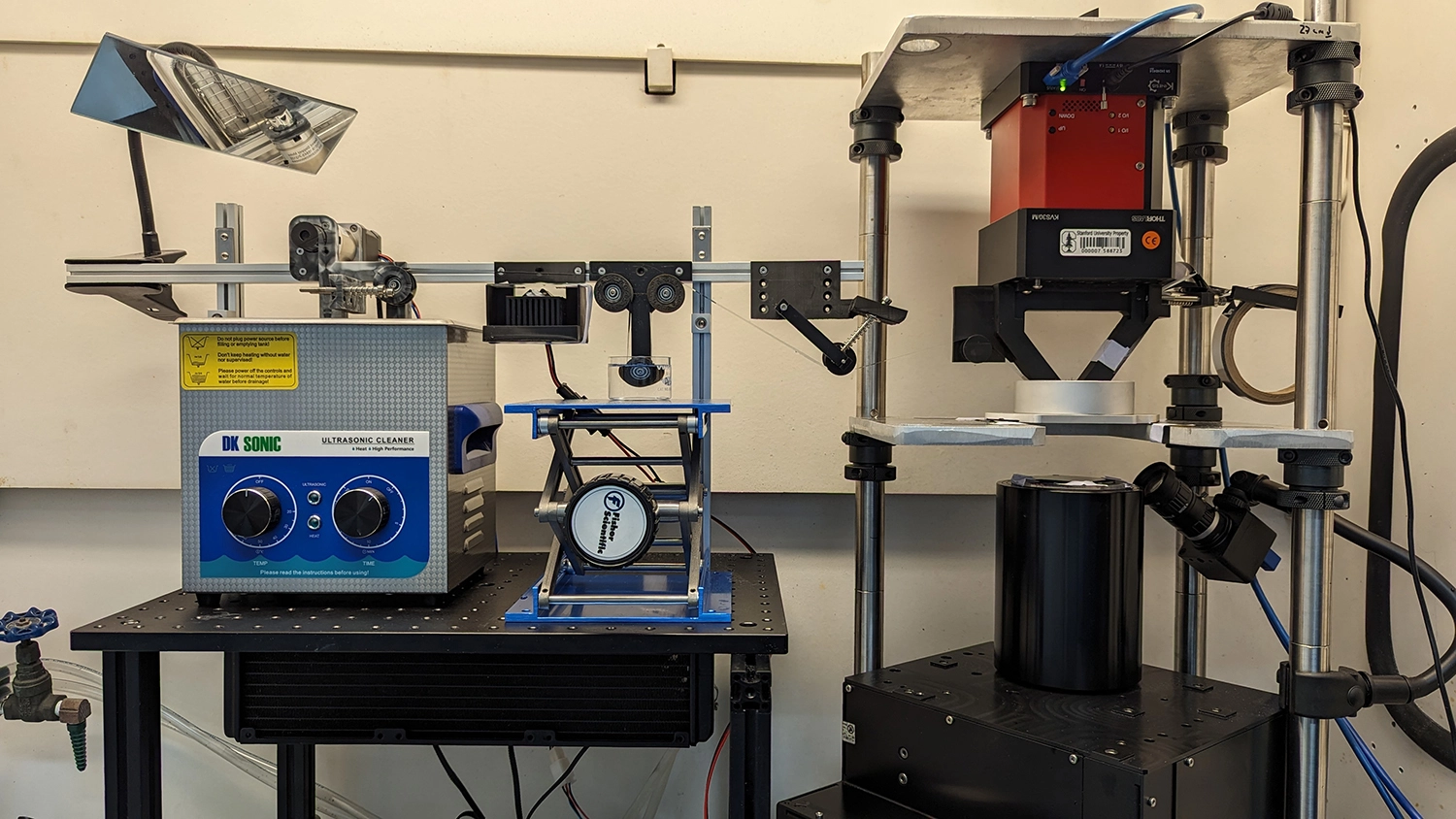
The r2rCLIP setup in the DeSimone lab runs from right to left. The printing occurs in the area below the red piece. Image courtesy of DeSimone Research Group.
That move into medicine now has the backing of Continuity Biosciences. The company, which usually works on implanted drug systems for chronic illnesses, sees this as a way to try something new— delivering treatments through the skin, without needles.
“This investment allows us to expand from implanted nanofluidic systems to a non-implanted microfluidic platform,” said Ramakrishna Venugopalan, Co-Founder and CEO of Continuity Biosciences. “It opens the door for more effective delivery of dermatologic, aesthetic, and cosmetic agents directly into the dermis.”
As part of the agreement, Venugopalan will join PinPrint’s board. PinPrint’s CEO, Renee Ryan, said his leadership and experience in drug delivery will “be instrumental, as we redefine what’s possible in drug and vaccine delivery.”
Continuity, which also has operations in Houston, has focused on long-term drug delivery for chronic diseases. PinPrint brings a new angle: non-invasive, personalized patches for things like vaccines, dermatology, and potentially even beauty treatments. Both companies say the partnership aims to make treatments easier, more precise, and more comfortable for patients.
Subscribe to Our Email Newsletter
Stay up-to-date on all the latest news from the 3D printing industry and receive information and offers from third party vendors.
Print Services
Upload your 3D Models and get them printed quickly and efficiently.













You May Also Like
Why the AM Industry Should Pay Attention to Schneider Electric’s $22.6B PTC Acquisition
By late 2024, there was already enough signaling of the additive manufacturing (AM) industry opportunity in the data center infrastructure market for AM Research to write a report on the...
How Does Nike’s 3D Printing Approach Fit Into Its Restructuring Plan?
Shares of Nike stock hit all-time highs in late 2021 but have cratered in the years following, with the company losing nearly 80 percent of its market cap since peaking....
3D Printing News Briefs, October 1, 2026: Defense, Enclosures, & More
In today’s 3D Printing News Briefs, we’re starting with defense news, first from Massivit and then from AML3D. Then we’ll move on to U.S. manufacturing of a new large-format LPBF...
South Korea’s Lincsolution Lands Hanwha Defense Deal as Hanwha Invests Billions in US
I recently wrote about how the South Korean additive manufacturing (AM) firm Lincsolution is building an aerospace and defense hub, part of the company’s construction of “the largest AM facility in...