New Bioprinted Fat Tissue Could Treat Burns, Foot Ulcers, and Sores, Say Korean Researchers

Bioprinting continues its steady march toward the ambitious goal of making new tissue and organs commonplace. Teams worldwide are specializing in hearts, spleens, and cartilage. Now, researchers from Korea’s Pusan National University have made progress in 3D printing adipose tissue, publishing their findings in Advanced Functional Materials.
Adipose tissue, commonly known as fat, is found in the body as visceral fat surrounding organs, in bones, and as subcutaneous fat in the skin. While 3D printing fat may not seem groundbreaking, adipose tissue is a major component of skin and could be instrumental in repairing, healing, and regenerating skin.
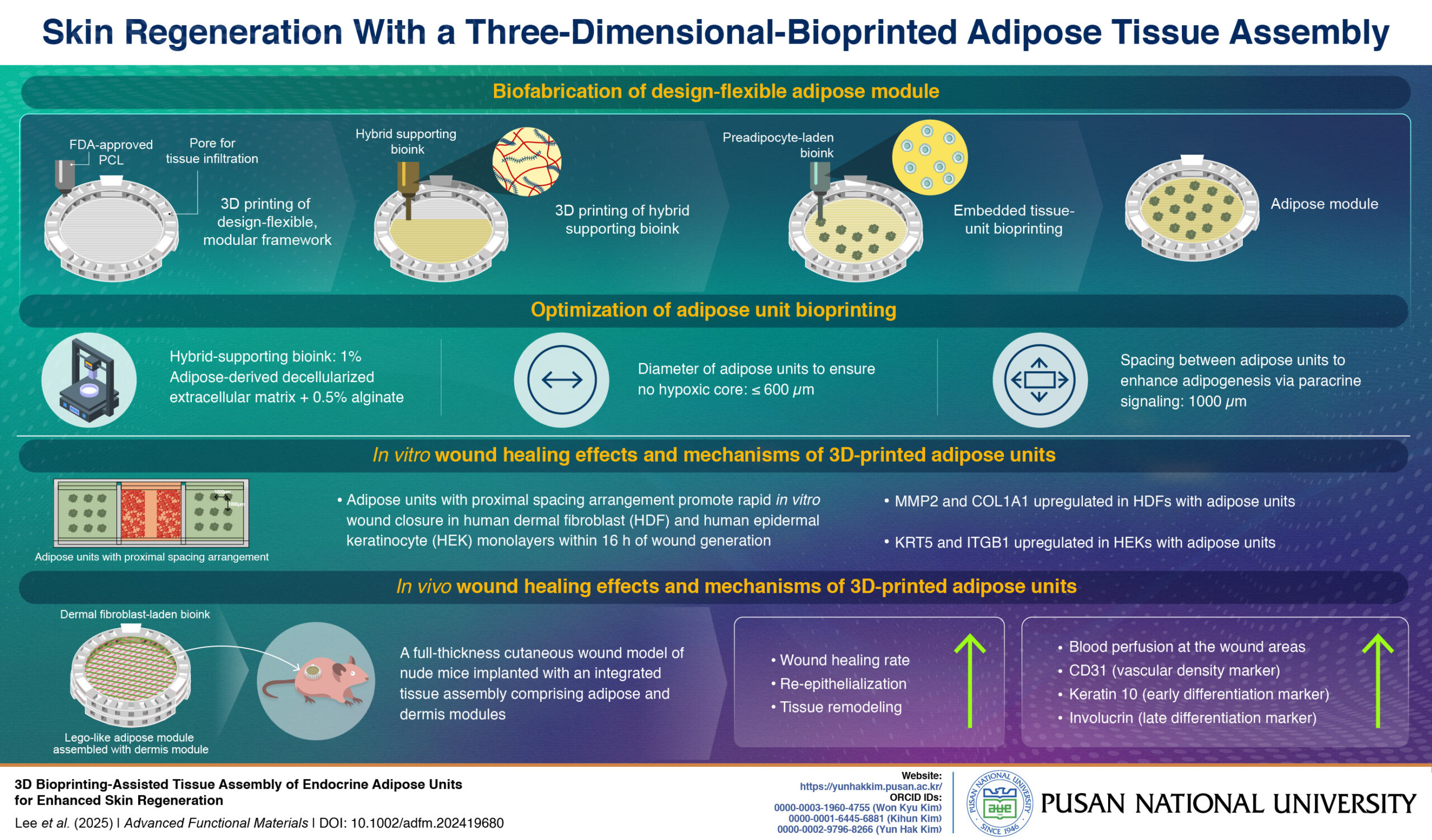
The team used a hybrid bioink to print adipose tissue with regenerative properties. They combined a decellularized extracellular matrix with alginate to create the ink, using a ratio of 1% adipose to 0.5% alginate. The printed structures more closely mimicked native tissue and lipid bodies. They then optimized printing settings and parameters, determining that ideal diameters were ≤ 600 µm and that tissues should be ≤ 1000 µm apart. Observations included wound healing and skin regeneration.
“Under standard culture conditions, preadipocytes tend to proliferate and migrate, preventing the formation of lipid droplets that are essential for adipose tissue functions. The hybrid bioink developed in this study maintains the physiological properties of the adipose tissue,” said Assistant Professor Byoung Soo Kim.
“The 3D bioprinted endocrine tissues enhanced skin regeneration, indicating their potential applications in regenerative medicine. While current fat grafting procedures suffer from low survival rates and gradual resorption, our hybrid bioinks enhance endocrine function and cell viability, potentially overcoming these limitations. This approach could be particularly valuable for treating chronic wounds such as diabetic foot ulcers, pressure sores, and burns,” noted researcher Jae-Seong Lee.
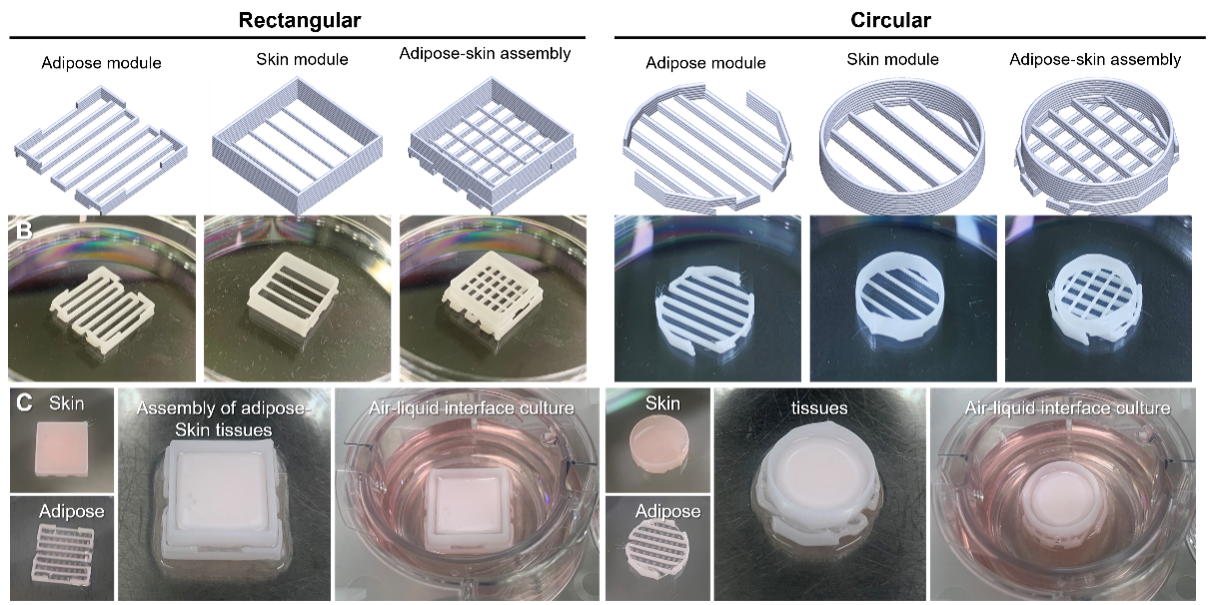
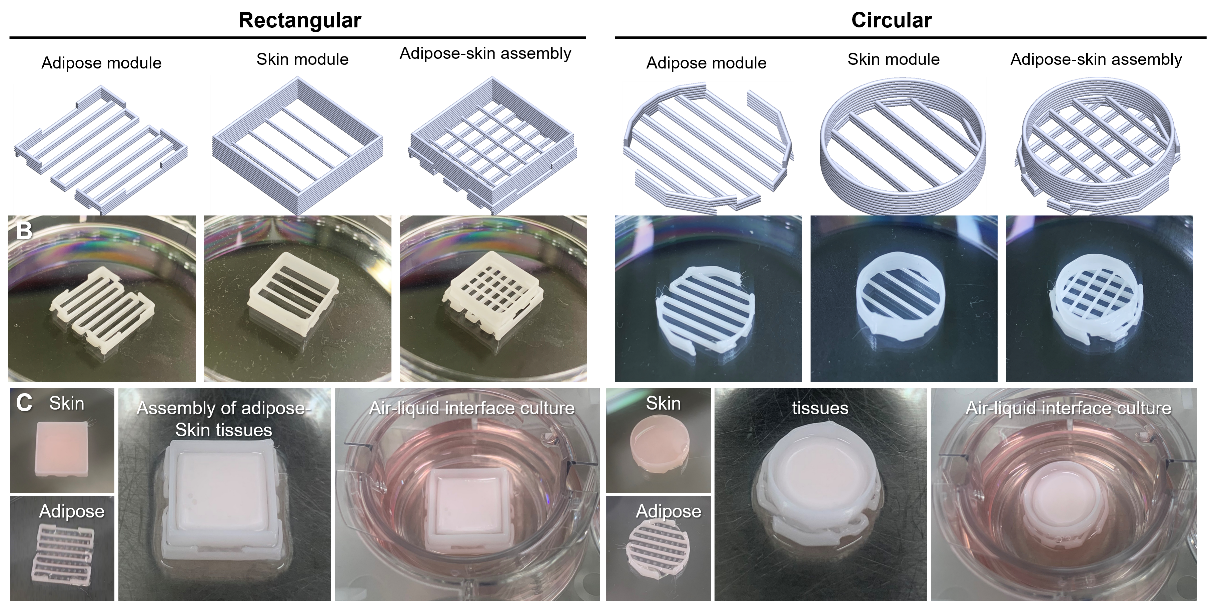
Modular assembly application in in vitro skin modeling. The modular PCL frameworks consist of a lower module containing adipose units and an upper module loaded with artificial skin, illustrating the flexibility of the assembly approach for in vitro applications.
The researchers stated that the “optimized 3D bioprinted adipose tissues rapidly promoted the migration of skin cells in vitro by modulating the expression levels of cell migration-related proteins” and that their “findings revealed that the tissue assembly promoted wound healing in mice by inducing re-epithelialization, tissue remodeling, and blood vessel formation and regulated the expression of skin cell differentiation-related proteins.”
This appears to be a promising step forward in bioprinting skin and beyond. Currently, there are no truly effective skin plasters or wound dressings. For individuals with severe burns, recovery is slow, and the process of changing dressings and cleaning wounds is extremely painful. Improved wound dressings that last longer or require fewer changes would be a significant advancement. A plaster incorporating bioprinted adipose tissue could serve as a valuable intermediate product. Skin is one area where even partial progress could lead to highly viable solutions—unlike an incomplete eye, which has limited function, partial skin regeneration could significantly aid burn recovery. Any product that brings us closer to fully 3D-printed skin would still hold immense value.
Advancing toward the full recreation of skin could significantly improve the lives of many patients. According to the NIH, “Every 5 seconds someone is severely burned, involving nearly 11 million people annually. A majority (95 percent) of burn cases occur in developing countries. Worldwide, an estimated 6 million patients seek medical help for burns annually, resulting in more than 300,000 deaths from fire-related burn injuries.”
While burns may seem like a relatively straightforward medical issue compared to, for example, engineering a functional heart, skin itself is an incredibly complex, high-performance material in a constant state of repair and regeneration. Injuries that damage some or all of its intricate layers can be locally devastating and even fatal. The work of the Pusan team represents a much-needed development in this space. Beyond the medical necessity, the potential global market for such a technology could be substantial, but more importantly, it could offer better treatment options for severe burn injuries, reducing suffering and improving recovery outcomes.
Subscribe to Our Email Newsletter
Stay up-to-date on all the latest news from the 3D printing industry and receive information and offers from third party vendors.
Print Services
Upload your 3D Models and get them printed quickly and efficiently.













You May Also Like
The Manufacturing Race Behind the Drone Revolution
We are in the middle of a major manufacturing shift focused on the production speed and payload capacity of uncrewed aerial systems (UAS), or drones. A recent Manufacturing Dive article...
ADDMAN to Buy Up to $10.8M in Nickel 718 Powder from 6K Additive Over 30 Months
After years of buildup, we’re finally starting to see what the US metal additive manufacturing (AM) market could look like at scale. To be sure, it’s still not quite there,...
Metal AM in a Multipolar World, Part 2: How PBF and DED Could Change by 2035
The first decades of PBF development were heavily shaped by machine capability: more power, more lasers, larger build volumes, better recoating, and improved process monitoring. These developments will continue, but...
Advanced Manufacturing at IMTS 2026: 3D Printing and AI and Drones, Oh My!
Last week’s International Manufacturing Technology Snow (IMTS) in Chicago welcomed over 90,000 attendees to the jungle that is McCormick Place. With over 1.17 million square feet of exhibit space, and...