ETH Zurich Spin-off SAEKI’s $6.7M Boost to Supercharge Industry in Europe

European manufacturing faces several challenges that threaten its global competitiveness. According to a recent European Commission report, high energy costs, fragmented supply chains, and slow adoption of automation have placed significant strain on the industry. Sectors like aerospace and automotive are particularly vulnerable and have shown production delays and rising operational expenses. Meanwhile, a McKinsey study indicates that Europe is falling behind in manufacturing productivity compared to the U.S. and China due to some outdated processes. Supply chain disruptions have made these issues worse, increasing lead times and making production cycles less efficient.
With industries feeling the pressure, a major shift is necessary to revitalize European manufacturing. Autonomous additive manufacturing (AM) company SAEKI, an ETH Zürich spin-off, just secured $6.7 million in funding to tackle these challenges. SAEKI is on a mission to merge artificial intelligence (AI), robotics, and automation into one system that can take a complex design and turn it into a finished part in a matter of days instead of weeks. SAEKI thinks of this as the future of industrial production, where massive structures can be built with precision, speed, and efficiency.

SAEKI factory. Image courtesy of SAEKI.
From a Family Workshop to the Factory of the Future
SAEKI’s journey starts with CEO Andrea Perissinotto, who grew up in his uncle’s workshop, watching skilled artisans labor over parts that took weeks or even months to complete. Manufacturing, especially for large components, has always needed experts with decades of experience. However, they are becoming increasingly rare.
“We saw an opportunity to integrate advanced manufacturing technologies to overcome these limitations and scale production efficiently,” Perissinotto explained. “The existing processes demand decades of experience and are incredibly hard to scale. With AI and robotics, we’re now able to abstract and automate these skills.”
Perissinotto, along with co-founders Oliver Harley and Matthias Leschok, set out to change that while studying at ETH Zürich. They imagined a system that could bridge the gap between what engineers design and what traditional manufacturing can produce. That vision became SAEKI.

SAEKI founders Oliver Harley, Matthias Leschok and Andrea Perissinotto. Image courtesy of SAEKI.
Like other startups, SAEKI wants to tackle one of the biggest bottlenecks in modern industry. Companies today can generate thousands of AI-optimized designs, but getting them built is an entirely different story when relying on traditional manufacturing. So SAEKI’s solution is a fully automated production system that integrates large-scale 3D printing, CNC machining, and AI-driven quality control.
That means SAEKI can deliver custom large-format parts in just one week, compared to the six weeks it takes traditional suppliers. Its instant quoting system also removes the back-and-forth negotiations, so customers can upload designs, tweak specifications, and get an immediate price. The hybrid manufacturing approach combines AM with CNC machining, ensuring both speed and precision without compromise. Finally, AI-powered quality control inspects every part in real time, eliminating errors and improving reliability.
The Demand is Already There
The opportunity for SAEKI and the entire industry is huge. According to the company, one of the largest Swiss construction groups said the country would need another three or four SAEKI-sized companies just to meet the current demand for their formwork products. Meanwhile, SAEKI claims an unnamed global automotive manufacturer shaved two weeks off its production time using SAEKI’s 3D printed composite tooling. The sheer speed of delivery, one week vs. six weeks from traditional suppliers, presented a significant opportunity, claims the company.
With global supply chains under constant stress and European manufacturing at a turning point, businesses are looking for ways to bring production back home while cutting lead times. SAEKI’s ability to produce large, complex parts quickly and cost-effectively puts it in the perfect position to push manufacturing forward.
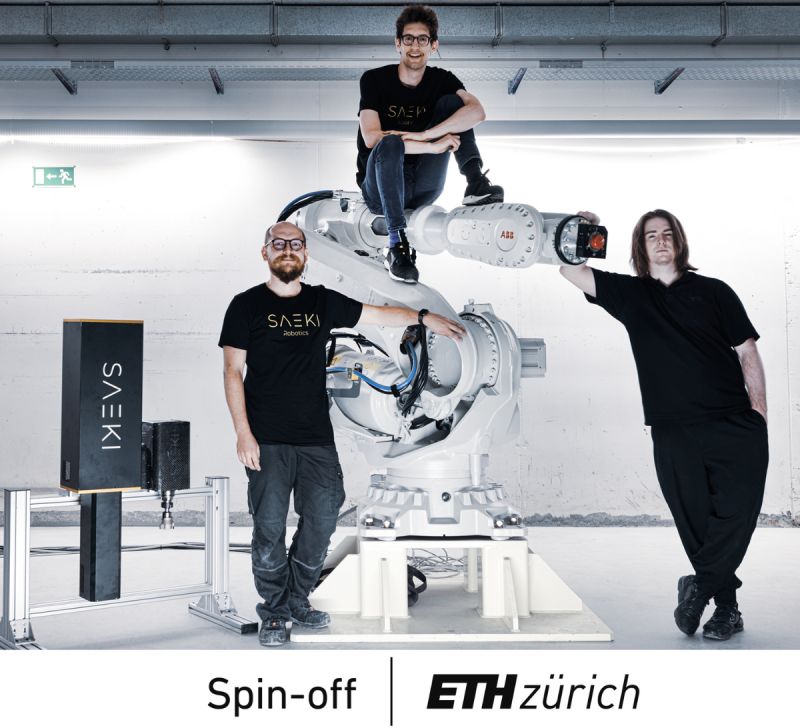
ETH Zurich spin-off. SAEKI founders: Oliver Harley, Matthias Leschok, and Andrea Perissinotto. Image courtesy of SAEKI.
What’s more, SAEKI recently raised $6.7 million in a seed round led by Swiss VC firm Lightbird, with support from VC firms Founderful and 2100VC, as well as industrial manufacturing company Danobat, along with several high-profile business angels.
“The company’s focus on large-format manufacturing is particularly timely, as sectors like aerospace and construction face increasing demand for complex, high-performance parts,” said Thomas Meier, Partner at Lightbird. “Global supply chains are under pressure, with rising costs and delays becoming the norm. We believe that SAEKI’s ability to deliver high-quality components quickly and reliably sets a new standard for the industry.”
The investment will accelerate SAEKI’s development of autonomous factories that integrate quoting, 3D printing, machining, and inspection into a seamless process.
“We share SAEKI’s vision of European dynamism and strengthening Switzerland’s manufacturing position,” concluded Alex Stöckl, Partner at Founderful. “Their interdisciplinary team has shown remarkable progress, demonstrating the potential to reshape industrial production.”
With this latest round of funding, SAEKI is set to expand its capabilities, refine its autonomous factory model, and bring European manufacturing into the future, one high-tech part at a time.
Subscribe to Our Email Newsletter
Stay up-to-date on all the latest news from the 3D printing industry and receive information and offers from third party vendors.
Print Services
Upload your 3D Models and get them printed quickly and efficiently.













You May Also Like
The Money Behind AM: What to Watch at AM Investment Strategies 2026
For years, simply being a 3D printing company could attract attention from investors. New machines, new materials, faster speeds, and the promise of mass production were often enough to get...
Metal AM in a Multipolar World: Resilience, Regional Production and a Changing Market
Technology develops in response to forces driving change. That was the starting point for a keynote I presented with Mikael Schuisky at AM Meetup 2026, held in Karlstad, Sweden, on...
EOS Bets on Mexico’s AM Market with Axiomatek Sales Channel Deal
Mexico is one of the biggest beneficiaries of the push to diversify manufacturing out of China. This development is perhaps inevitable given the current global trade environment, but even with...
3D Printing Market Hits $4.48B After Six Straight Quarters of Growth
The additive manufacturing market continued to grow in the second quarter of 2026, adding another quarter to what is becoming a much more consistent expansion for the industry. Worldwide revenue...