
Solideon and LEAP 71 Partner to Advance Space 3D Printing with WAAM Machine

The space industry has dramatically changed its game, becoming a leader in technological innovation. 3D printing has played a key role in transforming how some space hardware components are made. For decades, the sector relied on traditional manufacturing methods only. However, the entry of trailblazers like SpaceX helped to bring the advent of a new age when 3D printing could live up to a lot of the hype, highlighting the benefits of 3D printing to reduce costs, streamline production, and allow the creation of complex structures that weren’t possible before. This change made many companies in the space sector take a second look at 3D printing, leading to an increase in its adoption across various parts of the space manufacturing chain or even the whole of their production processes—like Relativity Space.
Keeping up with the trend, space tech firm Solideon has teamed up with LEAP 71, a Dubai-based developer of AI-based engineering technology, to build large-scale 3D printed metal structures for space. This partnership is about pushing the boundaries of what’s possible, aiming to produce massive components needed for future space missions. By combining Solideon’s expertise in robotic 3D printing with LEAP 71’s advanced computational models, the duo plans to revolutionize the manufacturing of space infrastructure, from large rocket propulsion systems to components for infrastructure in space habitats. Regardless, this collaboration is not just about building bigger but smarter, using the latest in AI to design and create structures that could one day support life beyond Earth.
“Access to space will expand significantly in the coming years. But how do we build the large components that will be needed to create extraterrestrial infrastructure? LEAP 71’s computational models can design sophisticated space hardware. However, limitations of the current manufacturing processes, including the small build volumes of most industrial 3D printers, are holding us back. Solideon will help us produce objects that are enormous by today’s standards,” says Josefine Lissner, Founder and CEO of LEAP 71.
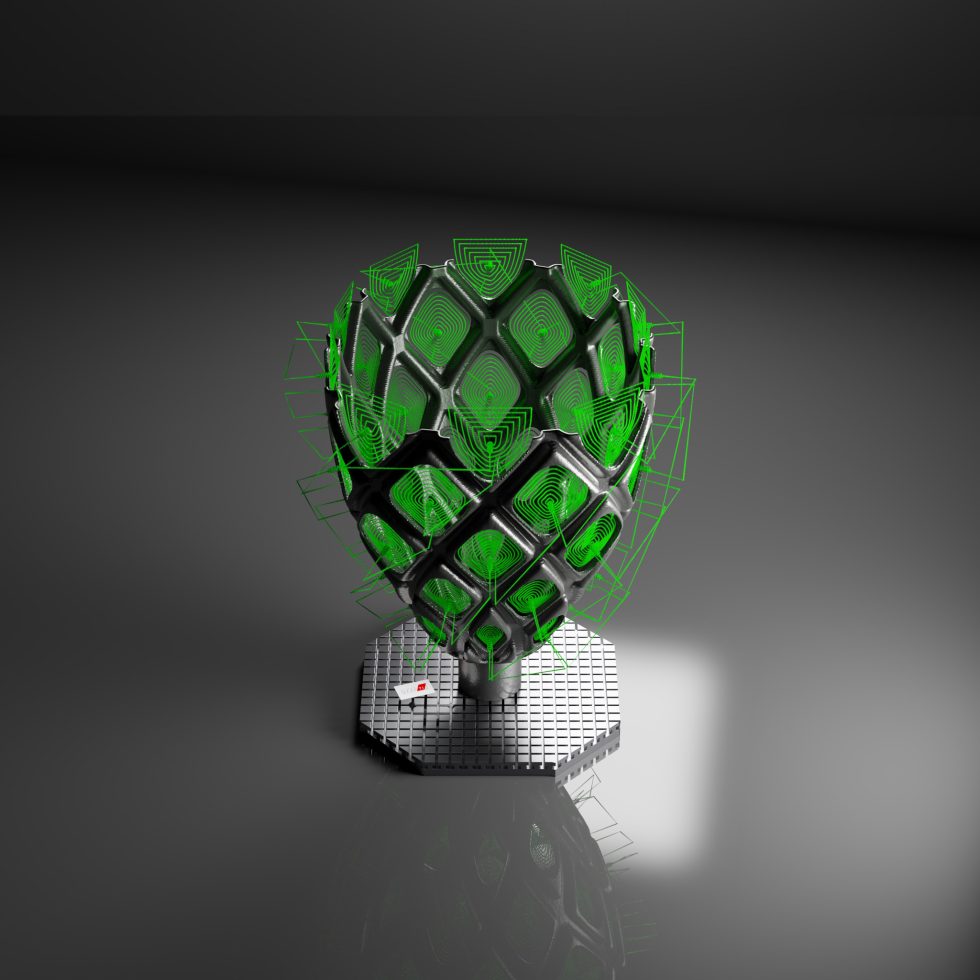
Solideon and Leap 71 to create large space parts. Image courtesy of Solideon.
In fact, Solideon’s robotic system, Aperture, integrates multiple manufacturing steps, including wire-arc 3D printing, CNC milling, and subcomponent assembly. This machine uses smart algorithms to build parts that have different materials blended smoothly in one piece, a technique called “algorithmic gradient material design.” Aperture is designed to produce materials that are tailor-made for their specific functions, representing a significant improvement in manufacturing, particularly for space missions.
The company says it’s advancing in developing a proprietary multi-metal Wire Arc Additive Manufacturing (WAAM) process, improving the capacity to achieve previously unimaginable mechanical properties for better performance. For instance, the system can start with Inconel, a material that’s good at handling high temperatures, at the outer edges of a part where the most heat is. Then, as it builds toward the less exposed areas, it gradually switches to lighter materials like Aluminum or Titanium, which are strong but don’t need to withstand as much heat. This seamless transition between different materials in a single component can lead to parts that are not only lighter but also tailored to handle stress exactly where it’s needed.
Moreover, Aperture has an impressive build capacity of 2.5 meters tall and 4 meters in diameter, targeting a deposition rate of up to 15 kilograms per hour. Its vertically integrated manufacturing process shortens the time from design to production, allowing products to be delivered within hours or days of the initial design. Additionally, Solideon’s tooling-free approach and advancements in in-space propulsion and sustainable space launch methods significantly reduce costs.

It’s easy to see why Solideon’s Aperture is such an interesting machine for manufacturing space parts. The co-founder, Oluseun Taiwo, has plenty of experience in additive manufacturing. Before founding Solideon in 2022, Taiwo worked with leading companies in the field, including the 3D Systems’ Application Innovation group, and as an AM engineer at the now-defunct Virgin Orbit, Arconic, and Rocket Lab. From this background, it’s clear that Taiwo will end up creating the next space, AM technology.
Along with LEAP 71, Solideon will work to build metal structures that could one day enable off-planet production. LEAP 71 and Solideon have been collaborating for the past year to interface between LEAP 71’s proprietary computational engineering models (CEM), which are generative frameworks for building sophisticated physical objects, and Solideon’s Aperture. The computational models developed by LEAP 71 generate geometric data and process input for all the separate steps, taking the capabilities and constraints of each production method into account.
Taiwo concludes: “A spacefaring society needs new production technologies that surpass conventional terrestrial approaches. The Aperture system combines many steps into one cohesive, autonomous, and collaborative whole. We can now manufacture large-scale objects on Earth and eventually will do so in zero gravity. By tightly integrating the engineering algorithms created by LEAP 71 with our software-driven production system, we can build objects that move space technology to a new level.”
Subscribe to Our Email Newsletter
Stay up-to-date on all the latest news from the 3D printing industry and receive information and offers from third party vendors.
Print Services
Upload your 3D Models and get them printed quickly and efficiently.













You May Also Like
Stratasys vs. Bambu Lab: What’s Really Behind the $27.6M Patent Verdict?
Editor’s note: This is Part 1 of a two-part series by Xu Fanglei examining the technology and patent issues behind the Stratasys-Bambu Lab dispute. Part 1 looks at the U.S....
Bambu Lab and SUSAN FANG 3D Print for London Fashion Week
At London Fashion Week, some of the more unusual pieces on the runway came from 3D printers. Chinese fashion designer SUSAN FANG presented her Spring/Summer 2027 Air-Illusion collection at the...
3D Printing News Briefs, September 26, 2026: Bioceramic Implants, 3D Concrete Printing, & More
In this weekend’s 3D Printing News Briefs, we’ll start with an integration between PanOptimization and AMCM, before moving on to healthcare news from KLS Martin and Lithoz, and then UltiMaker...
Bambu Lab Moves Beyond 3D Printing with R1 Laser Cutter
Bambu Lab has gone from one X1 printer, which did very well, to entry-level A1 systems, mid-market P2S systems, and larger H3Ds and more. They’ve also made systems that couple...























































