NGen Announces $100M to Boost Sustainability in Canadian Manufacturing


NGen, the non-profit behind Canada’s Global Innovation Cluster for Advanced Manufacturing, has announced a new project call dedicated to improving the ecological sustainability of Canadian manufacturing. Dubbed the Sustainable Manufacturing Challenge, the program will see NGen invest $35 million, matched by over $65 million from industry, to accelerate the adoption of Canadian clean and advanced technologies.
The program is meant to support the nation’s goal of achieving net-zero greenhouse gas emissions through such methods as reducing energy usage and natural resource consumption, increasing operational efficiency, cutting waste, using recycled and sustainable materials, improving product life cycle management and closed loop manufacturing, and cultivating circular materials production. Focus areas for applications should be dedicated to the following:
- Low carbon – fuel, feedstock, energy – applied to manufacturing.
- Implementation of net-zero facilities.
- Innovative solutions for high heat generation – applied to manufacturing.
- Carbon Capture, Utilization, and Storage – applied to manufacturing.
- Tracking and managing GHG emissions across the supply chain.
- Smart Manufacturing for efficiency gains and GHG reduction.
- Greener/circular/sustainable materials.
- Other – contact smc@ngen.ca to validate eligibility.
“Advanced manufacturing offers many of the solutions necessary to achieve Canada’s emission reduction goals,” said Jayson Myers, CEO, NGen. “NGen is looking to combine our tremendous strengths in cleantech, automation, advanced materials and smart digital technologies to develop solutions for sustainable manufacturing that will benefit Canada and the world.”
If any or all of this sounds like additive manufacturing (AM) to you, then you’re an avid reader of 3DPrint.com. We’ve been covering the opportunities for 3D printing companies in government-backed initiatives such as this for several years now. What makes AM so ideal for these sorts of projects is the fact that it can improve the operational efficiency of most systems while also reducing energy and resource inputs. In some cases, it can do so with recycled feedstocks. In other words, it meets most of the criteria mentioned by the NGen project call.
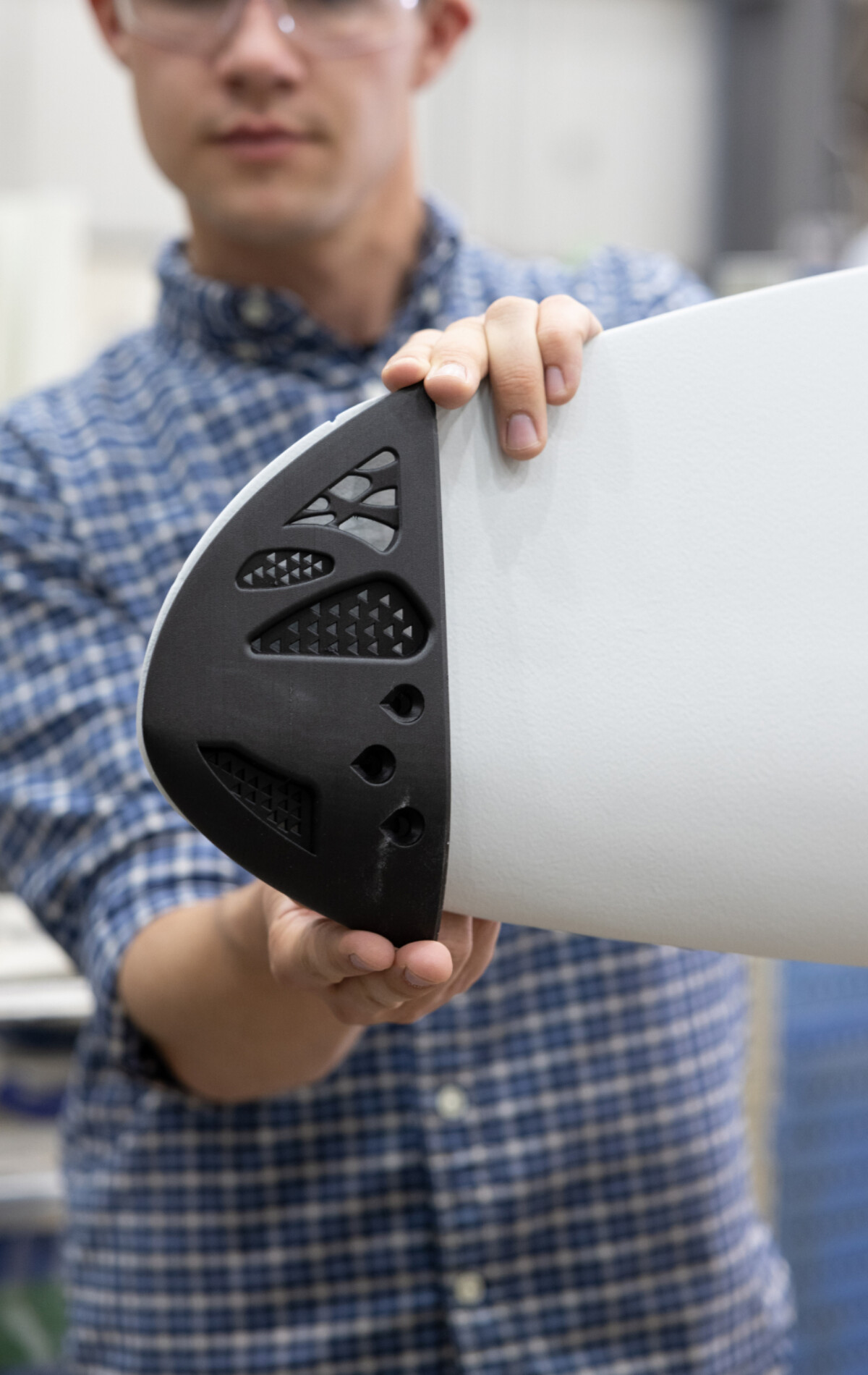
Composite prototype of lightning tip receptor for wind turbine blades to reduce lightning strike damage. Image courtesy of Markforged.
Despite market fragmentation, the U.S. 3D printing ecosystem is comparatively robust. Though Canadian manufacturers can turn to providers from outside of the country, Canada’s domestic AM landscape is less fully developed. At the same time, the nation’s natural resources set Canada up to be an ideal location for an advanced manufacturing revolution.
The country is experiencing an oil and gas boom that will likely serve as a key source for fuel in the near- and mid-term, as the world shifts to renewables. As discussed in other articles, this transition won’t be an abrupt one but will likely require buy-in from fossil fuel companies who, despite the valid concerns of environmentalists, essentially maintain the global economy.
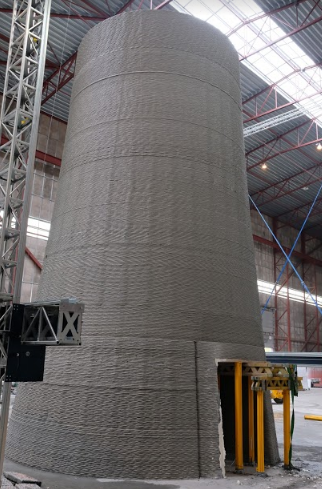
A 3D printed concrete wind turbine base made using the BOD 2 3D printer for GE. Image courtesy of COBOD.
For that reason, it is necessary for AM projects to help improve the overall efficiency of oil and gas operations in such a way that those same benefits can be ported over to renewable energy projects. Efficiency gains in running any energy system will ultimately reduce the impact of human activity on its ecosystem regardless of what input is fueling that activity. This is why the carbon credit contracts for difference that Canada recently enacted could be essential to funding such a transition.
With all of that in mind, the boom that Canada is experiencing otherwise could also be a boon for advanced manufacturing in the country. Going forward, there is a real opportunity for Canada’s Global Innovation Clusters to cross-pollinate not just with each other but the growing number of similar clusters appearing around the globe. To learn more about the project call, including key dates and deadlines, eligibility criteria, and program scope, visit the dedicated NGen program page. You can also contact NGen at smc@ngen.ca.
Subscribe to Our Email Newsletter
Stay up-to-date on all the latest news from the 3D printing industry and receive information and offers from third party vendors.
Print Services
Upload your 3D Models and get them printed quickly and efficiently.













You May Also Like
50,000 Orders and Counting: EPlus3D & Chinese AM Services Provider Are Scaling Liquid Cooling Solutions for AI Servers
An under-appreciated story driving the additive manufacturing (AM) industry this year has been the divergence between what’s driving the market in China and what’s driving it everywhere else. Let’s start...
Seven Trends Reveal What’s Next for 3D Printing at TCT Shenzhen 2026
TCT Shenzhen 2026 opened on October 14 in Hall 15 of the Shenzhen World Exhibition & Convention Center in Bao’an, and ran through October 16. The event brought together equipment...
With Increased Aerospace & Defense Focus, CORE Industrial Partners Buys More Manufacturing Firms
Private equity’s march into manufacturing continues with CORE Industrial Partners’ latest acquisitions. CORE purchased Fathom a few years ago, and later bought 3DXTECH LLC, Triton 3D LLC, and Gearbox3D. It...
Can India’s AM Push Help Make it a Viable Supplement to China?
Diversifying manufacturing supply chains to locales outside of China has nothing to do with actually cultivating “substitutes” to the Chinese economy. The real stakes are these: China is an irreplaceable...