3D Printing Leaders Team with Rivelin for Robotic Metals Post-processing


UK-based Rivelin Robotics is working on creating a manufacturing cell to automate the post-processing of metal 3D printed parts. If successful, this approach could reduce the costs of metal 3D printed components and decrease the labor required to finish parts. Now, the firm has received additional funding for this project from the UK Research and Innovation’s MSI Challenge, distributed by Innovate UK, the Engineering and Physical Sciences Research Council, and the Economic and Social Research Council. The funding is for the designated Project Certified Additive Manufactured Parts Finished with Intelligent Robotics Engine (CAMPFIRE). In total, £3.7 million were distributed, but the specific amount awarded to Rivelin Robotics for the project is not disclosed.
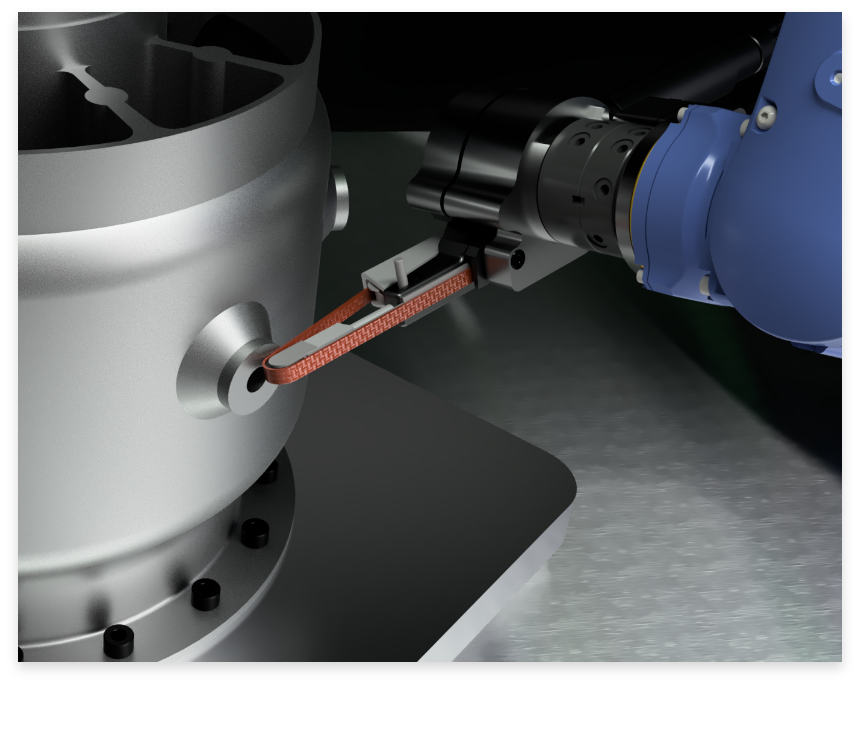 Rivelin Robotics will collaborate with GKN Aerospace, Siemens Energy’s 3D printing service Materials Solutions, patient-specific implant manufacturer Attenborough Medical, robot arm company Yaskawa, and materials giant Saint-Gobain in this project. Rivelin’s Netshape robots will be rigorously tested for use in medical, aerospace, automotive, and defense manufacturing. The key challenge is to determine whether the robots can finish parts to the strict tolerances and requirements demanded by these industries.
“The support from Innovate UK has been pivotal in accelerating Rivelin Robotics’ journey. The funding not only catalyses the development of our innovative platform, but also empowers us to tackle complex challenges in additive manufacturing. This grant is a key enabler in our mission to revolutionise robotic finishing of near-net-shape parts, enhancing the UK’s position in advanced manufacturing,” said Rivelin Robotics CEO Robert Bush.
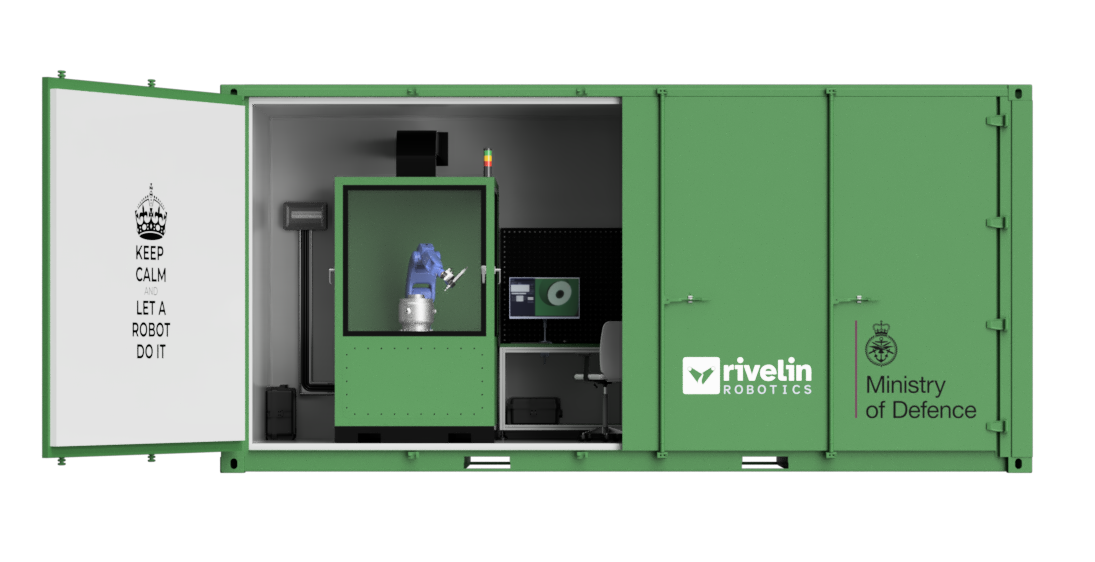 Rivelin Robotics currently has three robotic solutions: the NS0, designed for educational purposes; the NS1 production system, which can handle parts weighing up to 600kg and measuring 800mm x 650mm x 600mm; and the NS2, a dual robot unit. In metal components, finishing costs are significant. Parts may require multiple post-finishing steps, which sometimes can exceed the duration of the entire 3D printing process. Often, finishing must be performed manually using bandsaws or flexes, which is not only costly but can also lead to errors.
Automation could enhance reliability and repeatability in lengthy, repeated parts finishing processes. While depowdering has seen automated solutions like Solukon machines, and parts can be placed into vibratory and other finishing machines, automation tools for build plate, part, and support removal are limited and scarcely used.
Rivelin’s approach combines 3D scanning, robotics, and various tools, which appears straightforward. However, integrating the positioning of the robot arm, the tool’s functioning, stability, and the part is challenging, particularly for complex components like turbine parts or implants. Yet, if Rivelin successfully implements this technology, it could significantly improve the throughput and yield of metal 3D printing.
It is encouraging to see the UK invest in addressing key bottlenecks in additive manufacturing. Recently, the UK government funded further research into Q5D, a robot cell-based solution for wire harness production. Both this and the projects by Rivelin Robotics cater to a mature 3D printing market and aim to automate labor-intensive processes. They share similar challenges in stability, toolpathing, and 3D scanning. It might be beneficial for the next UK Innovate project to focus on an innovation that could assist both startups.
Subscribe to Our Email Newsletter
Stay up-to-date on all the latest news from the 3D printing industry and receive information and offers from third party vendors.
Print Services
Upload your 3D Models and get them printed quickly and efficiently.












You May Also Like
NASA Selects Relativity Space for Mars Science Mission
NASA has selected Relativity Space as its commercial partner for a new Mars science mission scheduled for launch in 2028, giving another boost to one of the most well-known additive...
AM Asia Watch: China’s 3D Printing Boom Is Creating a New Class of Micro-Manufacturers
China’s additive manufacturing (AM) industry has spent years trying to reduce its reliance on foreign technology. In polymer 3D printing, domestic companies have already become major players. In metal AM,...
Excellent Desktop Injection Molding, Made in Italy by Robot Factory
I was captivated when I saw my first Robot Factory 3D printer. The robust, precise machine was built to last. And this was in an era of very flimsy, disposable,...
Divergent Declares that German 3D Printers are Superior, And Plans Massive LPBF Expansion
Divergent has announced a new version of its Laser Powder Bed Fusion (LPBF) printer and a new site. The company aims to do nothing short of “further accelerating its mission...