
Phase3D’s In-Situ Monitoring Lands $2.9M in Oversubscribed Round

The use of metal additive manufacturing (AM) for production at scale appears to be steadily increasing, as evidenced by recent announcements like EOS’s sale of 30 M4 ONYX systems to Beehive Industries. Beyond the near-term potential for added production capacity by experienced users like Beehive, the pace of this scale-up will depend on how quickly new users can effectively implement metal AM into their workflows.
That, in turn, will depend on the trajectory of a combination of other factors, some of which are workforce development, qualification of materials, and quality control. Phase3D, maker of the AM in-situ monitoring (ISM) device Fringe Inspection and provider of its associated software programs, has a solution that can help the AM industry address all three of those needs.
The Chicago-based startup just closed an oversubscribed, $2.9 million funding round, led by Quest Venture Partners of Palo Alto. Phase3D plans to use the funds to speed up its path to scaling Fringe Inspection, which uses structured light to identify potential failures as they emerge.
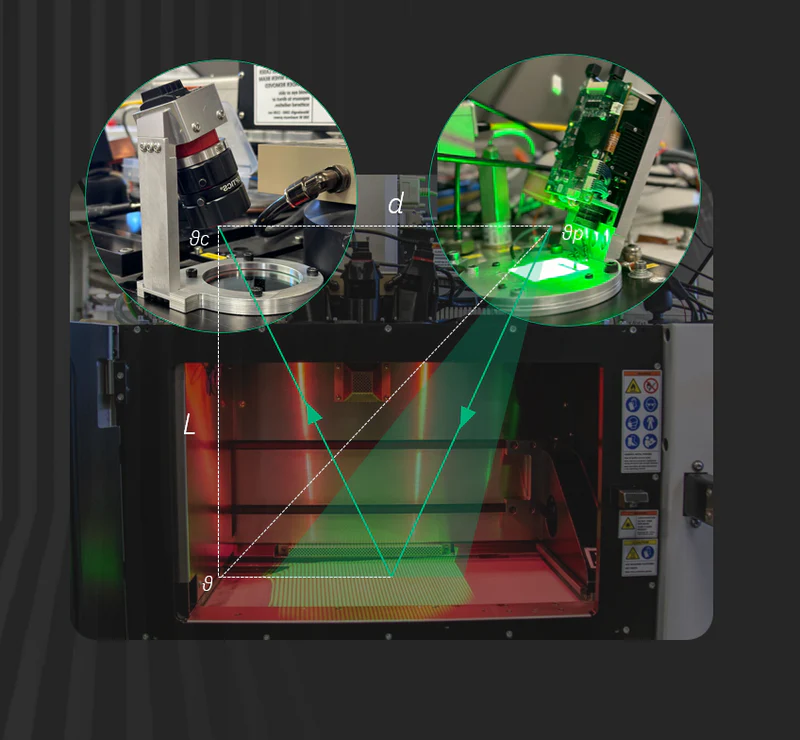
Phase3D’s Fringe Inspection system projects structured light onto a build surface to measure geometry and detect deviations during printing.
Fringe Inspection’s viability for widespread adoption is enhanced by the fact that it plugs directly into the printer and works with most industrial-scale metal machines, including PBF, MBJ, and cold spray. Additionally, Phase3D’s work with US military branches, including the US Air Force and the US Navy, as well as NASA, means it has been qualified for the same processes driving the current phase of the metal AM scale-up.
In a press release about Phase3D’s oversubscribed, $2.9 million funding round, the founder and CEO of Phase3D, Niall O’Dowd, said, “We are excited to announce Phase3D’s completion of a pivotal funding round. We have raised capital to support the continued growth and increasing deployments of our flagship quality inspection product for metal 3D printing. This investment will catalyze faster adoption of real-time quality inspection for [AM], and we are very excited for the future.”
Ray Farrell, incoming board member for Phase3D, said, “When the Phase3D opportunity came up, what stood out was the early customer traction. It’s special to have aerospace and automotive prime customers while simultaneously addressing top-level initiatives from the Air Force, Navy, and NASA.”
It’s self-explanatory how Fringe Inspection can help the AM industry with quality control, and enhanced quality control helps with materials qualification by improving the repeatability and reliability of a given manufacturing process. So how can it help with workforce development?
It’s expensive to train and staff workers in quality control processes, and when those processes move slowly, it becomes more difficult to deliver the parts that generate revenue to justify the expenses, including workforce development. That contributes to limiting industry investment, which, in turn, slows workforce development.
On the other hand, if a standardized device makes quality control both easier and cheaper, it also makes it easier and cheaper to train the workers needed for that part of the manufacturing process. Also, the fewer workers needed for the quality control stage, the more workers that can be trained to operate the printers themselves, which is the biggest personnel bottleneck for the AM industry.
None of this is to suggest that Fringe Inspection or improved quality control is a magic bullet: the point is that as AM continues to mature, its scaling trajectory will be more and more determined by technologies currently seen as peripheral to the printing process. But many of those technologies will prove to have been ‘peripheral’ solely at lower levels of adoption.
Images courtesy of Phase3D
Subscribe to Our Email Newsletter
Stay up-to-date on all the latest news from the 3D printing industry and receive information and offers from third party vendors.
Print Services
Upload your 3D Models and get them printed quickly and efficiently.













You May Also Like
Prusa Core One L+: A Worthy Upgrade?
Disclosure: The Core One L+ was provided to me by Prusa3d free of charge for the purpose of this review. I have not received any other compensation. All opinions expressed...
Building Profiles in the Additive Print Services Market – Market Research Beyond AI Scraping
AM Research New market research: AM Research is building its new Additive Manufacturing Services Market 2.0 model. View the report and preorder here → In case you haven’t heard, at...
3D Printing Services Near $2.5B as AM Market Shifts Beyond Hardware
The additive manufacturing market may be growing again, but one of the more interesting numbers behind that recovery has little to do with selling 3D printers. AM services generated nearly...
Bambu Lab and SUSAN FANG 3D Print for London Fashion Week
At London Fashion Week, some of the more unusual pieces on the runway came from 3D printers. Chinese fashion designer SUSAN FANG presented her Spring/Summer 2027 Air-Illusion collection at the...
























































