Rensselaer Polytechnic Institute Student Team Creates ‘PiBot’ Paste 3D Printer

It came about as a class assignment for Francis Bitonti and Xuedi Chen’s vertical studio at the Architecture School of Rensselaer Polytechnic Institute, and the PiBot is pretty cool.
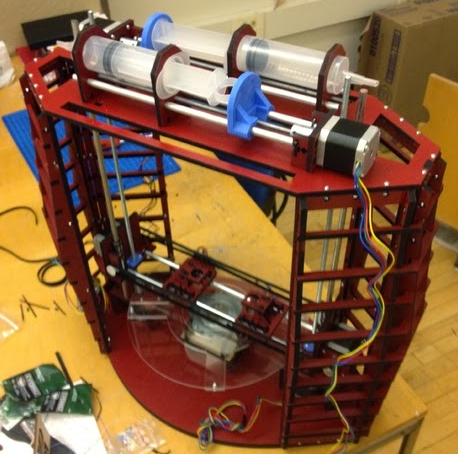 Bitonti, a renowned architect, designer and researcher, and Chen, a Brooklyn-based designer and educator whose work spans industrial design, architecture, fashion, robotics and installation, challenged the students to take on the build and design process for their version of a 3D printer.
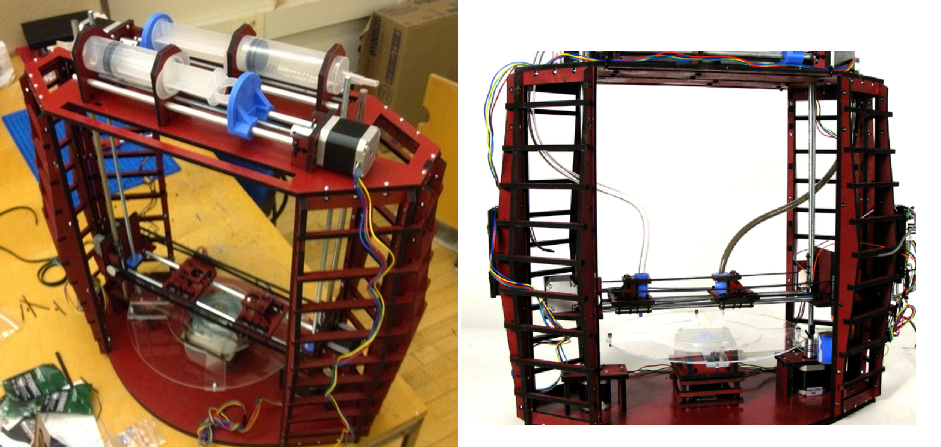
Students Nicholas Nord, Hiroki Sawai and Lauren Famularo were among the teams who took up the challenge from their instructors to build a paste extruding printer.Taking a Printrbot Simple Maker’s Edition unit and using the basic concepts behind that printer as their base to begin the work, they then looked to William Steele’s PiMaker for inspiration as well. What they came up with, the PiBot, is a flexible, dual extruder system which works in combination with a rotating, polar bed.
Their finished device allows them to print a single object with a combination of materials from a pair of extruders. As a bonus, the machine lets a user print two of the same object – at the same time – due to the rotating bed feature.

Nicholas Nord
The PiMaker 3D Printer they used as inspiration utilizes Printrboard electronics to drive a circular build plate and dispenses with the standard cartesian coordinate system used by most other 3D printers. It’s that design that gives the PiMaker a very large build volume in relation to it’s modest chassis size. The PiMaker features an 11″ build platform and an 8″ height, but the build volume amounts to more than 650 cubic inches.
Using all the standard firmware and software of the Printrbot (with the exception of a single post processor script that does the polar conversion) the PiMaker does it’s business via a C# (Mono) script.
The PiBot designed by the student team can, unlike the PiMaker, print with paste materials from it’s dual syringe extruders.If you want to make your own PiBot, you can download all the necessary design files here: https://www.thingiverse.com/thing:536108. Are you impressed with the PiBot student project? Let us know in the ‘PiBot’ Paste Printer forum thread on 3DPB.com. Check out the video below of the machine in action.
Subscribe to Our Email Newsletter
Stay up-to-date on all the latest news from the 3D printing industry and receive information and offers from third party vendors.
Print Services
Upload your 3D Models and get them printed quickly and efficiently.












You May Also Like
3D Printing News Briefs, July 2, 2025: Copper Alloys, Defense Manufacturing, & More
We’re starting off with metals in today’s 3D Printing News Briefs, as Farsoon has unveiled a large-scale AM solution for copper alloys, and Meltio used its wire-laser metal solution to...
Etsy Design Rule Change Reduces Selection of 3D Printed Goods
Online marketplace Etsy has implemented a rule change requiring all 3D printed goods on the site to be original designs. The update to the site’s Creativity Standards states, ¨Items produced using...
Siraya Tech Introduces New Elastomer 3D Printing Materials, Including Foaming TPU
California company Siraya Tech, founded in 2019 with a focus on material science, customer focus, and agility, develops high-quality 3D printing materials that meet the needs of creators, hobbyists, and...
3D Printing News Briefs, April 12, 2025: RAPID Roundup
The news from last week’s RAPID+TCT in Detroit just keeps on coming! That’s why today’s 3D Printing News Briefs is another RAPID Roundup of more exciting announcements from the trade...