Indian Billionaire Family 3D Prints Office in 40 Hours


Additive construction (AC) is exploding at what seems like an unexpected rate. A technology that once seemed like novelty is now being deployed for numerous tangible projects. One area of the world where that is most evident is India, where several companies, large and small, are pioneering the advancement of construction 3D printing in the nation and beyond. The latest legacy firm to showcase its move into AC is the Godrej Group, led by one of the richest families in India.
Godrej & Boyce, the flagship company of the Godrej Group, has jumped into the AC sector with the construction of a 3D printed concrete facility at Godrej Construction’s greenfield campus in Khalapur. Dubbed ‘The Cocoon’, to reflect its curved elliptical geometry, this 500 sq. ft. office structure was erected in a mere 40-hour timeframe using AC.
Crafting the 3D Printed Cocoon
The construction process encompassed a comprehensive range of tasks completed within the 40-hour window. This included the installation of 3D printed modules, civil works, waterproofing, flooring, painting, electrical and plumbing installations, and the fitting of office furniture and landscaping.
Anup Mathew, Senior Vice President and Business Head, Godrej Construction said, “‘The Cocoon’ is a manifestation of our relentless pursuit of pushing boundaries, not just in terms of architectural design, but also in redefining construction timelines. Construction of ‘The Cocoon’ is a good demonstration of an effective team collaboration integrated with good project planning using tools like Building Information Modeling (BIM), Lean Construction methods, and 3D Construction Printing.”
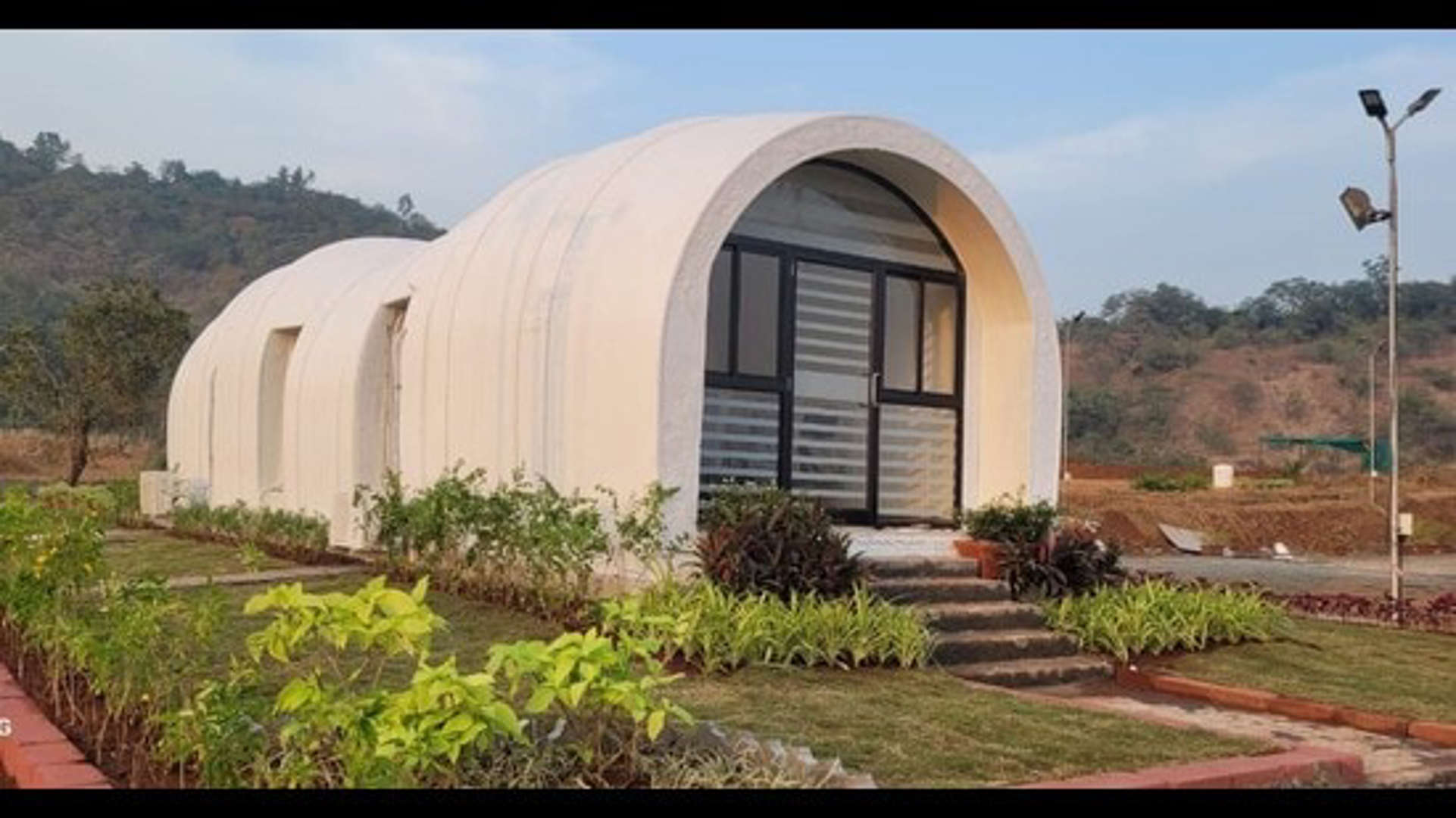
The curvilinear geometry of the office is not only meant to pleasing to the eye, but also demonstrates the flexibility of AC, as traditional construction techniques would have a difficult time achieving the same look. This particularly true since the layout is column-free, maximizing usable space. It also includes a prefabricated toilet unit, exemplifying the structure’s modular nature.
“We had the option of making it rectangular and build it with beams and columns, but it would have taken longer. So, we decided to make column-less structure with a curvature, and elliptical design which will look more aesthetic. 3D construction printing technology allows you to make complex designs,” said Abhijeet Gawde, Head of Business Development & Marketing at Godrej Construction.
Pursuing AC also falls in line with Godrej Construction’s strategy to make its field more sustainable, as the technology is meant to generate less waste overall due to the lack of concrete formworks necessary, among other things. In 2016, the business established a recycled concrete manufacturing plant.
“We have processed nearly 30,000 metric tonnes of construction debris so far. We manufacture and supply paver blocks, solid blocks, AAC blocks, box culverts using recycled concrete aggregates to real estate developers as well as infrastructure companies and projects,” Gawde said.
Gawde highlighted that the company has provided more than 450 box culverts, constructed with a mixture containing 10% recycled concrete aggregates, for major infrastructure developments. Additionally, the unit’s solid blocks and pavers have been key to the construction of the Mumbai Metro 2A and 7 lines.
In this case, the Cocoon was constructed using a concrete mix that includes up to 20% recycled concrete aggregates sourced from concrete debris recycled at the Godrej & Boyce facility in Vikhroli, Mumbai.
The Godrej Group and India’s Rising Status
The history of the Godrej Group dates back to 1897 with the sale of locks to address India’s rising crime at that time. Since then, it has evolved to become a US$4.1 billion conglomerate involved in real estate, consumer products, industrial engineering, appliances, furniture, security and agricultural products. The Godrej family now boasts $16.7 billion, making it one of the richest in India.
Just as AC has immense potential in developed nations, particularly the U.S., as they attempt to update infrastructure alongside sustainability initiatives, developing countries may be able to more quickly grow theirs in accordance with economic expansion. This is especially true for India, which is on track to becoming one of the world’s most powerful countries.
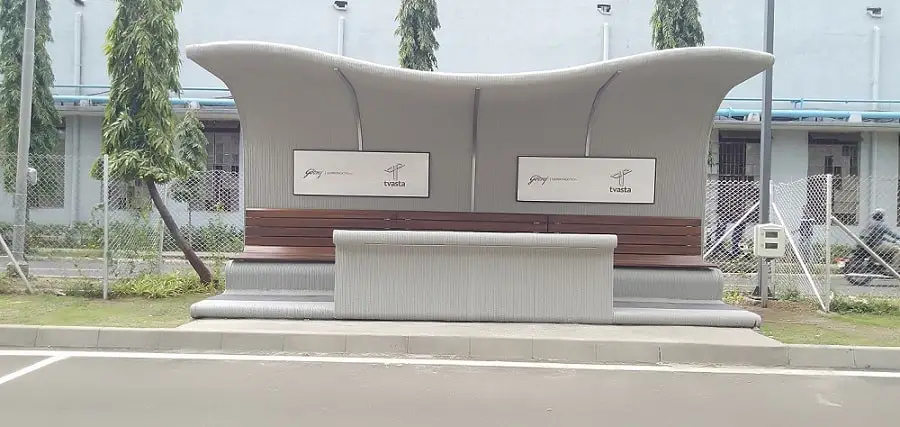
A bus shelter 3D printing by Godrej Construction and Tvasta.
From being the 11th largest economy in the world in the early 2000s, India became the 5th largest by 2019, overtaking the United Kingdom and France. In terms of AM, the country’s “Make in India” strategy seeks to carve out a five percent stake in the global AM market, with the aim of contributing nearly US$ 1 billion to India’s GDP by 2025. In turn, we’ve seen both established Indian conglomerates, such as ArcelorMittal, and 3D printing startups aim to tap this market.
Godrej Construction has been exploring AC for over two years with Indian construction 3D printing startup, Tvasta, making bus shelters and security pavilions that were erected at the Vikhroli campus. Given the importance of the group in India’s economy and the use of Godrej Construction in existing infrastructure projects, it wouldn’t be surprising for the business to deploy AC for future endeavors.
Subscribe to Our Email Newsletter
Stay up-to-date on all the latest news from the 3D printing industry and receive information and offers from third party vendors.
Print Services
Upload your 3D Models and get them printed quickly and efficiently.













You May Also Like
50,000 Orders and Counting: EPlus3D & Chinese AM Services Provider Are Scaling Liquid Cooling Solutions for AI Servers
An under-appreciated story driving the additive manufacturing (AM) industry this year has been the divergence between what’s driving the market in China and what’s driving it everywhere else. Let’s start...
Seven Trends Reveal What’s Next for 3D Printing at TCT Shenzhen 2026
TCT Shenzhen 2026 opened on October 14 in Hall 15 of the Shenzhen World Exhibition & Convention Center in Bao’an, and ran through October 16. The event brought together equipment...
With Increased Aerospace & Defense Focus, CORE Industrial Partners Buys More Manufacturing Firms
Private equity’s march into manufacturing continues with CORE Industrial Partners’ latest acquisitions. CORE purchased Fathom a few years ago, and later bought 3DXTECH LLC, Triton 3D LLC, and Gearbox3D. It...
Can India’s AM Push Help Make it a Viable Supplement to China?
Diversifying manufacturing supply chains to locales outside of China has nothing to do with actually cultivating “substitutes” to the Chinese economy. The real stakes are these: China is an irreplaceable...