1000Kelvin’s AI-Powered Autocorrect for 3D Printing Now Commercially Available

1000Kelvin, the US-Germany software as a service (SaaS) startup specializing in AI-powered solutions for additive manufacturing (AM), has announced the commercial launch of its signature AMAIZE platform at Formnext 2023 (November 7-10 in Frankfurt, Germany). AM sector heavyweight EOS is among the first two customers to integrate AMAIZE software into their operations.
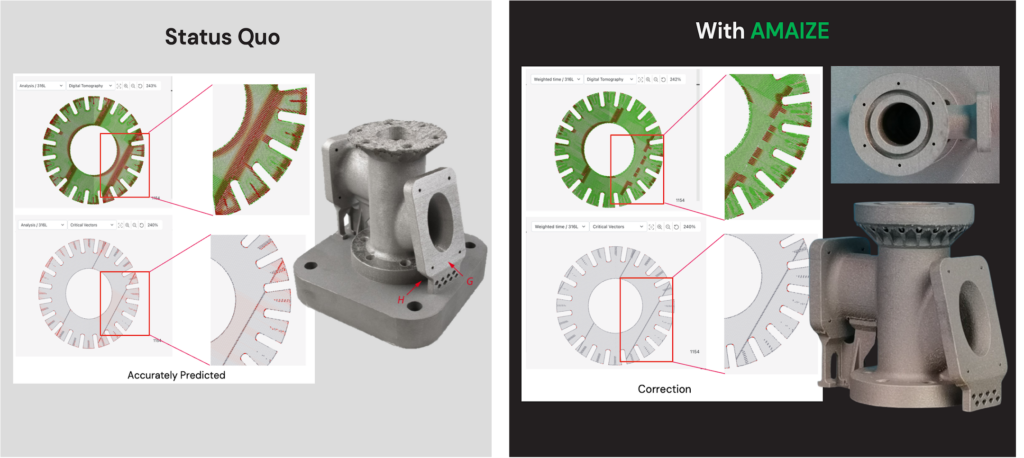
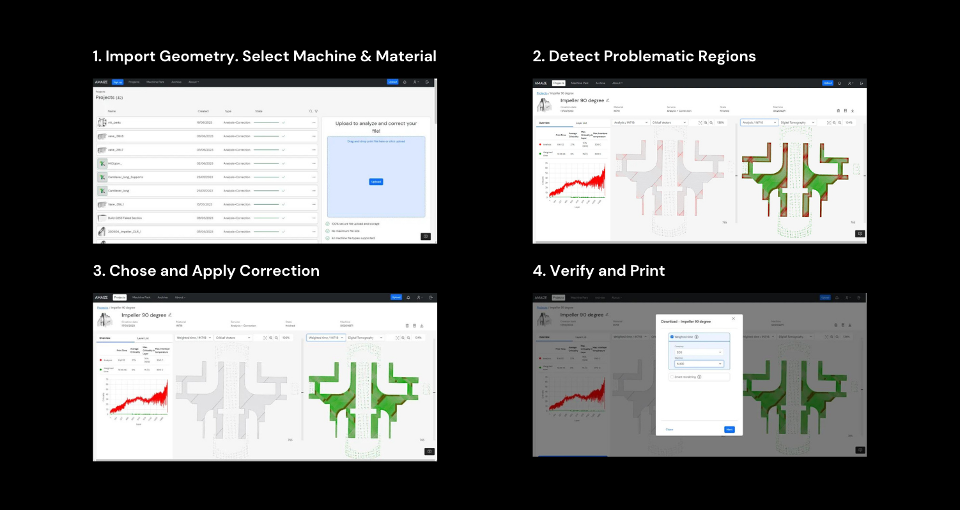
Utilizing AI informed by the laws of physics and feedback from manufacturing data, AMAIZE autocorrects print recipes to ensure the successful production of AM parts on the first try. Founded in 2021 by executives and AM experts from Siemens, 1000Kelvin has used its nearly $3 million in investments to expand from Berlin to Los Angeles, giving the company an optimal geographic foothold to serve its customers in the aerospace and space markets.
In a press release about the commercial launch of AMAIZE at Formnext 2023, Omar Fergani, Ph.D., 1000Kelvin’s CEO and co-founder, said, “The manufacturing and production sector accounts for one-fifth of global carbon emissions and 54% of the world’s energy usage. 3D printing has the unique ability to address these issues, but not until it works consistently. By improving the efficiency and reducing the waste associated with 3D printing, while making the technology easier to use, AMAIZE contributes to a more sustainable future.”
In addition to EOS, 1000Kelvin has also cited an unnamed rocket launch provider based in California as another early integrator of AMAIZE. According to 1000Kelvin, AMAIZE enabled the launch company to solve a thermal management problem related to printing one of its critical parts. AMAIZE yielded an 80 percent reduction in the support structures required to print the part, resulting in a cost savings of over 30 percent per part.
As the AM sector looks to increase new adopters, especially when it comes to metal platforms, one of the most important factors will be how quickly those new customers can see a return on investment (ROI) on their first machines. This is particularly challenging considering how relatively untested metal AM still generally is, combined with the inherently higher cost of both machines and materials.
Software is not a cure-all, but it could certainly make a significant contribution towards accelerating the path to ROI for new metal AM customers. Along those lines, this throws even more importance on the fact that 1000Kelvin counts companies like EOS among its initial customers.
Not only does the endorsement by those brands legitimize AMAIZE, but also, because of the popularity of EOS, 1000Kelvin has ensured the compatibility of its software with platforms that have a high likelihood of being the first machines owned by newcomers to metal AM. Again, software is not a magic bullet: but, on the other hand, the more high-value users that adopt AMAIZE, the faster that 1000Kelvin’s data will improve, putting the company in the best possible position to help the AM sector attract new generations of users.
Subscribe to Our Email Newsletter
Stay up-to-date on all the latest news from the 3D printing industry and receive information and offers from third party vendors.
Print Services
Upload your 3D Models and get them printed quickly and efficiently.













You May Also Like
The Money Behind AM: What to Watch at AM Investment Strategies 2026
For years, simply being a 3D printing company could attract attention from investors. New machines, new materials, faster speeds, and the promise of mass production were often enough to get...
3D Printed Football Helmets Are Amazing Business. They’re Also So Much More
NFL football is by far the most popular sport in the US, followed by college football (a state-of-affairs oddly similar to the fact that the world’s largest air force is...
Continuous Composites Wins Navy SBIR for 3D Printed UAVs
In a diversification effort, Continuous Composites has decided to seek work outside of the courtroom. The company that has been successful in defending its patent portfolio in composite 3D printing...
When Data Becomes the Differentiator: Qualified Material Data is Changing the Future of Structural Additive Manufacturing
For years, additive manufacturing has promised engineers greater design freedom. The challenge wasn’t printing the part—it was proving the part belonged on an aircraft. Designing a lightweight bracket or consolidating...