Detroit Is Home to Michigan’s First 3D Printed House

Michigan has welcomed its first 3D printed home, an unassuming avocado-colored, one-story structure situated in Detroit’s Islandview neighborhood. Led by the local nonprofit Citizen Robotics, the endeavor serves as a tangible demonstration of additive construction’s potential for Detroit’s urban landscape.
The project took shape four years ago when Evelyn Woodman was struck by the transformative potential of 3D printing in construction. Inspired by photographs of 3D printed homes from various corners of the world, she saw an opportunity for Detroit to be at the forefront of this technological wave. Drawing on the city’s rich automotive legacy, Woodman and her co-founder—who also happens to be her father, Tom— ingeniously repurposed a printer that had previously been used in automobile manufacturing.
“Once automotive companies have used them for nine years, they usually just throw them out,” says Woodman.
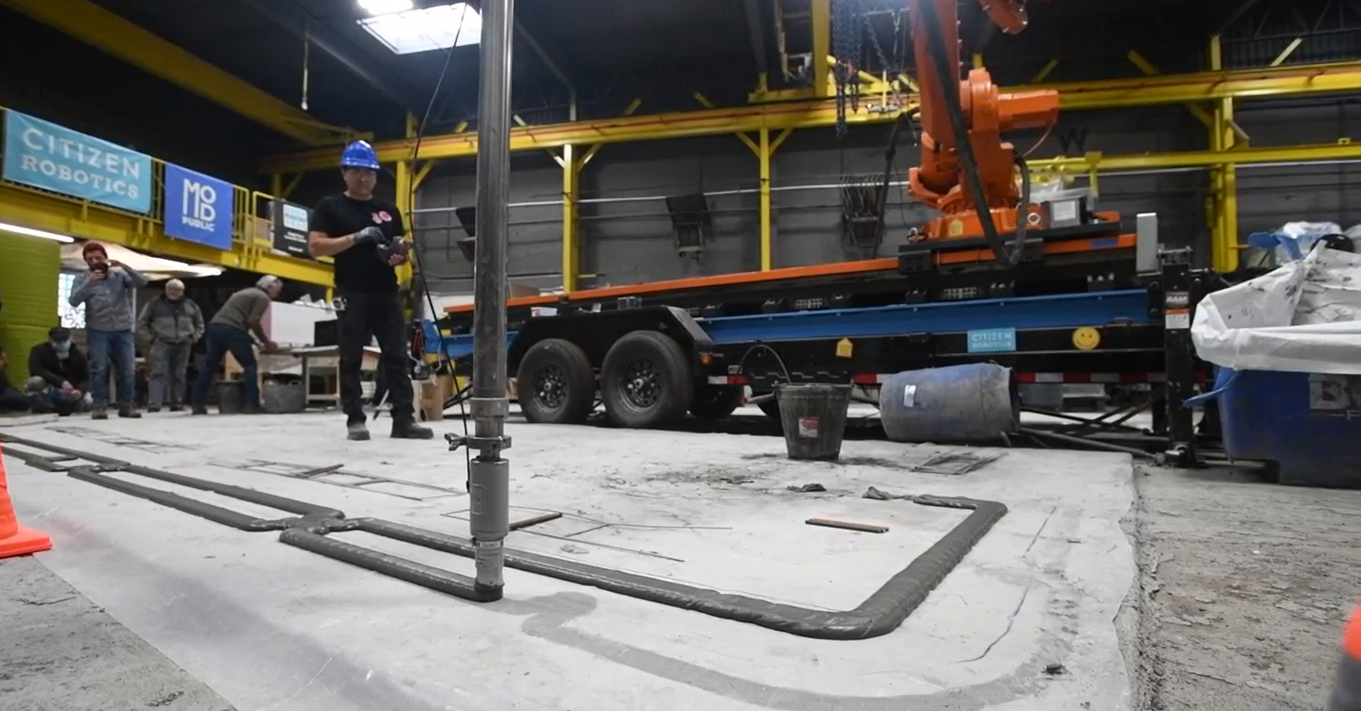
Citizen Robotics’ Upcycled Automotive Printer
The printer used in the construction of Michigan’s first 3D printed home works with a non-proprietary mortar mix and standard parts, a deliberate choice by Woodman and her team. They aim for each step of their construction process to be easily replicated by others, democratizing access to this technology.
Architect Bryan Cook of Develop Architecture was responsible for designing the home’s cottage-style aesthetic. One of the primary objectives for the design was to ensure that the house would seamlessly blend into the existing neighborhood. Cook felt that an overly avant-garde design would not serve as an effective introduction for Detroit residents to the potentials of 3D printing in construction.
Citizens Robotics took special care to design an accessible home featuring an open floor plan, specifically tailored to those with mobility challenges. The organization also emphasizes the home’s energy-efficient features, such as its “airtight” construction. This design advantage makes it easier to cool the home during hot summers and reduces heating expenses in winter.
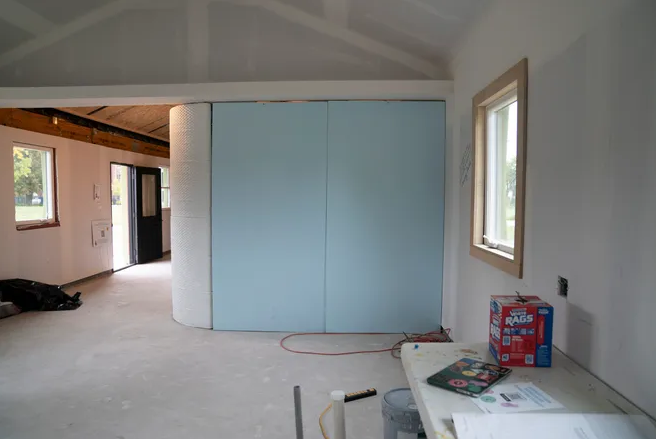
Interior of the 3D Printed Home – by Mandi Wright of the Detroit Free Press
Unlike the majority of projects in the additive construction space, Citizens Robotics chose to print the walls and structural supports of the home at their own production facility. Reinforced with a wooden frame and topped with foam panels for the roof, the structure was fully printed in a mere five days. It was then transported to the Islandview neighborhood for on-site assembly.
Despite the promise of 3D printed construction, the team candidly admits that, as of now, they haven’t been able to undercut the costs of traditional building methods. At the time the project was unveiled, it was believed it would cost about $230 per square foot to construct. The Michigan State Housing Development Authority also provided $160,000 in funding to cover the cost of construction materials. As the project moves forward, it will be fascinating to gauge its cost-effectiveness and the feasibility of replicating this model on a broader scale. Despite these financial challenges, the home is listed at $224,500—making it a more affordable option compared to other newly constructed homes in the area.
As 3D printing technology continues to mature, the mainstream integration of 3D printed homes will become increasingly common. Perhaps other pioneering builders and community advocates will find inspiration to repurpose industrial printers and offer new solutions to urban housing problems.
Subscribe to Our Email Newsletter
Stay up-to-date on all the latest news from the 3D printing industry and receive information and offers from third party vendors.
Print Services
Upload your 3D Models and get them printed quickly and efficiently.













You May Also Like
Foundation Alloy Raises $22M in Series A for Solid State Molybdenum
Foundation Alloy has just raised $22 million in Series A financing. The alloy company is trying to create a platform that will enable the solid state manufacturing of alloys. In...
Aerospace Giant IHI Bets on Freemelt E-Beam 3D Printing for Next-Gen Turbine Alloys
IHI Europe has purchased a Freemelt electron-beam powder-bed fusion (E-PBF) system. Previously, parent IHI bought two Freemelt systems, bringing the total to three. IHI is a Japanese engineering conglomerate. The...
Goldilocks’ Flywheel: Refractory Complex Concentrated Alloys (RCCAs) & The Race for the Future
Recently, Metalysis, Skyrora, and Thermo-Calc Solutions started to try to commercialize Tanbium. This alloy has been created for use in combustion chambers and rocket nozzles. Tanbium is a Refractory Complex...
3DPOD 236: AM Materials Science & Applications with Nick Sonnentag, Sunnyday Technologies & Oshkosh Corporation
Nick Sonnentag is a Senior Principal Engineer at Oshkosh, where he contributes to the development of some of the world’s toughest vehicles using additive manufacturing (AM). Drawing on experience from...