
3D Printed Electronics Market to Explode to $7.9B by 2033

According to the new “3D Printed Electronics 2023: Market Study & Forecast” report from Additive Manufacturing Research (“AMR,” formerly SmarTech Analysis), the 3D printed electronics sector is on the verge of a massive boom. With a 10-year compound annual growth rate (CAGR) of 37 percent, the additively manufactured electronics (AME) sector is expected to go from just $300 million in 2023 to a whopping $7.9 billion by 2033. While this may seem like a huge expansion, there are a number of reasons why it shouldn’t surprise those following the technology.
As it stands, there are only a handful of companies and organizations dedicated specifically to AMEs. AMR covers the following in its report, for instance: Ceradrop, Nano Dimension, NeoTech, Optomec, FujiFilm, Voltera, BotFactory, nScrypt, J.A.M.E.S., NextFlex, ChemCubed, PV Nanocell, Panasonic, additive electronics, nano3Dprint, and Notion Systems. However, as the worlds of traditional electronics manufacturing blends with 3D printing, this currently small segment will grow at a rapid pace.

Stretchable, wearable heater printed by a student using Voltera’s technology. Image courtesy of Voltera.
AMR estimates that, while the industry is consolidated around a small number of players and is expected to remain so in the near- to mid-term, the growth of low-cost AME providers is reducing barriers to entry. In turn, industrial AMEs represents 30 percent of the current market, but is expected to increase to 75 percent by 2033.
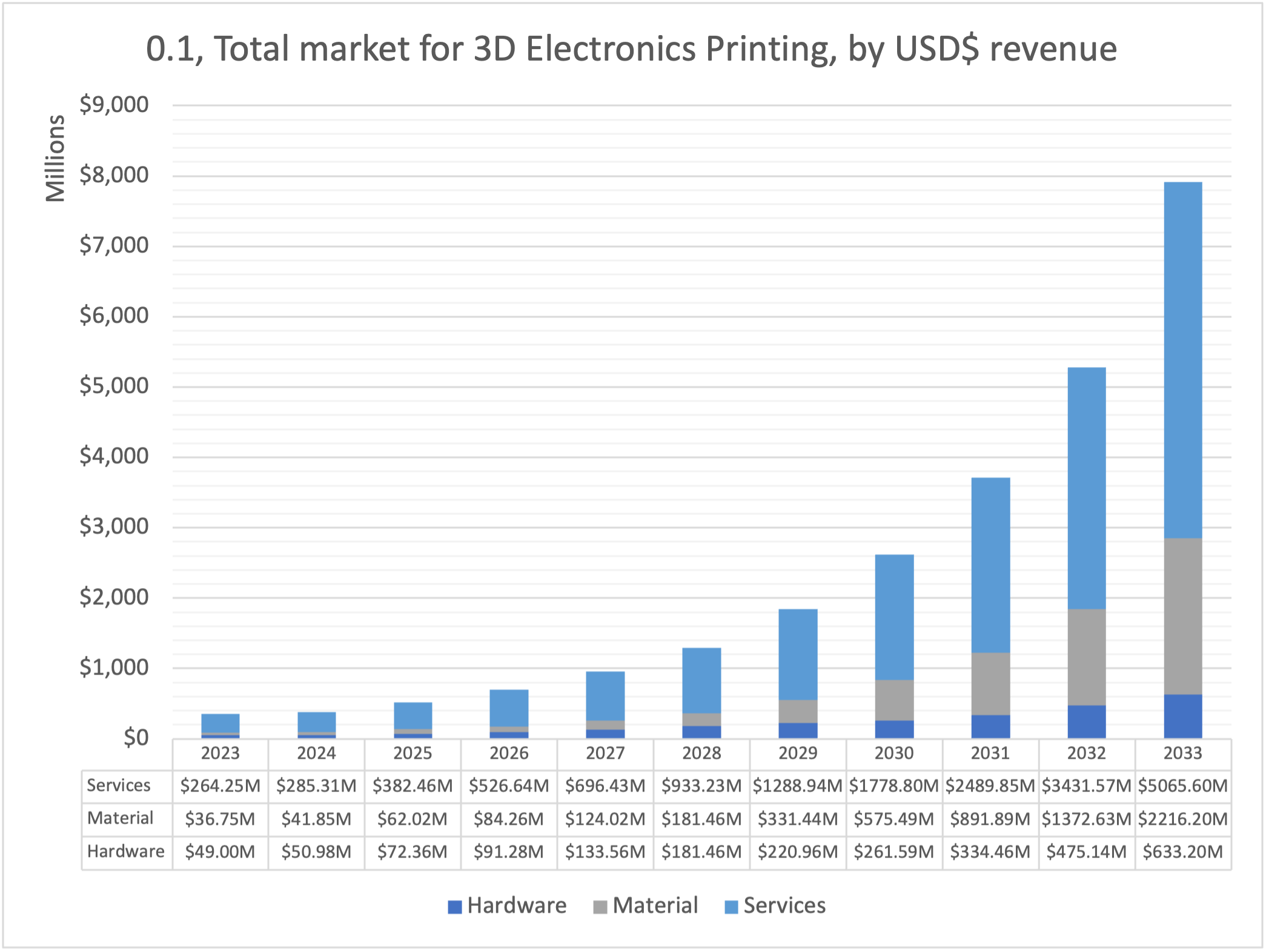
As the report points out, AMEs introduce crucial advantages to electronics production, such as miniaturization, design freedom, reshoring and localization, and sustainability. It’s no surprise then that companies as large as Apple, Meta, Google, and Samsung have adopted the use of Optomec for such applications as 3D printing antennas and stacked dies. At the very least, all of it would take now is for the technology to scale to large volume production. This is something that industry players are attempting to address in order to increase industry adoption, according to the AMR report.
With the CHIPS program now in full swing, the AME segment is about to get extremely exciting. The report details all of this, including value propositions for 3D printed electronics, the challenges to market growth, and the key players in the space, alongside detailed market data and forecasting. To learn more, visit the report page here. Also worth noting is that Additive Manufacturing Strategies event, hosted by 3DPrint.com and AMR, will have a dedicated panel on electronics 3D printing on February 7, 2024 in New York. Register for the event to take advantage of lower prices now.
Subscribe to Our Email Newsletter
Stay up-to-date on all the latest news from the 3D printing industry and receive information and offers from third party vendors.
Print Services
Upload your 3D Models and get them printed quickly and efficiently.













You May Also Like
How Should Businesses Build New Business? Dirk Simon Weighs In — Part 1
Dirk Simon had deep experience in materials and chemistry before joining the 3D printing industry. Instrumental in BASF and Farsoon’s market introduction, Dirk has spent a lot of time thinking...
The Frankenservice Part 2: Have Your Cake and Eat it Too
This series of articles delves into a thought experiment. What if we let go of using a few machines very optimally, but instead use lots of different machines to meet...
The Additive Chicken Coop, Part IV: Lemmings
If we look at our past, we can see how making custom machines, incessantly watching ourselves, and our inability to rescope shaped our industry. We have also looked at the...
The Additive Chicken Coop, Part III: Bananas
A friend of mine, Ed Davis, once pointed out the level of strategic replication in additive. I wasn’t aware of it before and haven’t been able to unsee it since....

























































