How Do You Safely Handle 3D Printing Resins? Ask PAMA


The Photopolymer Additive Manufacturing Alliance (PAMA), a collaborative effort between the National Institutes of Standards and Technology (NIST) and RadTech, has published a revised version of its guidance for photopolymers, titled the “Proper Handling of UV Curable 3D Printing Resins.” The updated release includes a new section dedicated to frequently asked questions (FAQs), aiming to promote enhanced health and safety practices within the 3D printing and additive manufacturing (AM) community.
“As new applications emerge, the continued communication of proper health and safety practices is vital to the 3d printing/additive manufacturing community,” says Mickey Fortune, Associate Executive Director, RadTech.
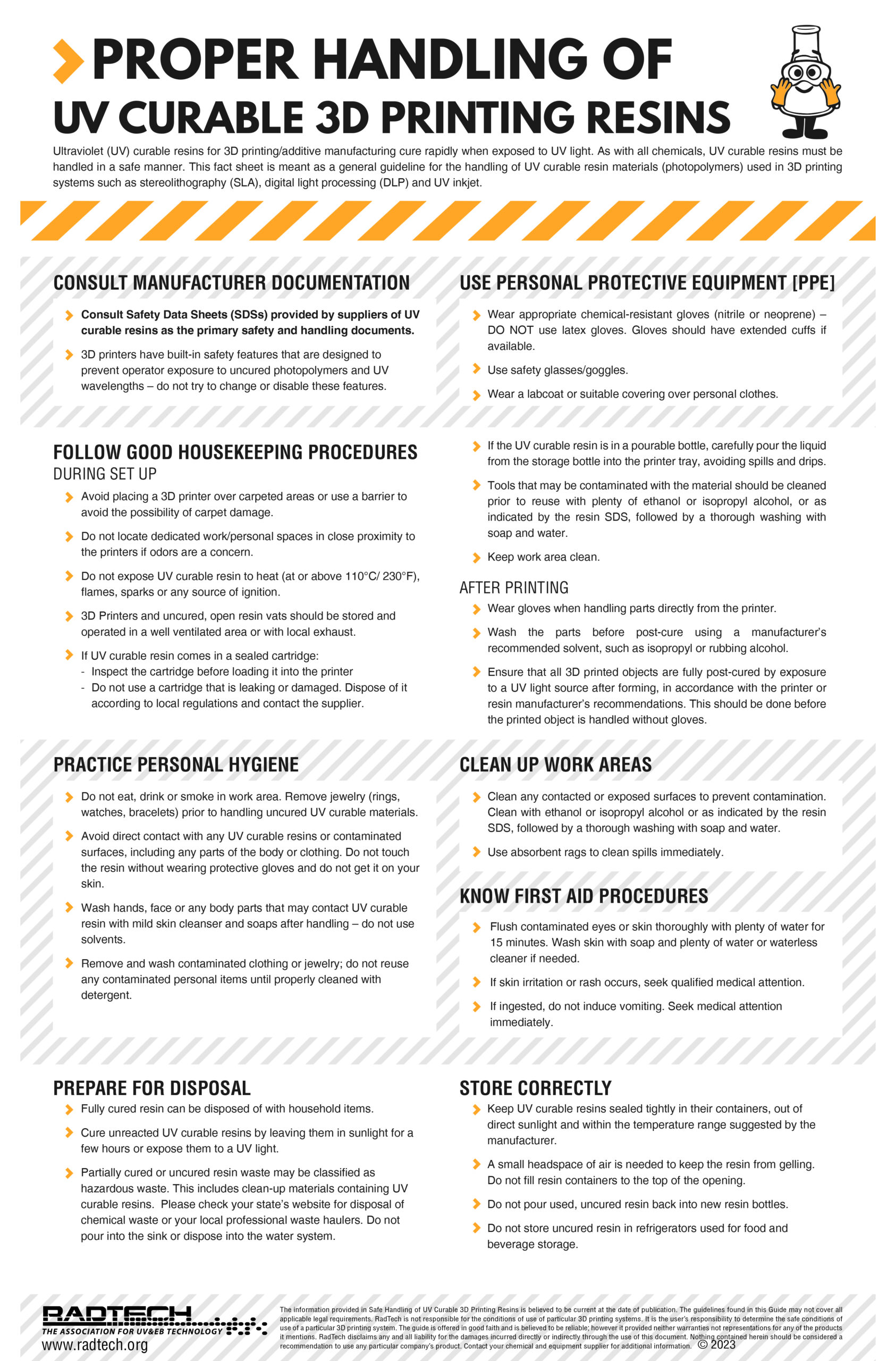
The PAMA resin safety poster, available for download. Image courtesy of PAMA.
One of the significant additions to the revised guidelines is a comprehensive FAQ section. This segment addresses common queries and concerns related to the handling of UV curable 3D printing resins, empowering users with a better understanding of best practices. Moreover, the updated guidelines also feature revised sections on Good Housekeeping procedures, Clean-up, Disposal, and Storage. By providing clear and practical instructions, PAMA aims to ensure safer practices are followed consistently across the industry. A convenient printable poster including all of the best practices is available for download, as well.
PAMA is attempting to advance industry terminology, practices, protocols, and standards. As part of this endeavor, PAMA is organizing a groundbreaking workshop titled “Building a Unified Vision from Research to Regulations.” This workshop follows the success of the NIST/RadTech event held in 2019, which brought together suppliers, users, academia, and government representatives.
Scheduled for September 18th-19th, 2023, the PAMA Workshop for photopolymer additive manufacturing will take place in Boulder, Colorado. The event presents an opportunity for stakeholders to engage in candid, pre-competitive conversations regarding the current state of photopolymer AM. Through a series of panel discussions, attendees will explore potential directions for future advancements in the field and collaborate on the development of updated, comprehensive roadmaps.
The workshop aims to foster innovation and cooperation while facilitating the establishment of industry-wide standards. Participants will benefit from a wealth of knowledge, enabling them to enhance their contributions to the photopolymer additive manufacturing industry. To support the dissemination of safety guidelines and promote the workshop, PAMA encourages interested parties to download the Proper Handling Poster and learn more about the event at www.pama3d.org.
Subscribe to Our Email Newsletter
Stay up-to-date on all the latest news from the 3D printing industry and receive information and offers from third party vendors.
Print Services
Upload your 3D Models and get them printed quickly and efficiently.













You May Also Like
3D Printing Financials: 3D Systems, Prodways, and Align Build on Positive Momentum
The latest earnings from 3D Systems (NYSE: DDD), Prodways (EPA: ALPWG), and Align Technology (Nasdaq: ALGN) show that the 3D printing market continues to move forward. Some businesses are growing...
3D Printing News Briefs, August 8, 2026: Seawall Funding, Defense Capabilities, Supports, & More
We’re starting with business in this weekend’s 3D Printing News Briefs, then moving on to defense. We’ll move on to young 3D printing entrepreneurs, and finish with some research out...
Walter Reed Gets Premarket Clearance to Make 3D Printed Point-of-Care Medical Devices
The Walter Reed National Military Medical Center’s 3-D Medical Application Center (3-D MAC) has received premarket clearance to make 3D printed medical devices. This is the first time that a...
Jeff Graves Seeks New 3D Systems CEO, The Company at a Crossroads
Jeff Graves is to step down as 3D Systems‘ CEO once a replacement has been found, the company has announced. He will then retire as CEO and as Director of...