First Washington D.C. Fly-in Signals National Importance of 3D Printing

As the industry’s sole U.S. lobbying group, the Additive Manufacturing Coalition has steadily built up a reputation as an important advocate for members of the 3D printing sector. Through regular webinars and roundtables with government representatives and industry stakeholders, the organization provides direct access to policymakers so that those in additive manufacturing (AM) are able to voice their interests, concerns, and ideas. Now, the Additive Manufacturing Coalition is taking its mission one step further with its inaugural AM Washington, D.C. Fly-In.
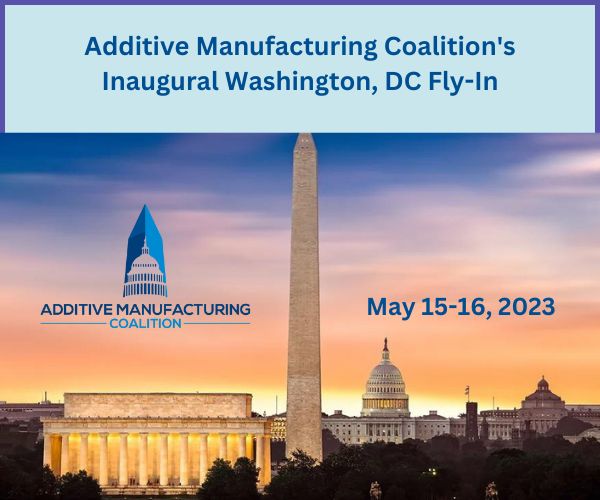
Taking place in D.C. from May 15-16, 2023, the event will allow Coalition members to meet with key decision-makers on Capitol Hill related to the Coalition’s priorities in the fiscal year 2024 budget process. The group will be raising awareness and educating Congress about the significance of AM, while highlighting key policies that the industry needs to thrive in the U.S.
The event will begin on May 15 with a training/workshop session on lobbying Congress and on legislative priorities, which will follow with a reception and group dinner. The following day, the group will meet for breakfast before meeting with key Congressional staff, including staff from each trip member’s home state.
The event comes at a time when spending by national governments are executing a variety of programs to support new modes of manufacturing. In particular, re-shoring and sustainable production are receiving widespread attention and funding as countries attempt to make their supply chains more resilient and less resource intensive.
In the U.S., this has come in the form of the CHIPS Act, Bipartisan Infrastructure Bill, AM Forward, and other moves that direct federal investments to qualifying businesses. Canada, Australia, and the E.U. have followed suit. In tandem, large corporations and municipal governments are also driving funds toward advanced manufacturing programs.
As a result, AM has been and will continue to be a large benefactor of these programs. However, for the industry to fully engage with decision-makers at the federal level, it’s important to be able to communicate needs directly. For this reason, the first AM DC Fly-in is a potentially crucial method for the 3D printing community to elevate its voice in Washington and improve understanding of the issues and the policy opportunities in the future.
As Mark Burnham, Director of Policy at the AM Coalition, put it to 3DPrint.com, “Everyone’s voice matters. Washington is often looked at as a ‘who you know’ type of business, but in many ways, it is a ‘who you get to know’ type.”
In addition to serving as a means of amplifying the AM community’s voice in D.C., the AM DC Fly-in will surely act as a great bonding experience for those involved.
Feature image courtesy of the Additive Manufacturing Coalition.
Subscribe to Our Email Newsletter
Stay up-to-date on all the latest news from the 3D printing industry and receive information and offers from third party vendors.
Print Services
Upload your 3D Models and get them printed quickly and efficiently.













You May Also Like
AM & National Competitive Advantage, Part One: the Real Problem with US Manufacturing
The problem with US manufacturing is the productivity growth rate. Depending on the source, US manufacturing productivity has either been flat or slightly declined since 2010. Before going any further...
Advanced Manufacturing at IMTS 2026: 3D Printing and AI and Drones, Oh My!
Last week’s International Manufacturing Technology Snow (IMTS) in Chicago welcomed over 90,000 attendees to the jungle that is McCormick Place. With over 1.17 million square feet of exhibit space, and...
Let the Games Begin! Xi Throws Down the Advanced Manufacturing Gauntlet
Sangmin Lee went to TCT Asia back in March and reported on the event for 3DPrint.com. He wrote two articles arguing that China’s AM industry looks “ready to scale.” This...
What 3D2GO Says About 3D Printing’s Growth in Southeast Asia
The Philippines offers an interesting case study in how 3D printing can develop in Southeast Asia, and Manila-based 3D2GO helps illustrate it. 3D printing in Southeast Asia doesn’t have to...