Online 3D Printing Service Sculpteo Announces New CEO

Sculpteo, BASF’s French 3D printing service, announced that the company’s new CEO is industrial designer Alexandre d’Orsetti. Promoted from in-house, d’Orsetti was previously the head of Sulpteo’s design studio for six years.
 D’Orsetti has taken over the leadership role from Clément Moreau, who, along with Eric Carreel, founded Sculpteo in 2009. The company was purchased in 2019 by the largest chemical producer in the world, BASF, which is also one of the leading providers of additive manufacturing (AM) materials. BASF acquired Sculpteo via BASF 3D Printing Solutions, a division of the German conglomerate that operates under the brand name Forward AM.
In a press release, Sculpteo’s new CEO said, “Even when distribution chains were slowed down or paralyzed in a crisis context like the Covid pandemic, 3D printing ensured the continuity of various production lines. The development of new materials with efficient mechanical properties, especially by BASF, are making it possible to target new industrial applications. …For a designer, it is exciting to see how these technologies are making it possible to rethink not only the shapes and design approach for parts, but also to revisit production and supply scenarios.”
Recently, Sculpteo also became part of HP’s Digital Manufacturing Network. The company has twelve HP Multi Jet Fusion (MJF) machines at its French headquarters — the largest such fleet in France. This, along with Sculpteo’s far-flung reach in international markets, puts the company in a favorable position to become a hub for emerging AM supply chains.
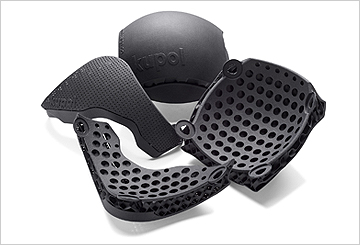
Kupol helmet parts made by Sculpteo with Multi Jet Fusion.
Regarding its role under the BASF umbrella, it is notable that Sculpteo filled the position with someone from within, and especially, someone who has worked for the company both before and after its acquisition by BASF. This suggests not only that Sculpteo’s continuity will be maintained under the reins of a new leader, but more broadly, that it has successfully maintained such continuity since its acquisition.
Over the next few years, as the AM sector enters a new phase in its history, we will probably see many more examples of companies passing the torch from founders and/or inaugural CEOs to the next generation of leaders in the industry. It will be interesting to see the patterns that could potentially materialize. For instance, with the present case in mind: to see which types of companies tend to elevate an existing employee, versus which types tend to recruit externally.
One isn’t necessarily better than the other. But paying attention to how it, along with other questions related to new corporate leadership, continues to unfold, may likely be one more variable that helps shed light on the 3D printing industry’s trajectory in the intermediate future.
Subscribe to Our Email Newsletter
Stay up-to-date on all the latest news from the 3D printing industry and receive information and offers from third party vendors.
Print Services
Upload your 3D Models and get them printed quickly and efficiently.













You May Also Like
3D Printing News Briefs, October 10, 2026: Drones, WAAM, Ceramics, & More
We have a packed 3D Printing News Briefs for you this weekend! First, America Makes celebrated the recent National Manufacturing Day with 3D printed drones, and then it’s on to...
10 Years of Multi Jet Fusion: Onsite at HP’s Vancouver, Washington Facility
At this year’s RAPID event in Boston, HP Additive Manufacturing Solutions celebrated ten years in the additive manufacturing (AM) market. The company ushered in the milestone with several innovations, including...
PharmaTher Plans U.S. Network to 3D Print Medicines on Demand
3D printing medicines has often been tied to the idea of personalization, basically making a pill in the right dose, shape, or drug combination for a patient. PharmaTher is now...
3D Printing News Briefs, September 17, 2026: 3D Printed Boat, UAS Development, & More
We’ll start with maritime manufacturing in this week’s 3D Printing News Briefs, and continue on to defense 3D printing. We’ll end with funding for Tripo AI. Read on for all...