UCLA Researchers Develop 3D Printed Pen that May Help Detect Parkinson’s Disease

Diagnosing Parkinson’s disease is difficult. Often, early symptoms of the progressive neurological condition may be overlooked, or mistaken for signs of aging. Early diagnosis can help save lives and improve treatment outcomes immeasurably. A team at UCLA Samueli School of Engineering has developed an inexpensive way to test for Parkinson’s. If it is cheaper than existing testing and turns out to be accurate, the test could perhaps be adopted widely, helping people get the treatment they need before the inexorable march of Parkinson’s has gone too far.
The test utilizes a 3D printed pen that essentially evaluates your handwriting. A team led by Associate Professor of Bioengineering Jun Chen developed the pen and published a paper about it in Nature Chemical Engineering. The ingenious pen uses a ferrofluid (combination of an oil and iron shavings) to track motions when writing, and also when moving from word to word. Rather than send away for tests, have to take blood samples, or worry about the cost of the test, the pen is meant to be a convenient, quick, and inexpensive way to test a person right in the doctor’s office.
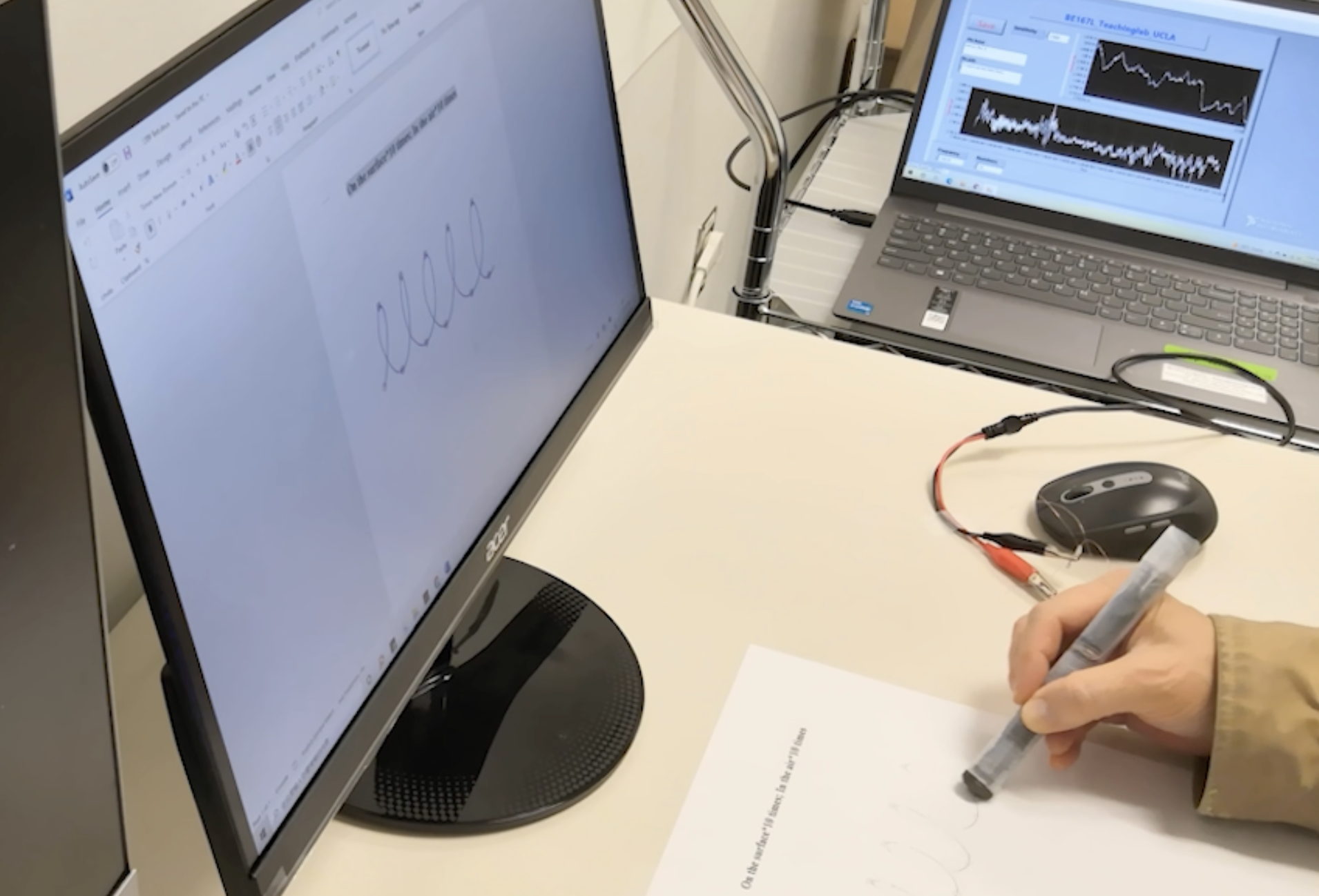
By tracking the motion of the ferrofluid and a magnetic coil in the pen, complete motions of the hand are able to be tracked in a very accurate way. A pilot study with 16 participants, where three had Parkinson’s, has shown that so far, the test is 96.22% accurate. Later, an AI model was used to compare their motions to known motions of people with Parkinson’s. The idea is that preliminary tremors or other typical movements will be present from a very early stage of the disease.
Chen said that,
“Detection of subtle motor symptoms unnoticeable to the naked eye is critical for early intervention in Parkinson’s disease, Our diagnostic pen presents an affordable, reliable and accessible tool that is sensitive enough to pick up subtle movements and can be used across large populations and in resource-limited areas.”
The pen doesn’t actually write, but using it in this instance is as easy as writing, with mock drawings or writing being enough. People could take around five minutes to do the test. In the tests, the patients drew spirals, circles, and letters on paper and in the air.

The research was paid for by the National Science Foundation (NSF), the American Heart Association, an NIH Grant, and rather surprisingly, the Office of Naval Research. The study was done by Guorui Chen, Trinny Tat, Yihao Zhou, Zhaoqi Duan, Junkai Zhang, Kamryn Scott, Xun Zhao, Zeyang Liu, Wei Wang, Song Li, and Katy A. Cross, as well as Chen.
In the US, 90,000 people get a Parkinson’s diagnosis every single year, and it is estimated that 1.2 million people will have the disease in five years. Parkinson’s is poorly understood; we don’t know for sure what causes it, and the disease has no cure. The disease is neurodegenerative and seems to take place in a particular part of the brain, the substantia nigra. Movement may become difficult, slow, or include tremors. Treatments aimed to reduce the impact of the disease and make life more livable are still expensive, and the economic burden may be as high as $52 billion.
By making it simple to test for the disease, this could be something that is painless, easy, and quick that millions will be asked to do. Perhaps it could be something that you could do, over a certain age, every time you wait for your general practitioner? That could make it a super effective test for the health system. Conceivably, you could use this test to look for more diseases as well. Or you could perhaps use it to look for reduced motor function or muscle mass. Something that is essentially a side catch on a doctor’s visit could then become a fast way to track many health indicators. I think that this is a great idea, and hope that more innovative devices will emerge that test patients inexpensively.
Subscribe to Our Email Newsletter
Stay up-to-date on all the latest news from the 3D printing industry and receive information and offers from third party vendors.
Print Services
Upload your 3D Models and get them printed quickly and efficiently.













You May Also Like
Kickstarter is Testing the Next Wave of Desktop 3D Printing
3D printers are raising serious money again…on Kickstarter, that is. Over the last few months, a new group of 3D printer campaigns has attracted millions of dollars and thousands of...
Stratasys vs. Bambu Lab: What’s Really Behind the $27.6M Patent Verdict?
Editor’s note: This is Part 1 of a two-part series by Xu Fanglei examining the technology and patent issues behind the Stratasys-Bambu Lab dispute. Part 1 looks at the U.S....
Bambu Lab and SUSAN FANG 3D Print for London Fashion Week
At London Fashion Week, some of the more unusual pieces on the runway came from 3D printers. Chinese fashion designer SUSAN FANG presented her Spring/Summer 2027 Air-Illusion collection at the...
Stratasys Wins $27.6M in Patent Case Against Bambu Lab; Bambu Challenges Verdict
Update, September 21, 2026: This article has been updated with a statement from Bambu Lab responding to the verdict, along with additional information about the company’s ongoing patent challenges against...