World’s Largest Concrete 3D Printing Facility Opened by GE Renewable Energy


The more that the renewable energy and additive manufacturing (AM) sectors evolve, the clearer it becomes how much the two industries have to offer one another. So far, this has mostly been true regarding wind turbines. Nonetheless, the wind industry’s steadily increasing success with AM techniques could, soon enough, lead other renewable sectors to explore more seriously the possibility of adopting AM, as well.
The latest example of companies leveraging AM for wind-power supply primarily involves three firms — GE Renewable, COBOD International, and Holcim — that have already been working together in this area for several years. The present project takes the collaboration to even greater heights: GE’s now-operational concrete 3D-printing R&D facility in Bergen, NY, the world’s largest such site. Most notably, the research center is powered by entirely new hardware from COBOD, perhaps the world’s most significant additive construction (AC) company.
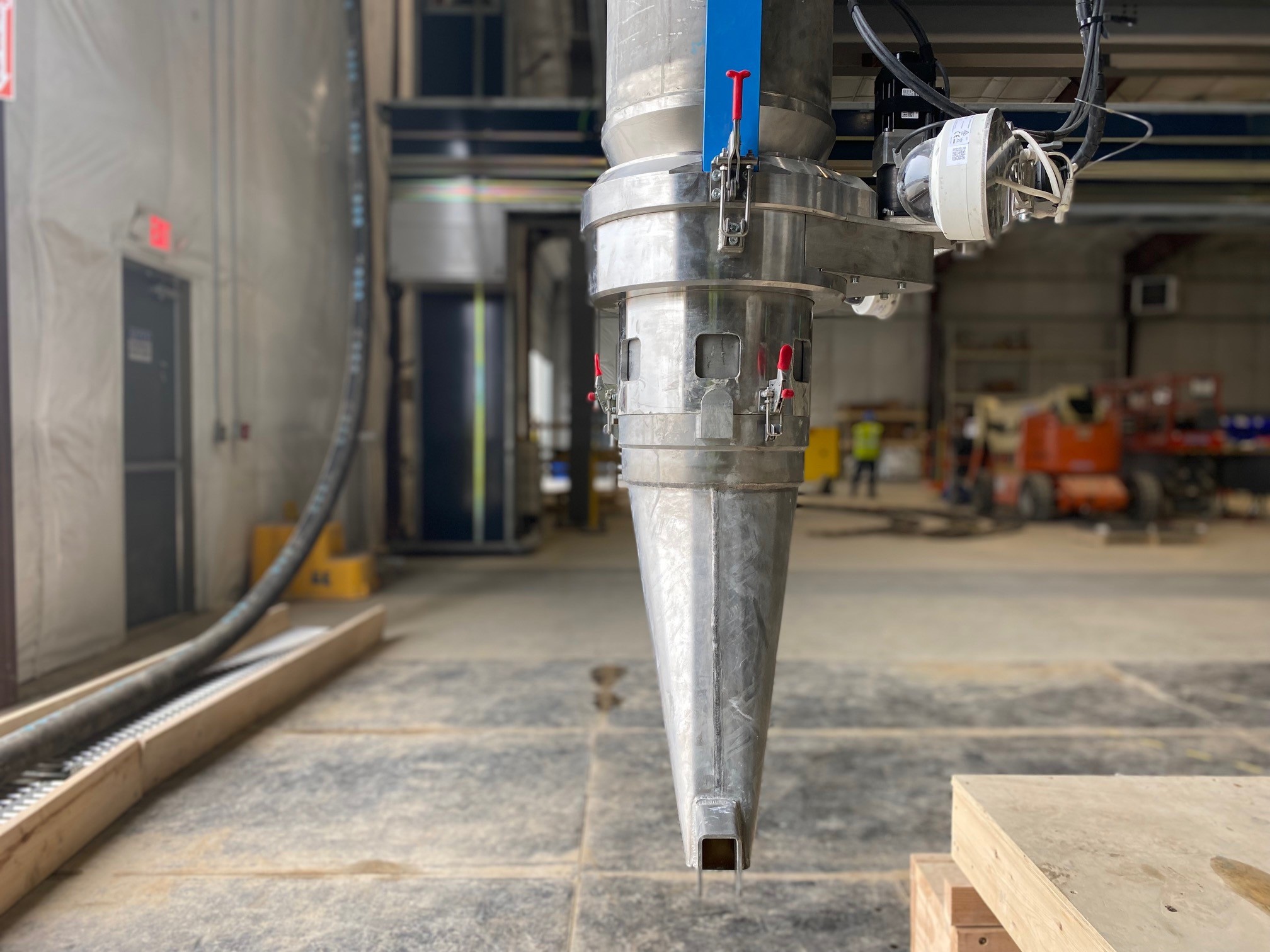 Image courtesy of GE Renewable Energy
COBOD’s latest printing system, designed specifically for GE’s research facility, is the size of a three story building, and can print concrete sections up to 60 feet high. The system achieves its hourly output rate of over 10 tons of concrete in part due to its having two X-axes — the only concrete 3D-printer in the world with this feature. As such, COBOD’s founder and general manager, Henrik Lund-Nielsen, argues, “…the printer can better be described as a multifunctional construction robot than a printer.”
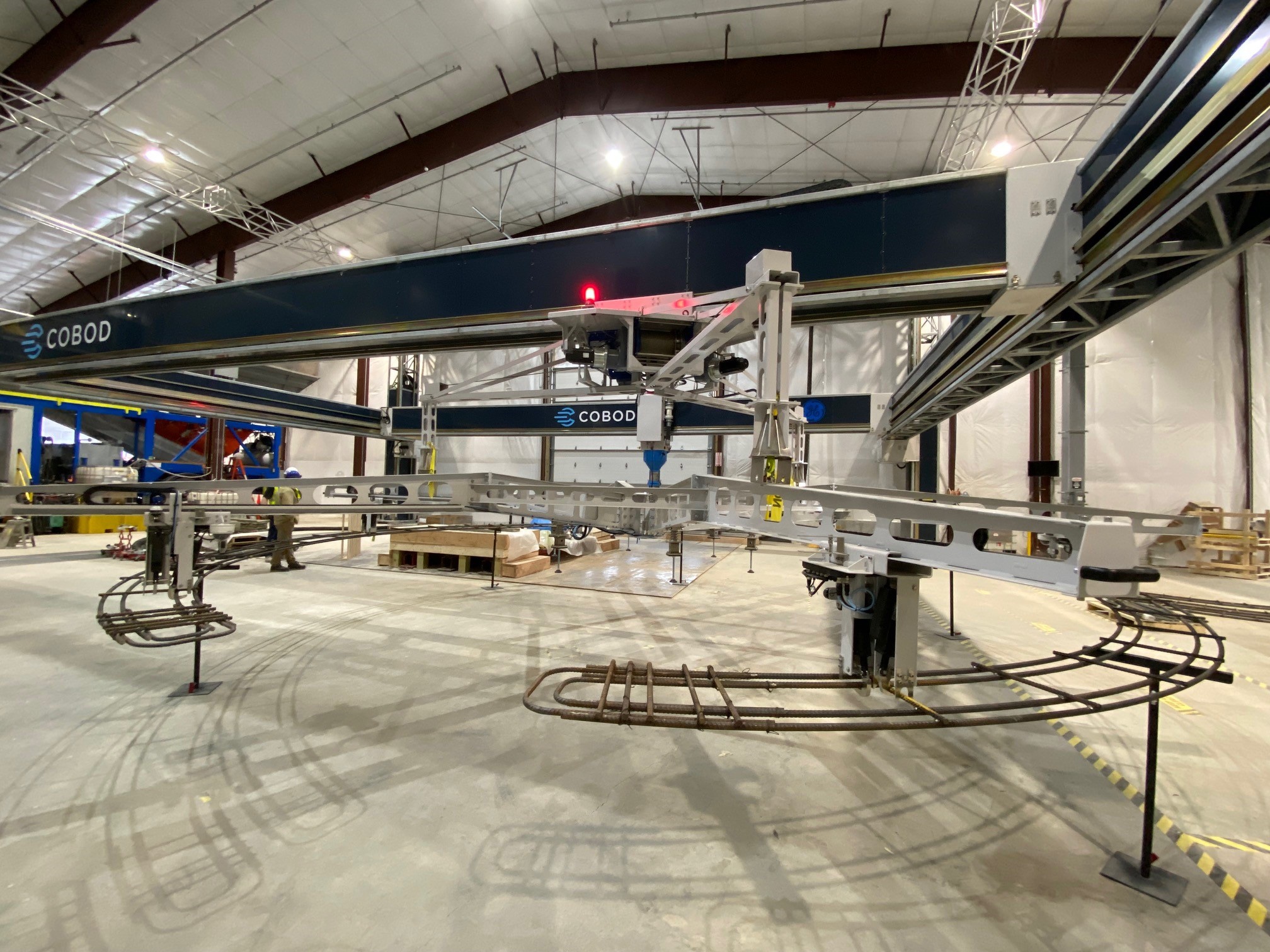 Image courtesy of GE Renewable Energy
Previously, in 2019 and 2020, GE Renewable, COBOD, and Holcim worked together on a similar project to print concrete bases for wind turbines. That the current, follow-up phase of the project will also be focused on printing bases for wind turbines indicates the success of the initial phase. In addition, when the project was originally being reported on, back in the summer of 2020, the companies involved were already mentioning plans to collaborate on the COBOD system currently being rolled out. This suggests that we can take as a fairly useful rough estimate, the timeline of five years which GE projects it will take for the R&D center’s work to lead to turbine bases that are operating in the field.
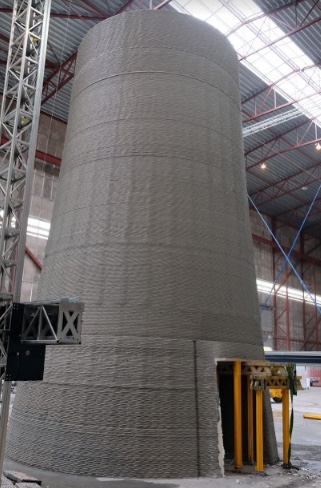
Image courtesy of COBOD.
Most nations appear to have set an initial target of 2030 for reaching the first big threshold of carbon emission reductions, on the way to (what still seems an almost impossibly ambitious) target of net-zero carbon emissions. If GE Renewable is planning on the R&D project paying real-world dividends by about 2027, this is yet another recent sign that bodes well for AM techniques making a major contribution to the next generation of wind-power.
Finally, this entire collaboration is a highly illuminating window into what is, for better or worse, the current state of the renewable energy sector. Aside from the three companies already mentioned, at least two other, more local companies are involved. So is the U.S. Department of Energy, which partially funded the project with a grant. The number of interests necessarily involved in a project of this magnitude illustrates how complex the economic conditions are in the business environment of the renewables sector. On the other hand, a business environment finally does seem to exist, which can realistically get a project like this off the ground. This hints that the idea of a new generation of renewable energy infrastructure may no longer be the mere pipe dream that it once was.
Subscribe to Our Email Newsletter
Stay up-to-date on all the latest news from the 3D printing industry and receive information and offers from third party vendors.
Print Services
Upload your 3D Models and get them printed quickly and efficiently.













You May Also Like
3D Printing News Briefs, June 13, 2026: Management Changes, Project Calls, & Wheelchairs
We’ll kick this weekend’s 3D Printing News Briefs off with some advisory board and management changes, and then move on to project call news. We’ll end with some heartwarming stories...
Researchers Combine AI and Bioprinting to Create Tiny Blood Vessel Networks
If 2026 has a theme in bioprinting, it may be blood vessels. Researchers can already print incredibly sophisticated tissues. The harder part is keeping those tissues alive. Without a network...
University of Arkansas Researchers Test Metal 3D Printing in a Mars-Like Atmosphere
If humans eventually establish a long-term presence on Mars, they will face a major manufacturing challenge almost immediately. Tools will break. Parts will wear out. Equipment will need repairs. But...
UT Researchers Use 3D Printing to Develop “Tabletop EUV Lithography” Process
Photolithography, the semiconductor manufacturing process whereby lasers transfer patterns onto chemical layers coating a substrate, is one of the most amazing industrial processes humanity has ever created. It is also...