Massivit 3D Launches Massivit 10000 3D Printing Tooling System


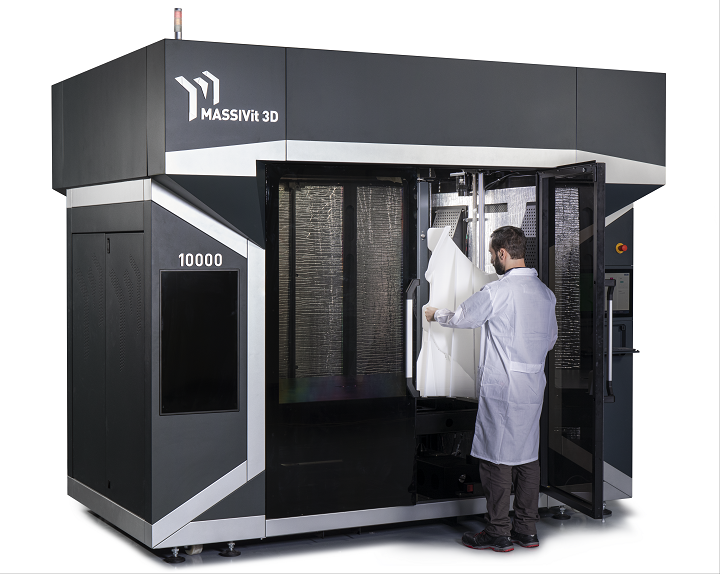
Large-scale 3D printer provider Massivit 3D Printing Technologies Ltd. (Tel Aviv Stock Exchange: MSVT) announced that it will be officially launching its most recent printer, the Massivit 10000 additive manufacturing tooling system, at the Paris-based JEC World 2022 event. The already award-winning system was first introduced last year, and features the company’s Cast-In-Motion technology. It was created to overhaul composite materials manufacturing by using automation to get past the common tooling bottlenecks and speed up the process.
The Massivit 10000 also represents a major company milestone, as it is the start of a new composites product line.
“We eagerly await this momentous occasion, marking a significant company milestone and injecting innovation into the composites manufacturing market,” Massivit 3D’s CEO, Erez Zimerman, said in a press release. “The composites tooling arena has long been held back by antiquated processes and technologies. It’s high time to facilitate digital transformation in this market and we are proud to bring the relevant knowhow, expertise, and innovation to the table for that purpose.”
Most traditional composites tooling processes require manual skilled labor, and can also be wasteful, expensive, and slow. The Massivit 10000 makes the process faster by using the company’s second-generation Cast-In-Motion technology, which is based on its high-speed Gel Dispensing Printing for large-scale printing.
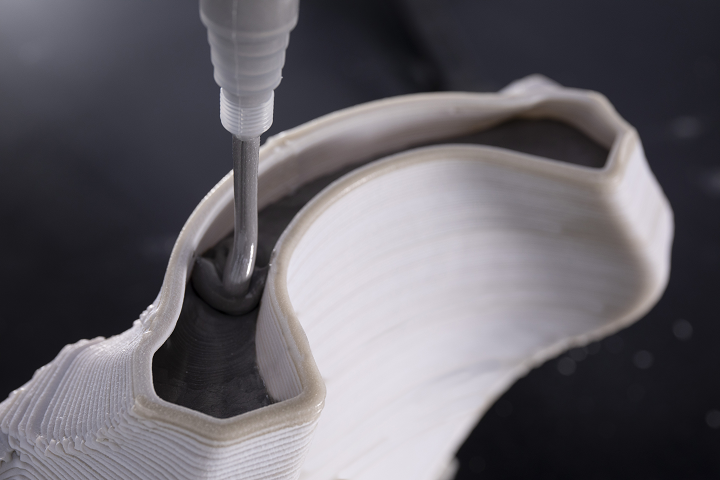
Casting between sacrificial walls
Massivit 3D’s Cast-In-Motion process makes it possible to directly 3D print complicated molds, mandrels, masters, and prototypes. Additionally, users that fabricate composites can use the technology to majorly decrease their tooling workflows from 19 steps to four. That’s because the Massivit 10000 doesn’t require you to manufacture an initial master or plug. Instead, it uses industrial-grade casting materials to directly print and cast the mold at high speeds.
-

- 3D printed bicycle seat mold inside sacrificial outer shell
-
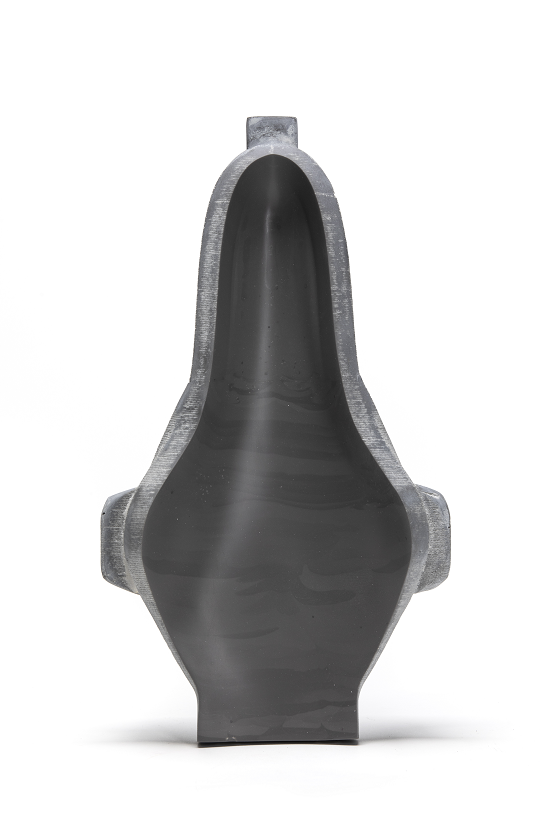
- Isotropic 3D printed bicycle racing seat mold
This Cast-In-Motion technology is meant to be used in a wide variety of industries, such as aerospace, automotive, defense, rail, marine, sporting goods, and furniture. Massivit 3D says the process offers digital accuracy and freedom of geometry to create efficient designs, and also offers several other benefits as well. For instance, it’s said to shorten tooling time by 80%, reduce labor-associated costs by 90%, majorly decrease expensive material waste, and reduce manual labor and associated inventory and transportation.
The new Massivit 10000 additive tooling system, according to the company, also brings the “first 3D printed isotropic mold for composites manufacturing” to market. The large-scale machine uses high-performance thermoset-based materials, instead of current thermoplastic additive tooling systems, to fabricate one uniform cast, the result of which is an isotropic mold. Additionally, the casting materials it uses are said to have a low coefficient of thermal expansion, predictable thermal and mechanical properties, and a high heat deflection temperature.

As of now, 17 preorders have already been made for the Massivit 10000, including beta agreements with US-based luxury bath ware specialists Lyons and Israel-based company Kanfit, which manufactures composite material parts for the global aviation market.
At JEC World, from May 3-5, visitors can reserve a live demonstration of the new Massivit 10000 at the company’s stand in Hall 5, M46, and also see a variety of molds and parts printed on the system. Visitors will also have the chance to preorder the Massivit 10000 for a limited time. To learn more, visit the Massivit 3D stand at 3 pm on Tuesday, May 3rd for a press conference. Massivit 3D plans to deliver the systems to customers starting in Q2 of this year.
Subscribe to Our Email Newsletter
Stay up-to-date on all the latest news from the 3D printing industry and receive information and offers from third party vendors.
Print Services
Upload your 3D Models and get them printed quickly and efficiently.












You May Also Like
3D Printed Chip Packaging Specialist XTPL Enters Japanese Market
The additive manufacturing (AM) industry naturally wants to move beyond prototyping to production at scale, and the industry is certainly starting to demonstrate success with that objective, especially in Asia....
UT Researchers Use 3D Printing to Develop “Tabletop EUV Lithography” Process
Photolithography, the semiconductor manufacturing process whereby lasers transfer patterns onto chemical layers coating a substrate, is one of the most amazing industrial processes humanity has ever created. It is also...
3D Printing News Briefs, May 30, 2026: RIMPAC 2026, Acquisition, Ceramic Implants, & More
We’re kicking things off with materials news in this weekend’s 3D Printing News Briefs. Then it’s on to a hybrid manufacturing system for a maritime exercise, an expansion of industrial...
The University of Utrecht: “3D Printing Could Change Who Gets to Become a Manufacturing Power”
For decades, manufacturing has mostly been controlled by countries with huge factories, lower labor costs, and industrial systems that took years, sometimes decades, to build. But Utrecht University human geographers...