PEEK Ceramic 3D Printing Filament Unveiled by Roboze

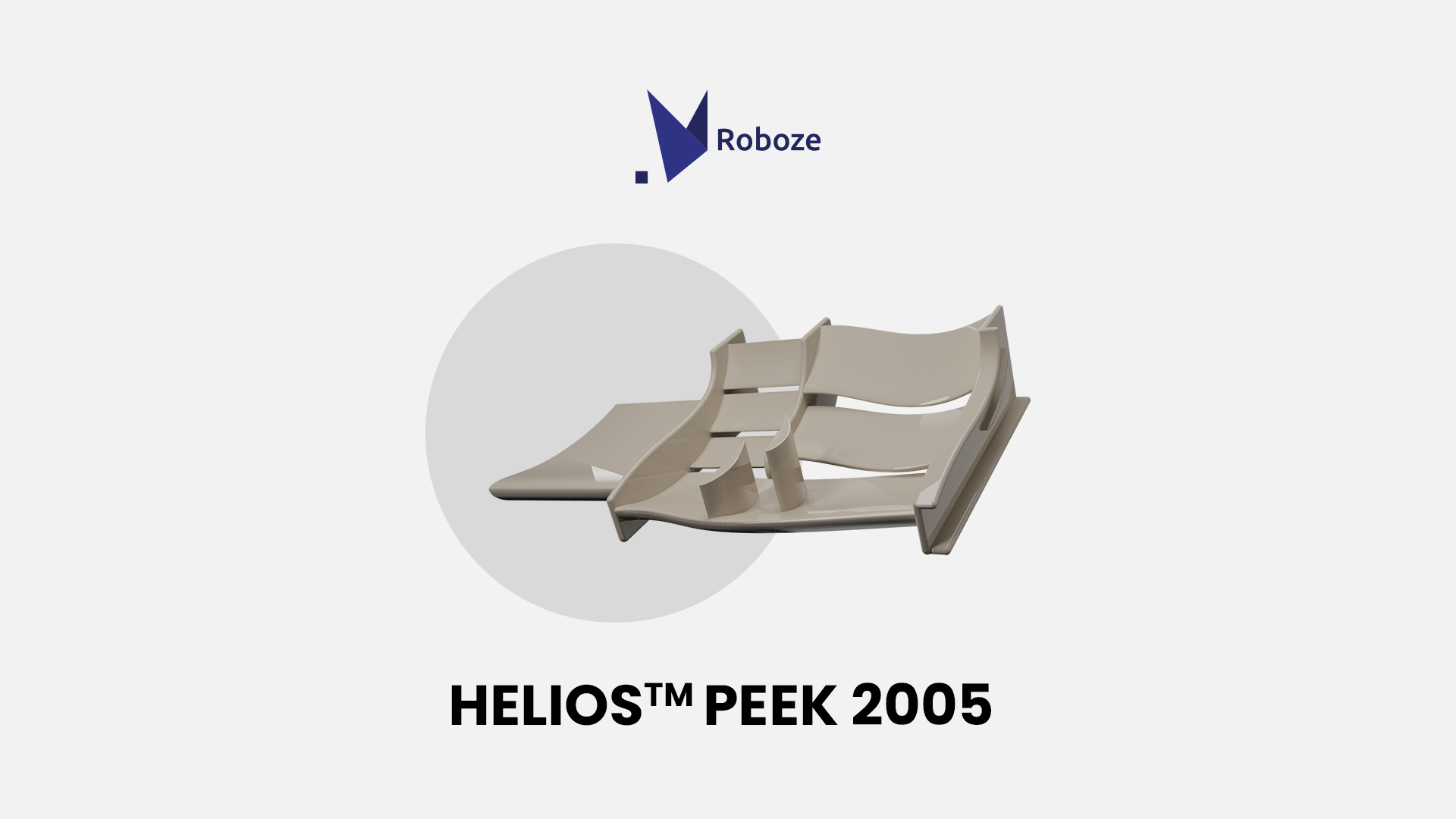
Upon receiving a multi-million-dollar investment, Roboze has unveiled its first new 3D printing material of the year. The Italian firm’s new high-performance filament called Helios PEEK 2005, a composite of the powerful and widely used polyether ether ketone (PEEK) polymer and a ceramic.
The new ceramic-filled PEEK is meant to maintain greater stability at high temperatures, while also offering improved surface finish. It is best suited for complex parts with thin walls, with the reduced need for post-processing resulting in a 60 percent cut in labor times compared to other polymers and composites, according to the company. Helios PEEK 2005 demonstrates high thermal insulation at temperatures beyond 170°C, as well as low electrical conductivity. The material is also described as being lightweight.
“The ceramic phase has smaller dimensions when compared with the more common carbon and glass fibers…” Roboze noted. “The monocrystalline nature of the reinforcement allows the elimination of grain boundaries and the minimization of crystallographic defects, maximizing its effectiveness.”
The material will be available in March via the company’s 3D printing service, the Roboze 3D Parts Marketplace. To learn more, you can attend an upcoming Roboze webinar, March 17th, 2022 at 10am CDT/5pm CET.
“At Roboze, we have seen great strides with the use of our 3D printing technology in sectors including aerospace, energy and motorsports. We work closely with many of these regulated industries, supporting the integration of additive manufacturing technology from prototype to production.” says Simone Cuscito, CTO at Roboze. “Helios™ PEEK 2005 derives precisely from the needs of these industries and is an excellent candidate for applications that require specifications of lightness, mechanical strength and heat resistance.”
We’re only beginning to see the introduction of ceramic materials into the 3D printing market. While there are a handful of firms dedicated to 3D printing high-performance ceramics, such as Lithoz and Xjet, we’re also seeing an increased number of ceramic composites. In addition to this product from Roboze, Fortify has developed a ceramic particle reinforcement that it is framing as ideal for high-temperature tooling applications.
With that in mind, we can see that Roboze is an early innovator in the space, leading the pack of high-temperature 3D printer manufacturers that are steadily chipping away at Stratasys’s market share. We can expect firms like 3DGence and INTAMSYS to also explore ceramic materials. In its “Ceramics Additive Manufacturing Production Markets: 2019-2030” report, SmarTech Analysis estimates the ceramic 3D printing market to be worth $4.9 billion by 2030. To learn more about the state of ceramics in 3D printing, register for the Additive Manufacturing Strategies summit, taking place March 1 – 3, 2022, where there will be a panel dedicated to the topic.
Subscribe to Our Email Newsletter
Stay up-to-date on all the latest news from the 3D printing industry and receive information and offers from third party vendors.
Print Services
Upload your 3D Models and get them printed quickly and efficiently.













You May Also Like
Prusa Core One L+: A Worthy Upgrade?
Disclosure: The Core One L+ was provided to me by Prusa3d free of charge for the purpose of this review. I have not received any other compensation. All opinions expressed...
Building Profiles in the Additive Print Services Market – Market Research Beyond AI Scraping
AM Research New market research: AM Research is building its new Additive Manufacturing Services Market 2.0 model. View the report and preorder here → In case you haven’t heard, at...
3D Printing Services Near $2.5B as AM Market Shifts Beyond Hardware
The additive manufacturing market may be growing again, but one of the more interesting numbers behind that recovery has little to do with selling 3D printers. AM services generated nearly...
Bambu Lab and SUSAN FANG 3D Print for London Fashion Week
At London Fashion Week, some of the more unusual pieces on the runway came from 3D printers. Chinese fashion designer SUSAN FANG presented her Spring/Summer 2027 Air-Illusion collection at the...