Fleet Readiness Centers, a Six-Month Metal AM Push, and Shifting Defense Procurement


As I wrote about earlier this month, the Trump administration has requested a record $1.5 trillion in Department of Defense (DoD) funding for FY 2027. In my post about what that signals for the additive manufacturing (AM) industry’s role in the defense sector, I discussed how defense industry experts have cautioned that a contentious fight over spending levels could most negatively impact precisely the sorts of companies — smaller, younger enterprises from outside the traditional defense fold — that the Pentagon needs to succeed in order to effect its long-term transition towards a more agile procurement process.
Now, the newer spending programs that the emerging class of Western defense firms are most relevant to represent a much smaller portion of the defense budget than do behemoths like the F-35, aircraft carriers, etc. But, since they are newer and thereby have less proven track records than the programs managed by the handful of largest primes, the idea that such programs could be targets for lawmakers aiming to bring down the topline budget number seems like one potential likely outcome of the forthcoming defense budget fight. In the time since the post was published, for instance, I’ve seen other sources mention that lawmakers could be hesitant to give the Defense Autonomous Warfare Group (DAWG), a relatively new unit that oversees the development of unmanned weapons systems, the unprecedented budget increase it’s asking for.
However, I would make a recommendation to anyone (especially anyone in the AM industry) whose livelihood depends on the disruptors winning the potential budget dispute that you push back aggressively on the idea that the length of a budget program’s history should be the most important consideration in determining how worthwhile it is. The work underway at the Fleet Readiness Centers, including Fleet Readiness Center East (FRCE) in North Carolina, is a perfect example of how collaboration across entire branches is succeeding at implementing new capabilities that DoD will benefit from more or less immediately. In the latest case, FRCE announced that it recently delivered its first metal AM parts to the US Navy fleet, including two different helicopter models and a transport aircraft.
The most impressive thing about this isn’t solely the delivery of the final parts — a weapons pylon fitting, a repair fitting for landing gear, and a blanking plate — but the fact that FRCE qualified the parts in less than six months. The FRCE Advanced Technology and Innovation Team achieved that feat by working with the AM Team and Fleet Support Teams from Naval Air Systems Command (NAVAIR).
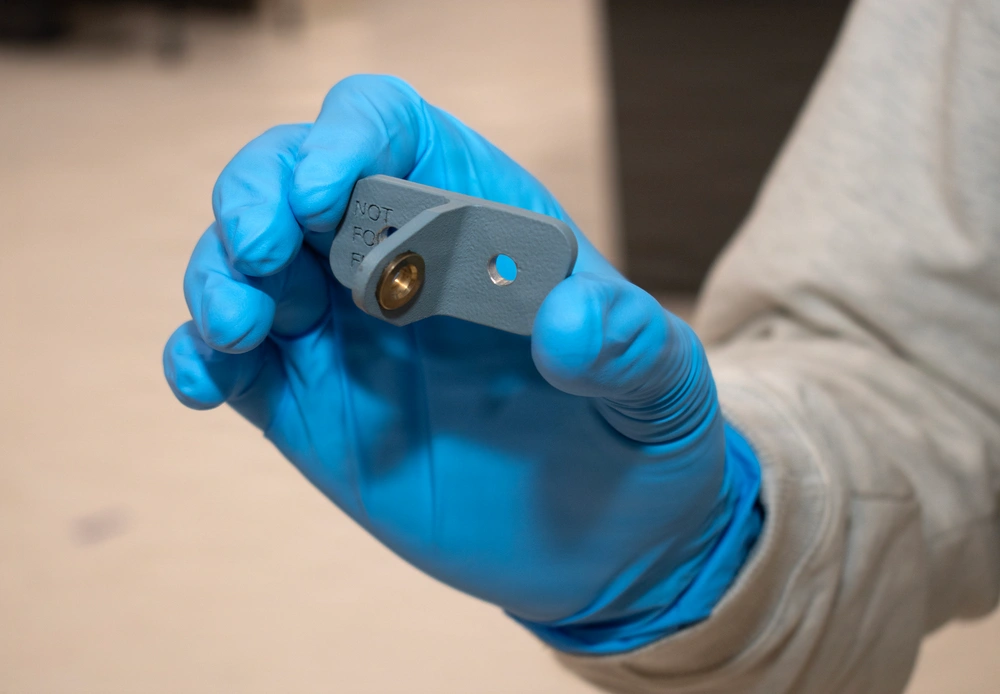
FRCE recently delivered its first non-flight-critical metal additive manufactured aircraft parts to the fleet, boosting flight line readiness. Image courtesy of Samantha Morse/DVIDS.
This echoes another announcement issued last summer, also by FRCE, involving work by the same FRCE group with collaborators from NAVAIR on a project to print 2,000 O-ring installation tools for the F-35 Lightning II. According to FRCE, the previous job reduced the lead time for the component by over 90 percent.
In a press release about FRCE’s first delivery of metal 3D printed parts for the US Navy fleet, the unnamed lead for the FRCE Advanced Technology and Innovation Team said, “We were challenged to complete the qualification, production and certification processes for these parts in six months, and we not only met but exceeded that standard. This is the fastest this sort of thing has ever been done within Naval Air Systems Command, and it shows that we are competitive with industry standards. This entire process has been a team effort between FRC East, our headquarters, the site in Lakehurst, and the Fleet Support Teams, working together to ensure these parts are ready and reliable for our troops.”
The unnamed lead for the FRCE AM Team said, “If there’s a fight and the fleet needs these parts tomorrow, they won’t have time to wait for those parts through traditional supply chains. The fleet was having a hard time getting their hands on repair fittings for the V-22 main landing gear – it’s basically a doorstop for the landing gear door when it comes up. They turned to [AM] and asked us if it was something we could make, so we took on that part, and a few others, as part of our capability demonstration. The goal is to give the fleet what they need when they need it, and we did just that.”
The FRCE team, moreover, has been using its newly acquired metal AM capabilities to produce in-house tooling and support parts, demonstrating how adding AM capacity can, in the right hands, quickly lead to multifaceted gains. This is exactly why any decision to pull back on spending programs centered around the buildup of digital manufacturing processes would be such a mistake.
A compromise solution would be to leave the funding for new programs untouched, but to require that they’re implemented via organizations like the FRC’s, in all situations where that makes sense. The fascinating thing about the FRC organizations is that they’re not funded via direct appropriations, but rather through the Navy Working Capital Fund (NWCF), which means that units within the Navy and Marines “fund” the FRC’s by spending portions of their allotted MRO appropriations. In that sense, the FRC’s generate revenue and operate at break-even in the long run.
Filtering spending on new programs through the FRC’s would solve multiple problems simultaneously, including the problem of tracking the exact value of AM-enabled savings to give DoD a better idea of how much it could realistically reduce waste with 3D printed parts. The downside is that it would strain the limited manpower resources of the FRC’s, but that could also be addressed by supplementing personnel with rotating involvement from other DoD working groups, and by boosting hiring in the form of a workforce development program — another problem that such an initiative could address.
While $1.5 trillion is, from any perspective, a lot of money, and objectively, would be an almost unprecedented year-to-year increase in funding, in terms of percentage of US GDP, it wouldn’t actually be the most the US has ever spent on its defense budget. I’d certainly prefer if federal spending were more evenly distributed over all government departments, but the topline number itself isn’t the biggest cause for concern: what Americans should be concerned with is how that money gets spent. We can’t keep pouring it into the same underachieving, behind-the-curve weapons systems that have played such a dominant role in driving the US into a budgetary crisis. The US has to spend smarter, not harder.
Subscribe to Our Email Newsletter
Stay up-to-date on all the latest news from the 3D printing industry and receive information and offers from third party vendors.
Print Services
Upload your 3D Models and get them printed quickly and efficiently.













You May Also Like
3D Printing News Briefs, October 21, 2026: Digital Twins, AI CAD Service, AR Smart Glasses, & More
In today’s 3D Printing News Briefs, America Makes announced the winners of its MIAMI Project Call, and AM Europe released a new report. Artec 3D launched its new Artec Twins...
3D Printing News Briefs: October 17, 2026: Affordable Housing, Bone Implants, Rubber Gloves, & More
In this weekend’s 3D Printing News Briefs, we’re starting off with quality assurance in metal additive manufacturing (AM), a new 3D printer, and 3D printed housing. We’ll finish up with...
3D Printing News Briefs, October 14, 2026: Bolus, Aerospace Tooling, Water Filter, & More
In today’s 3D Printing News Briefs, we’re starting with medical news, as Myrava has received FDA 510(k) clearance for its 3D printed bolus. Moving on to aerospace and metals, AML3D...
Can India’s AM Push Help Make it a Viable Supplement to China?
Diversifying manufacturing supply chains to locales outside of China has nothing to do with actually cultivating “substitutes” to the Chinese economy. The real stakes are these: China is an irreplaceable...