Nano Dimension Unveiling DragonFly IV 3D Printer & FLIGHT Software at Productronica


Additively Manufactured Electronics (AME) and Printed Electronics (PE) leader Nano Dimension Ltd. (Nasdaq: NNDM) will be attending Formnext in Frankfurt, Germany, next week, showcasing the Fabrica 2.0 micro AM system from Fabrica Group, one of its recent acquisitions. But company representatives will also be at the productronica show in Munich at the same time, showing off Nano Dimension’s DragonFly IV electronics 3D printer and FLIGHT software package. In fact, the new printer will actually be unveiled live at productronica on Tuesday, November 19th, at 10 am CET (4 am EST).

Nano Dimension’s DragonFly IV electronics 3D printer to be unveiled at productronica. Image courtesy of Nano Dimension.
The new DragonFly IV, meant for printing new classes of High-Performance Electronic Devices (Hi-PEDs), is a Dielectric & Conductive-Materials Additive Manufacturing System and deposits multiple proprietary materials while simultaneously integrating the necessary in-situ capacitors, coils, antennas, electro-mechanical components, and transformers.
“DragonFly IV is the latest innovation in our present line of AME products. Combined with the FLIGHT software, it expands the electronic & mechanical performance envelop of AME devices and the fabrication ability thereof. With the ability to leverage rapid and environmentally friendly additive manufacturing processes, customers can change and metamorphose form, fit, and function,” stated Yoav Stern, Chairman and CEO of Nano Dimension. “DragonFly IV will enable agile and rapid customization and personalization, as well as allows for the innovative structuring of electronics in the third dimension. Nano Dimension is bringing a completely new design and fabrication paradigms shifts to the electronics industry.”
The printer, featuring a 160 mm x 160 mm x 3 mm build volume, is said to offer improved PCB quality and better accuracy of traces and spacing and be able to design and print 3D Hi-PEDS in a one-step process, which can help save on lead time. Other listed capabilities for the new DragonFly IV include the support of the HDI level elements, low thickness variation of <5%, 75µm traces and 100µm spacing, 18 µm (x), 18 µm (y), 10 µm (z) resolution, one printhead each for conductive and dielectric inks, ethernet conductivity, and more.
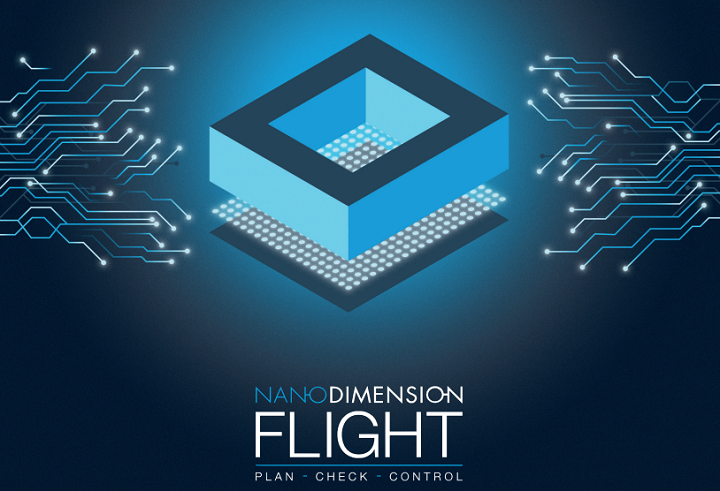
Nano Dimension Flight software. Image courtesy of Nano Dimension.
“The DragonFly IV is a milestone within the evolution of AME technology. Nano Dimension’s latest system, combined with the new FLIGHT software, enables the completion of complex jobs like no other AME system before,” stated Andreas Muller, CEO of J.A.M.E.S GmbH, a joint venture with Hensoldt. “The J.A.M.E.S electronic design engineers’ community will greatly benefit from better access to AME solutions enabled by the FLIGHT software platform and the first-of-a-kind collaboration of ECAD/MCAD 3D design and testing.”
Another capability of the new DragonFly IV system is integration with Nano Dimension’s new FLIGHT software, which offers a comprehensive, end-to-end design-to-manufacturing process for AMEs. The suite can incorporate ECAD designs into real MCAD designs and features job control solutions, intelligent verification, and slicing. Nano Dimension says that it “enables the 3D design of electrical and mechanical features in 3-dimensions,” while also making sure that any new product designs comply with system requirements before they’re printed on the DragonFly IV.
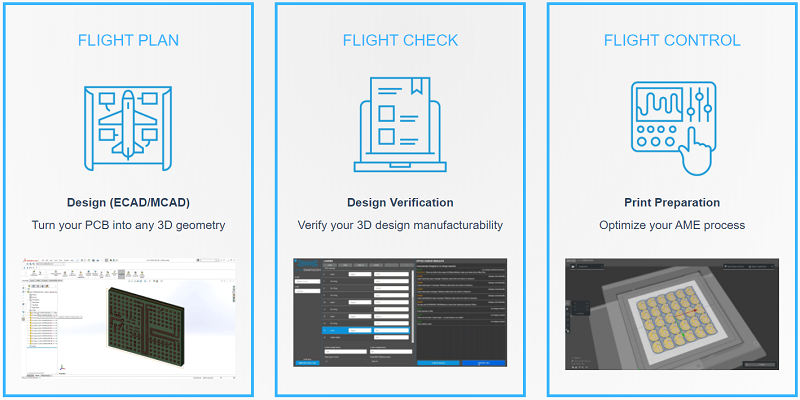
Nano Dimension Flight software. Image courtesy of Nano Dimension.
There are three separate components to the FLIGHT software suite. The first, called FLIGHT Plan, allows users to turn PCBs into any 3D geometry. Designers can import and integrate 3D ECAD and MCAD capabilities into their existing 3D electro-mechanical designs and use current 2D design data and novel 3D data to create viable 3D AME, which can speed up the design time.
The second component, FLIGHT Check, is focused on design verification. The application ensures that 3D designs meet the DragonFly requirements for manufacturability by enabling design rule checks and consolidating ECAD design rules that meet the printer constraints, which helps reduce the amount of design iteration cycles. Finally, the FLIGHT Control component is all about print preparation and offers a new pre-production solution to optimize the AME process. It allows for the fabrication of 2D and 3D multimaterial Hi-PEDs simultaneously, which is a major productivity boost, and supports new file formats, integrates system and job management toolsets, and can deliver a better user experience through an improved interface and higher rendering accuracy.
The DragonFly IV 3D printer and FLIGHT software suite are now available for order.
Subscribe to Our Email Newsletter
Stay up-to-date on all the latest news from the 3D printing industry and receive information and offers from third party vendors.
Print Services
Upload your 3D Models and get them printed quickly and efficiently.













You May Also Like
Printing Money Episode 39: Q1 2026 Public Markets 3D Printing Earnings Analysis with Troy Jensen, Cantor Fitzgerald
Welcome to Printing Money Episode 39, (or, “The one where they all went to market”). It’s that quarterly time, so Troy Jensen (Managing Director, Cantor Fitzgerald) joins Danny for a review...
Goldilocks’ Flywheel: Refractory Complex Concentrated Alloys (RCCAs) & The Race for the Future
Recently, Metalysis, Skyrora, and Thermo-Calc Solutions started to try to commercialize Tanbium. This alloy has been created for use in combustion chambers and rocket nozzles. Tanbium is a Refractory Complex...
Printing Money Episode 35: Notable VC and M&A Deals, with Arno Held and Alex Kingsbury
Welcome to Printing Money Episode 35 and let us be the last to wish you a happy new year. For this episode Danny is joined by Arno Held (Managing Partner,...
Snapmaker Secures Series B Backed by Xiaomi Founder’s Network and China’s Investment Elite
Desktop 3D printer manufacturer Snapmaker has gotten a series B round. The round is led by Hillhouse Ventures and Meituan. Cowin Capital and Orient Securities Capital dipped in for another round,...