Automated Support Removal for 3D Printed Parts Introduced by XJet

Israel-based additive manufacturing solutions provider XJet, which focuses on both metal and ceramics 3D printing—sometimes even combined in the same machine—introduced something new this week in its SMART station, which was launched to automate the post-processing of its 3D printed ceramic parts. SMART, which stands for Support Material Automatic Removal Technology, works with all of XJet’s Carmel additive manufacturing systems, and will help manufacturers achieve repeatable, low-cost production using its NanoParticle Jetting (NPJ) technology.
“SMART ensures a repeatable high-yield process that significantly reduces cleaning time and costs while eliminating the need for expert operator,” XJet’s website states about the SMART station.
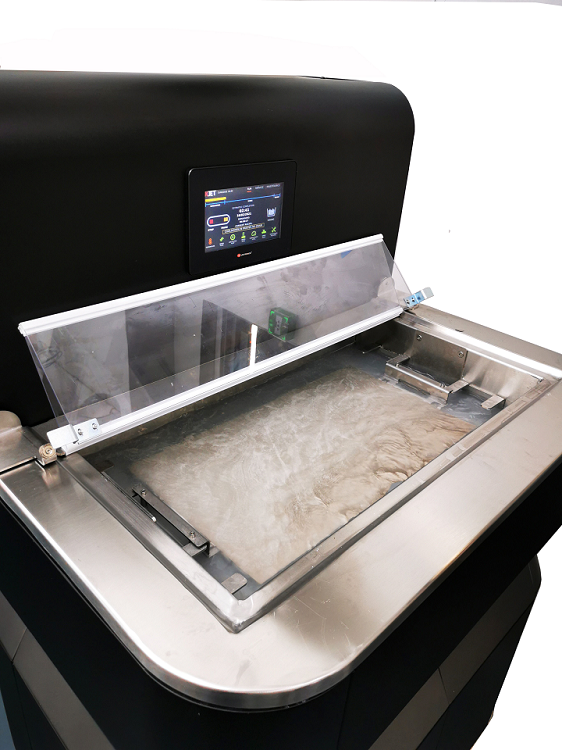
XJet’s award-winning soluble support material becomes even easier to remove with SMART.
In order to ensure automatic end-to-end 3D printing with XJet’s technology, the user-friendly SMART station automates the removal of the company’s soluble support materials, which means the printing process is less dependent on a human operator. Weighing in at 100 kg when it’s empty, the water-based station uses intelligent algorithms to suggest the appropriate removal program for a tray of ceramic parts by taking into account parameters like the flow rate and water level.
“One of our beta customers has reported a 90 percent reduction in cleaning time and hassle using the XJet SMART station, so we’re delighted with the results! Additive manufacturing is supposed to offer true design freedom and complex geometries with zero additional cost. Our soluble support material delivers those capabilities – even for tiny cavities. Now with the SMART station our customers can benefit from simple, predictable, low-cost operation,” Dror Danai, XJet’s Chief Business Officer, stated in a press release.
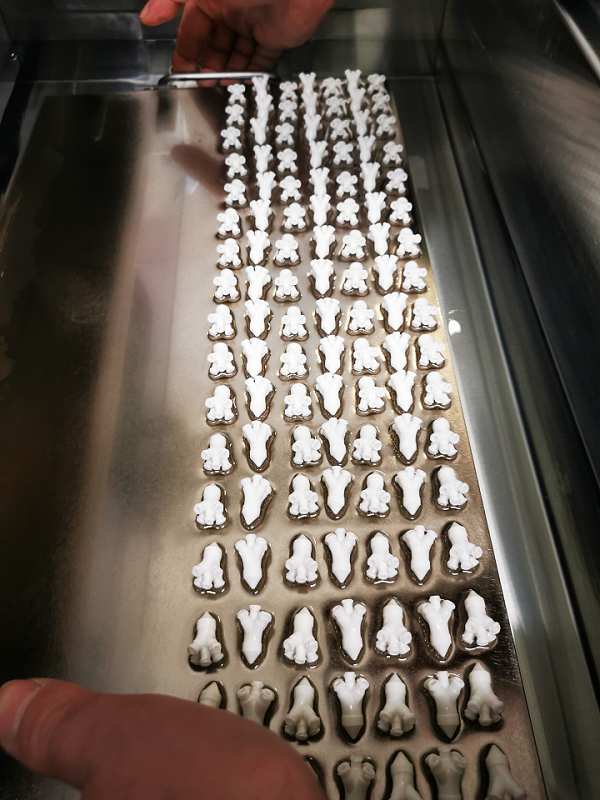
The XJet SMART station has a selection of programs to suit any tray of 3D printed parts.
The SMART station builds on what the company’s proprietary NPJ technology offers—the simultaneous jetting of one build material and a different soluble support material, which can now be dissolved quickly and easily from the printed part. This gentle melting away means that all of the part’s tricky geometries and fine details should be safely preserved during post-processing, which gives users the ability to print high-quality parts.
“The SMART station delivers the final missing link in AM. Now XJet’s award-winning soluble support material becomes even easier to remove, making part production really easy and allowing virtually any geometry as water can access even the smallest channels that XJet ultra high-quality printing enables,” Danai said. “This is all part of XJet’s drive to support manufacturers in a true production environment. XJet technology is designed for manufacturers who want to build better parts for real-world applications. We examine the whole workflow to see what can be done to reduce production time, minimize operational costs, and ensure the premium quality of parts is repeatable.”
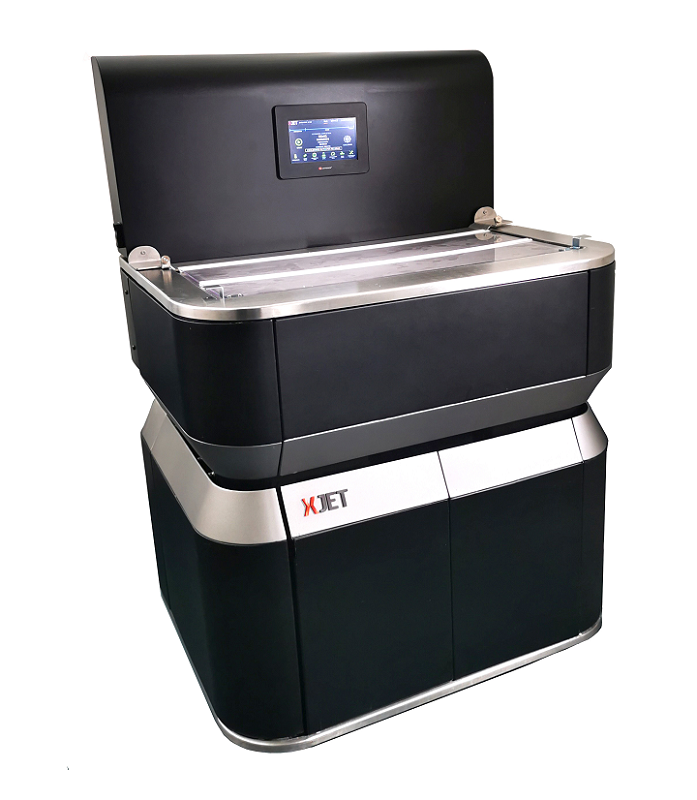
The XJet SMART system for automated post-processing of ceramic AM parts.
XJet’s new piece of automated post-processing equipment features a 220/110 volt power supply, a tray size compatible to what the Carmel 1400 printer can offer, and physical dimensions of 90 x 150 x 90 cm. The SMART station can drain 45 liters of water per minute, heat five liters per minute in 30°C, and has a 250 or 500 L/H flow rate system for the reverse osmosis process. However, infrastructure requirements for the necessary water supply are not included with the station.
You can see XJet’s new SMART station for yourself, along with a variety of 3D printed samples that have been cleaned in the station, at next week’s RAPID + TCT in Chicago, Illinois and at formnext in Frankfurt, Germany, from November 16-19.
Subscribe to Our Email Newsletter
Stay up-to-date on all the latest news from the 3D printing industry and receive information and offers from third party vendors.
Print Services
Upload your 3D Models and get them printed quickly and efficiently.











You May Also Like
Sintokogio Buys Bosch’s Ceramics Unit, Plans Global AM Expansion
Japan’s Sintokogio Group is buying Bosch Advanced Ceramics to expand its work in 3D printed technical ceramics. The agreement was signed on November 18 and formally announced at the Formnext...
Boston’s Additive Edge at Autodesk: Rooftop Wind Gets a 3D Printed Spin
Walking through Autodesk’s Technology Center in Boston, I’ve come to expect surprises. One second, it’s MIT engineers pushing concrete printers to their limits, the next it’s Harvard architects stitching stone...
XJet Continues Its Push to Lower Barrier-to-Entry with Carmel Pro 3D Printer
Over the summer, Israeli metal and ceramic additive manufacturing (AM) original equipment manufacturer (OEM) XJet announced the sale of a Carmel 1400M metal 3D printer to Youngstown Business Incubator (YBI),...
Incus Releases Hammer Pro25, Proving Innovation Doesn’t Need to Be Flashy
Viennese firm Incus is showcasing the new Hammer Pro25. That system is meant to be a scalable Slurry SLA unit created for continuous manufacturing (Incus uses DLP but we refer...