UK’s National Centre for Additive Manufacturing Invests in XJet Ceramics 3D Printing


This spring, the UK’s National Centre for Additive Manufacturing (NCAM), which is hosted by independent research and technology organization (RTO) the Manufacturing Technology Centre (MTC), opened a new additive manufacturing facility at its home in Coventry. The MTC offers integrated manufacturing system solutions to large and small customers in many different fields, and its NCAM works to increase AM adoption by developing innovative systems that can further industrialize the technology. One of its main focus areas is ceramics additive manufacturing.
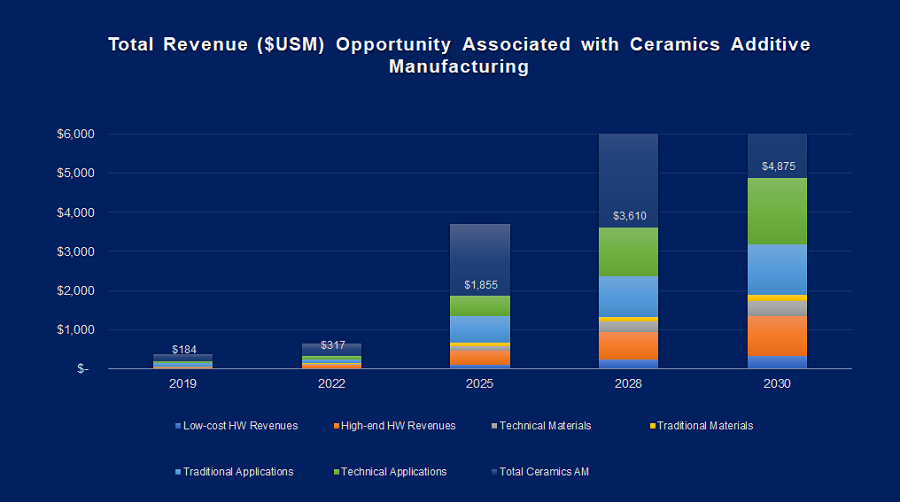 (Image courtesy of SmarTech Analysis)
According to the Ceramics Additive Manufacturing Part Production: 2019-2030 report from SmarTech Analysis, revenues for the ceramics 3D printing market will reach $4.8 billion by 2030.
“In SmarTech’s currently forecasted timeline, ceramics AM adoption will experience an inflection point after 2025 as all major AM technologies that support ceramics final part production come to maturity and enjoy enough of a presence in the market to support actual serial production,” SmarTech stated.
The NCAM recently published a whitepaper that provides what it calls a “route to widespread adoption” of ceramics AM for the UK.
“We are now seeing a renewed interest in the application of AM to ceramic materials. Particularly the introduction of new systems designed to produce high-density technical ceramics is beginning to generate publicity that will in turn stimulate interest and ultimately trigger a rapidly growing global market,” the whitepaper explains.
“The UK is expected to invest up to £600m over the next 5 years in AM, with ceramic AM expected to grow across the entire UK supply chain. Europe currently leads ceramic AM development and UK industry is well positioned to exploit this market area through R&D activity underpinned by immense experience in traditional and technical ceramic manufacturing.”
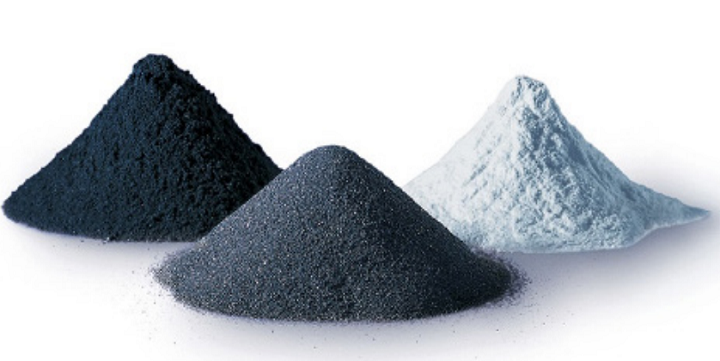 From NCAM whitepaper: Ceramic feedstock powders (Source: Kennametal)
This is why the MTC has decided to invest in the NanoParticle Jetting (NPJ) technology developed by XJet Ltd, a provider of metal and ceramic additive manufacturing technologies and solutions.
“XJet’s NanoParticle Jetting technology delivers very high-density parts, so users can have confidence in the materials. Designers often feel the need to ‘overengineer’ AM parts for basic applications, for instance using thicker walls so parts are less fragile, because they are using AM materials, not the real thing, but this is not the case with XJet,” explained Dr. Tom Wasley, MTC Senior Research Engineer, in a press release. “In addition, the large build platform, the lack of interaction with powders and no extra step needed for debinding, scaling up for volume production is easily achievable with minimal time and labour.”
Dr. Wasley says that because the Israeli company was able to successfully demonstrate the ability of its Carmel 1400C system to produce premium end-use ceramic parts with complex geometries, as well as scale up for production purposes, the ceramics printer will be “an ideal addition to its existing AM capability.”
“The surface finish that can be achieved with XJet is arguably very hard to replicate with any other kind of additive process. It also provides a means to make small, intricate and extremely detailed parts,” Dr. Wasley said.
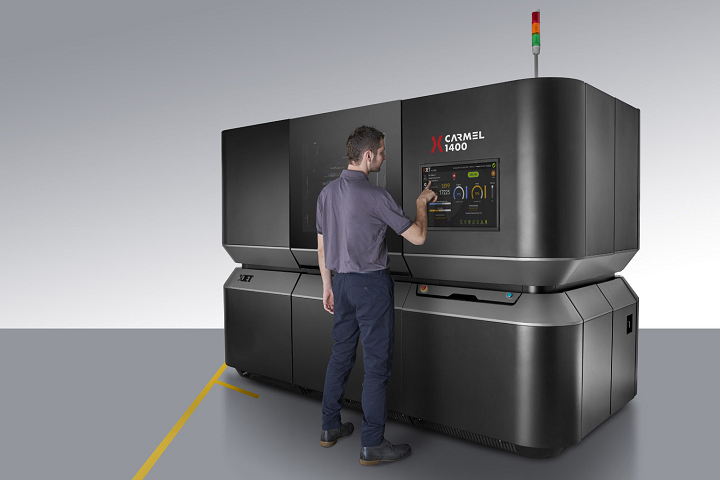
The components that XJet’s ceramics NPJ technology can create feature, according to the company itself, excellent accuracy, superfine details, and smooth surfaces. These types of parts can be especially useful in the medical and dental fields, among others.
“There is a high demand for parts like this in the aerospace, medical, dental and defence industries, some businesses are interested in high precision tooling, but largely they’re looking for end-use parts. We’ve been working in ceramics for over six years, and now we’re looking forward to growing our in-house AM capability. A lot of the organizations that are interested in ceramic manufacturing are searching for a means to batch produce custom, personalized products and the volume capability of the XJet printer will help to realize this need,” Dr. Wasley said.
In order to reinforce the UK industry’s ceramics AM proficiency, MTC is adding the Carmel 1400C printer to its existing portfolio at NCAM’s additive manufacturing facility. XJet has already shipped the system out, and it will go live at the MTC soon.
“We develop our technology so companies can easily move from one design to another, at any point in the manufacturing process, with true freedom of design and zero-cost complexity,” said XJet’s CBO Dror Danai. “However, it’s organisations like MTC that will push the technology to its limits and see what it can really do, make possible what was previously impossible. We’re very excited to work together and see how MTC applies the technology.”
(Source/Images: XJet)
Subscribe to Our Email Newsletter
Stay up-to-date on all the latest news from the 3D printing industry and receive information and offers from third party vendors.
Print Services
Upload your 3D Models and get them printed quickly and efficiently.













You May Also Like
Q5D and Molrix To Supply US Army With Harness Robots
Q5D Technologies and Molrix will offer their advanced harness production manufacturing units to the US Army. One production cell will be used for the SkyFoundry project, while two further systems...
Excellent Desktop Injection Molding, Made in Italy by Robot Factory
I was captivated when I saw my first Robot Factory 3D printer. The robust, precise machine was built to last. And this was in an era of very flimsy, disposable,...
RAPID 2026: 6K Additive’s Domestic Metal Powders & Consolidation Plan
6K Additive (ASX: 6KA), a U.S. supplier and manufacturer of metal powders for additive manufacturing (AM), has been very busy lately. I caught up with CEO Frank Roberts and Chief...
Walking into the Future: 3D Printed Footwear Moves Closer to the Mainstream
Footwear is quickly becoming one of the most active and promising applications for additive manufacturing (AM). What once seemed experimental—midsoles and concept shoes—is now expanding into full products, new materials,...