China’s Belt and 3D Printed Road: Moving up in the World

If we look at the way that China advances technologically then we can define a few trends and generally look at how it is occurring. On the whole China is driven to become independent and rely solely on its own resources, people, competencies, research, and institutions for further economic growth and development. If China can do this at a fast enough pace and with sufficient independence it can be the master of its own future and usher in an era of permanent stability and wealth. If it fails it could face upheaval and even collapse. So how do you, on the back of an economic miracle, assure that your own future is in your own hands? Generally, you develop clusters, some of which will go on to lead the world in ever more demanding manufacturing and knowledge products. On the whole, this is a—super-simplified—view of how this happens.

Shanghai 2020. Image Joris Peels.
The country identifies long-term strategic goals. Committees aided by scientists and experts identify long-term goals, technologies, and roadblocks that, if mastered, can help the country to become more independent. In essence, the country is on a path to return to technological supremacy as it was during the age of Emperor Qianlong in 1793. Only difference being of course that China’s own invention—gunpowder—had been militarized by warring European states, and centuries of conflict gave these states technological advantages over China in ships, training, small arms, cannon, and generally military. China is unlikely to make that mistake the second time around.
The country then staggers five-year plans along with many other strategic plans. Layers of long-term plans are combined to provide the scientists some years to research the areas that subsequently have to be commercialized. First the focus is on inexpensive things, then the company will develop competencies, training, learning, people, and procedures to surmount this obstacle and increase its capabilities.

Shenzhen. Dietertimerman.
Individual leaders then can localize plans, reinterpret them, or implement them (more or less in concert). When the time is right to implement a particular phase, leaders can determine precisely how, where, or by whom, giving them influence on the who but not necessarily what is to be done.
Local clusters will be activated. Particular regions, cities, blocks, governmental organizations, or SOEs will, in concert, develop a particular industry or competence.
Research and commercialization will occur at high speed. In one or sometimes many areas, technologies will be commercialized conjunctively and with fierce competition. Each region, city and neighborhood is in effect fighting to stay and become relevant. Regions, staff, and areas can assure their own political relevance, their own relationship-driven relevance, a future tax basis, growth, jobs, and advancement through conforming to a particular plan or achieving a goal, often in direct competition to other influence networks, regions, or parts of the economy.
Money will be pumped in to make a region or company a national champion. City financing and aid may boost growth in that sector locally, leading to provincial finance, approval, and favoritism. This will lead to more banks, financing, and stimulus in the broadest sense. At this stage, the technology is often just China only, so no IP is generated or it is even appropriated.
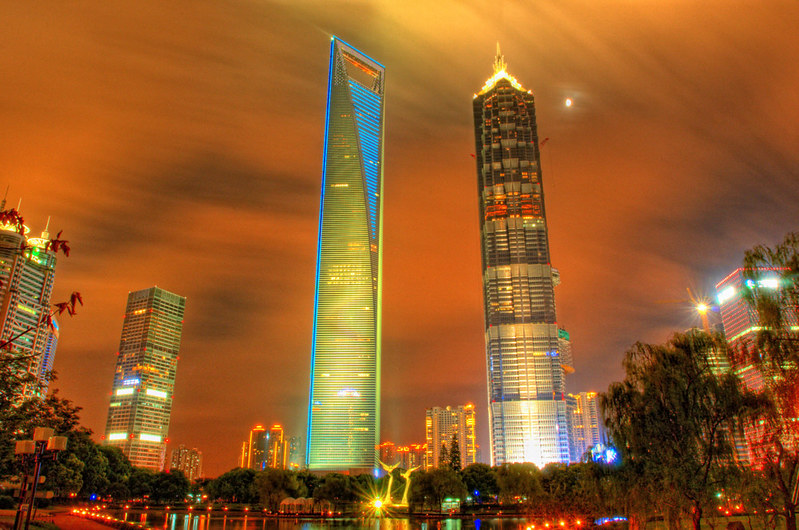
Shanghai Skyline. lwtt33.
Foreign expertise is sought. Foreign managers, joint venture partners, employees, research partners, validation, exposure, best practices, knowledge, IP, and experience are actively sought. Once this has made the product more competitive, more financing will lead to national champions.
National competence is developed. All of the key inputs, machines, machine tools, processes, materials, knowledge, and competencies will be developed by firms or regions so that they are globally near competitive.

Factories. tong-der-miauw.
Internationalization is the last stage. When the product is sufficiently competitive, more financing and a national push will hopefully translate into continued national success. If internationalization and export has been based on no-name companies that have limited power in the value chain, then a further push towards a next generation of firms with more market power will be undertaken.
Developed prowess is reused to go to the next stage. Whether the firms, markets, regions, or effort overall is successful or not, the learned lessons and increased competence is then used to get to the next stage in development.
In so doing, Chinese policies and strong internal competition together work towards the country developing ever more complex and technologically advanced products. By investing in strong clusters and the important pain points keeping technologies from becoming successful, China assures its own future and stability.
You can read the first article in this series here. You can read the second article in this series here.
Subscribe to Our Email Newsletter
Stay up-to-date on all the latest news from the 3D printing industry and receive information and offers from third party vendors.
Print Services
Upload your 3D Models and get them printed quickly and efficiently.











You May Also Like
The Real ROI of Personalized 3D Printed Medtech in Oncology
Discover how patient-customized 3D printed devices like Stentra™ significantly reduce high toxicity-related treatment costs and improve workflow efficiencies to handle more cases more effectively overtime. Introduction: The Economic Paradox in...
Why SiC-Dedicated Additive Manufacturing Is Gaining Industrial Relevance
Silicon carbide is not a material problem—it’s a manufacturing one. Silicon carbide (SiC) has become a critical material across semiconductors, aerospace, energy, and defense. Its exceptional thermal stability, chemical resistance,...
Championing a Made-in-America Future for Additive Manufacturing
As the additive manufacturing industry continues its rapid global evolution, one theme has risen to the top of strategic conversations: the importance of strengthening domestic production to support national competitiveness...
Friendshoring and Additive Manufacturing: Turning Australia’s Research Strength into Commercial Impact
Global supply chains are being re-written. After decades of globalisation driven primarily by cost efficiency, geopolitical tensions, trade disputes and pandemic-era disruptions have exposed the risks of concentrating manufacturing and...