3D Printed Device, ClampHero, Lets You Mount Your Electronic Device on an Airplane Seatback


If you’ve spent anytime at all traveling by plane, you know how challenging it can be to carve out a little personal space for yourself in the 17 x 30 or so inches of space you pay to call home or office for the duration your flight. You jockey for elbow space on the shared armrest and wish fervently that the person in front of you doesn’t go into full-on recline mode. If you’ve brought along your favorite electronic gadget to  work or justpass the time, creating a stable space for it that doesn’t require a contortionist feat is not always easy.
One enterprising 3D printing-savvy inventor and entrepreneur, Italian-born Niccolò Gallarati, who has made Dublin, Ireland his home base, has come up with ClampHero, a simple but brilliant solution for maximizing your space and ensuring that your prized gadgets stay with you when turbulence strikes. Gallarati is a self-professed tech enthusiast who is passionate about industrial design, digital marketing and communication, and user-friendly interfaces. Gallarati founded Garagegeeks Limited with another hardware enthusiast, Davide Viganò, in order, he explains, “to create affordable and simple tech solutions for daily living.”
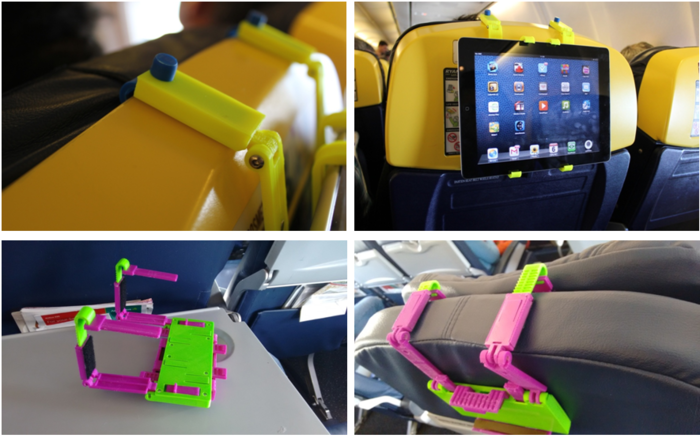
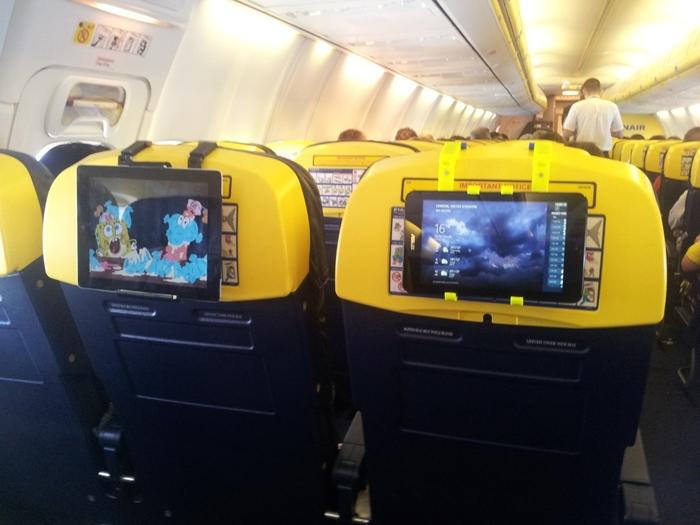
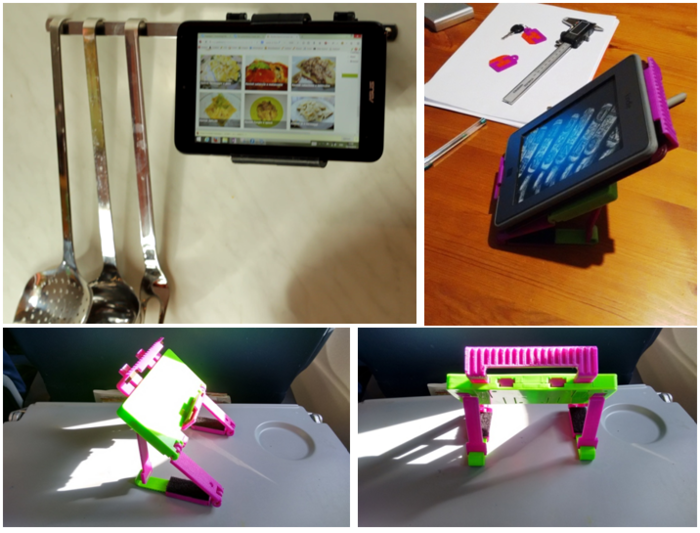
ClampHero is designed specifically for use on public transport — airplanes, trains, and buses. It clamps securely over the back of the seat in front of you, even when the seat has been reclined, and holds your gadgets so that they’re directly in your line of vision, so no neck strain! The device will accommodate most any kind of tablet, e-reader, or smartphone (even the smaller ones!) as it is adaptable. How does it adapt? You can mount ClampHero using top hooks, Velcro ®, tray hooks, or additional attachments provided by the device’s makers. The adaptable clamp that secures your device grips securely without scratching or otherwise damaging your electronics. Devices can also be secured in places like the kitchen (pull up recipes for easy access, maybe?) or propped up easel-style anywhere you might want to see your screen. ClampHero is also portable as it folds to become quite compact (about 5.5 x 3.5 x 1.2 inches) and weighs about as much as a smartphone (around 3.5 oz.).
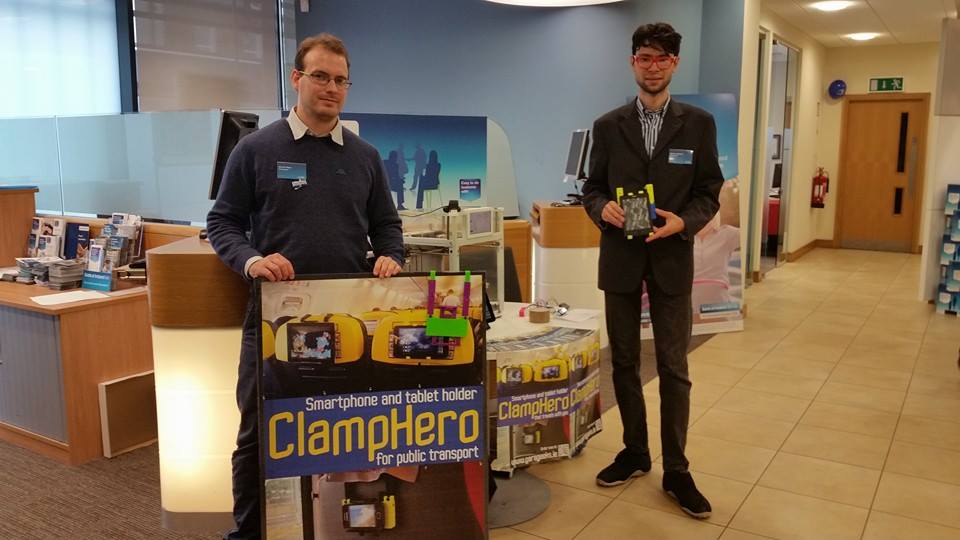
The Garageeks team have been doing in-person marketing for ClampHero around Dublin and Milano.
After coming up with the idea for ClampHero, the Garageeks team spent well over a year refining the design, eventually producing 15 different versions and over 30 prototypes, which they tested in the field — on airplane and train journeys. The final design was turned over to a mold design engineer with 20 years of experience. The team also consists of an experienced factory assembly worker, who helped figure out how to make the device easy to assemble. Ideally, Gallarati wants to produce ClampHero using the injection molding process, which produces parts of high quality and low cost.
The injection molding process works great in more large-scale manufacturing scenarios but is not particularly cost-effective for small production runs. So, Gallarati and his product development team are using a hybrid approach to manufacturing called parallelized 3D printing. Using OctoPrint open source printer software with each printer, OctoScript for remote command-line control, and a custom-created Python script to, explains Gallarati, “feed the printers,” multiple 3D printers can be used at once to increase production numbers.
Gallarati compared the 3D printing and injection mold methods. He found that the overall smoother texture of the mold-produced devices was generally more appealing than the texture of the 3D printed version of ClampHero. “On the other hand,” he said, “3D printing offers a higher flexibility both on timing and customizing.” 3D printing allows them to offer a larger variety of color options and you can also personalize your ClampHero: up to 10 letters including spaces can be incorporated into the design of an individual’s 3D printed device.
Currently, Gallarati is raising money to facilitate upgrading to the injection mold, higher yield and cost effective manufacturing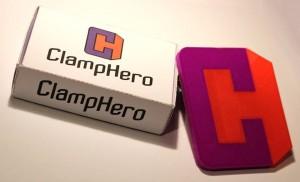 process, although it seems he plans to retain the 3D method for special orders. The ClampHero Kickstarter campaign runs through December 16 as Garageeks attempts to get backing, asking for a somewhat modest €6,000 (about $7,400 USD) to help get the mold making process underway. Thus far, Garageeks has raised about a third of the total amount, with just over two weeks left in the campaign. Backers are offered a variety of gifts, including a “Clampy” cartoon t-shirt, for smaller donations, and limited editions of ClampHero to donors who give just a bit more — as little as €23 (around $29) can get you a limited edition ClampHero.
Hopefully, ClampHero outsells the more controversial device that prevents the person in front of you from reclining their seat — not a very neighborly product or gesture! Would you use ClampHero for your device? Let us know what you think about this new product over at the ClampHero forum thread at 3DPB.com.
Subscribe to Our Email Newsletter
Stay up-to-date on all the latest news from the 3D printing industry and receive information and offers from third party vendors.
Print Services
Upload your 3D Models and get them printed quickly and efficiently.













You May Also Like
Metal 3D Printers for the Desktop Are Finally Starting to Feel Like Desktop Products
FDM 3D printing is becoming increasingly accessible, yet metal 3D printers designed for everyday desktop use remain rare on an ordinary workbench. The real challenge is not making a metal...
What 3D2GO Says About 3D Printing’s Growth in Southeast Asia
The Philippines offers an interesting case study in how 3D printing can develop in Southeast Asia, and Manila-based 3D2GO helps illustrate it. 3D printing in Southeast Asia doesn’t have to...
The Frankenservice Part 2: Have Your Cake and Eat it Too
This series of articles delves into a thought experiment. What if we let go of using a few machines very optimally, but instead use lots of different machines to meet...
Silencer Market Set to Test Metal Additive’s Readiness for Production Prime Time With Enormous Market Expansion
Throughout the history of additive manufacturing (AM) technologies, there are only a couple of really interesting case studies in which we see a market significantly disrupted and revolutionized by AM....