
New Design A Day 3D Printed Smartphone Case Challenge Has Begun!

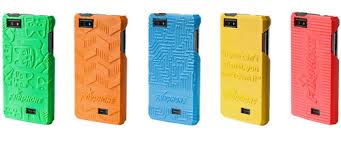
I remember when it was a big deal to have a mobile phone. Then more and more people started getting cell phones, as I stubbornly looked at my land line, with arms crossed, saying to myself, “This too, in time, shall pass.” But, secretly, I knew cell phones were here to stay. Not only are cell phones the standard, but the smartphone has stolen much of the limelight of mobile communication and information devices. People want their smartphones, they even want them personalized, but some also worry about the dumb side of these phones — dependent on finite minerals for production, the planned obsolescence of many of the phones, and the waste produced by the plethora of trashed smartphones and smartphone accessories.
 Fairphone is a company that wants to gain more control of smartphone design and production, confronting some of these looming production and manufacturing social and ecological issues head on. Their phone designs use conflict-free minerals, they focus on longevity, not obsolescence in usage, and they seek fair working conditions for the workers on the manufacturing floor. Fairphone provides an alternative for those who want to put their money where their mouth is regarding labor and environmental issues: and they partner with smart 3D printing technology, too.
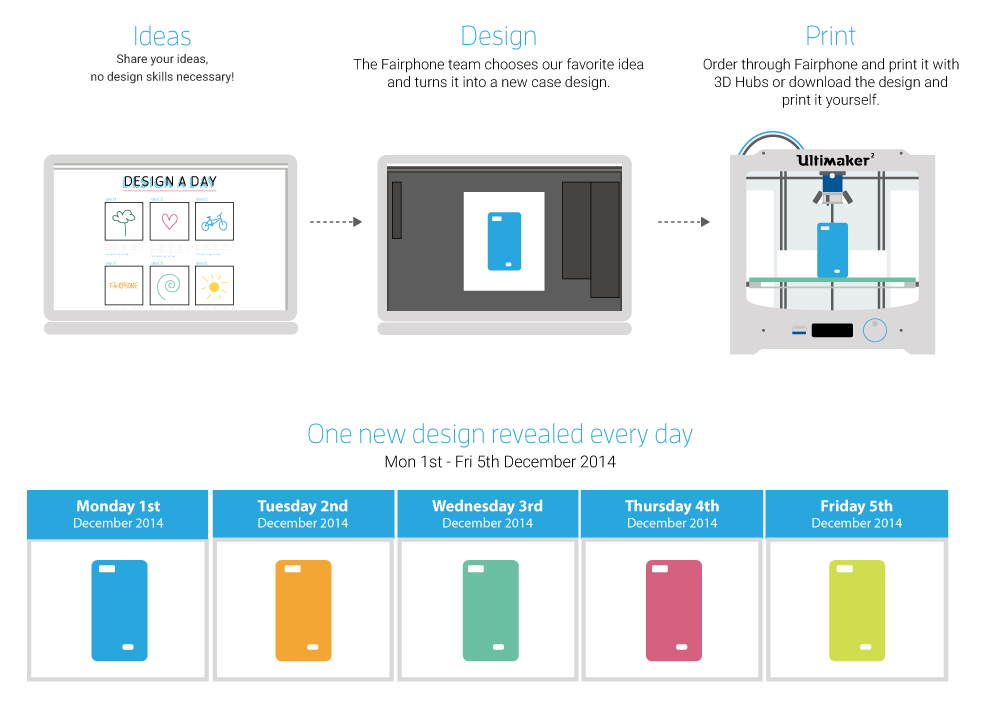
This week is the second Design A Day challenge — an event arising out of a collaboration between Fairphone and 3D Hubs. The Design A Day competition, where people submit smartphone case designs and then print them locally, operates on the rapid prototyping concept, where a community-based idea can exist one moment, and about half a day later it can come into fruition. Smartphone cases will be designed with input from the Fairphone community, and after you’ve ordered one, you can print it at your nearest 3D Hub.
Amsterdam-based 3D Hubs makes 3D printing available for the masses of people with great ideas, but without the means to fully realize them. With about 9,700 printing locations in 160 countries, 3D Hubs has partnered again (they also did this last July, with great success) with Fairphone for its Design A Day competition which runs December 1-5, 2014.
Here’s how the Design A Day process works: a platform has been established where people can submit their ideas. They are encouraged to write descriptions, send photos, make sketches, or if they’ve got the skills, send a mock-up design. Then the next day, the Fairphone team reviews feedback, makes a new design for 3D printing — moving from a concept to a final 3D-printable product in just 4 hours! 24 hours after the process started, a final design is presented for sale in Fairphone’s online shop. Then a new new design loop begins until five cases are made.
Fairphone CEO and founder, Bas van Abel, summarizes the potential of 3D printing technology:
“3D printing has the potential to disrupt the manufacturing industry as we know it, offering an efficient cost-effective way to produce products only at the moment when consumers require it. It’s another way for Fairphone to examine the supply chain, make improvements, and forge stronger connections between buyers and their products.”
3D Hubs co-founder Brian Garret concurs with van Abel regarding the natural affinity between sustainable production and 3D printing: the success of the Design a Day collaboration is an example of this fit. He states that Fairphone 3D printed cases have been 3D Hubs’ most printed product to date, and Fairphone reports they have sold 3,200 cases since July.
So,if you’ve been itching to contribute a case design, with a promise that it could possibly see the light of day, you can participate in Fairphone and 3D Hubs’ Design A Day challenge. Will you be entering? Let us know about your design! Tell us what you think at the Design A Day Smartphone Case Contest forum thread over at 3DPB.com.
Subscribe to Our Email Newsletter
Stay up-to-date on all the latest news from the 3D printing industry and receive information and offers from third party vendors.
Print Services
Upload your 3D Models and get them printed quickly and efficiently.













You May Also Like
South Korea’s Lincsolution Lands Hanwha Defense Deal as Hanwha Invests Billions in US
I recently wrote about how the South Korean additive manufacturing (AM) firm Lincsolution is building an aerospace and defense hub, part of the company’s construction of “the largest AM facility in...
Bambu Lab and SUSAN FANG 3D Print for London Fashion Week
At London Fashion Week, some of the more unusual pieces on the runway came from 3D printers. Chinese fashion designer SUSAN FANG presented her Spring/Summer 2027 Air-Illusion collection at the...
Why Cross-Border 3D Printing Is Closing the Speed Gap with Local Manufacturing
The fastest 3D printing supplier in your shortlist may no longer be the one closest to your office. That sounds unlikely to many engineers. For years, overseas 3D printing carried...
Arridex Expands 3D Printing Network to Ghana
Nigeria-based Arridex has deep experience in oil and gas additive manufacturing. Previously known as RusselSmith, the firm has in-house metal and polymer additive technology. The company is making 3D printed...























































