Unique Moving Supports Reduce 3D Printing Waste by 35%


While additive manufacturing (AM) may save substantial amounts in terms of material waste compared to subtractive techniques, AM is not without its own subtractive procedures, namely in the post-processing of prints. Depending on the specific 3D printing method used, there may be significant support structures that need to be removed from a print. Researchers at USC Viterbi’s Daniel J. Epstein Department of Industrial and Systems Engineering have come up with a novel way to reduce this in fused filament fabrication (FFF).
In an article for Additive Manufacturing, Yong Chen, professor of industrial and systems engineering, and PhD student Yang Xu, describe their method for a dynamically-controlled 3D printing substrate. Inspired by pin impression toys, the team created a print bed made up of a series of square washers connected to rods controlled by a single stepper motor. The rods and washers move to the necessary heights to support the object in various locations.
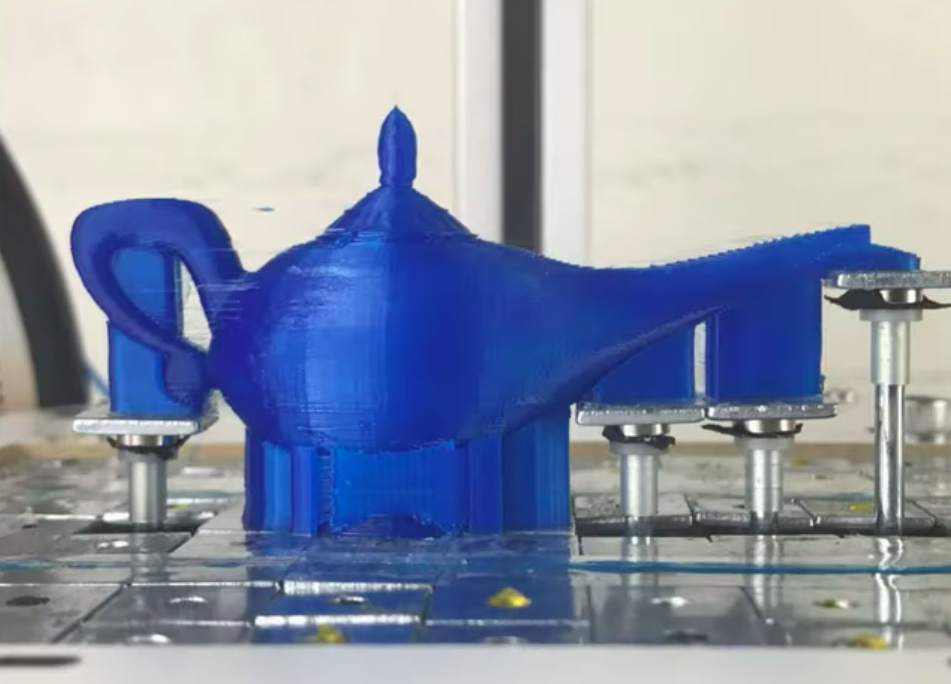
The team first demonstrated their technique for an arbitrary CAD model, completely replacing the need for printed support structures. For more complex geometries, printed supports were still needed. The metal squares would raise to a point and the remainder of the required support would be printed atop those metal pieces. Once the prints were complete, the researchers could easily remove the washers.
According to Chen, this method could reduce material waste by about 35 percent, which can have a significant impact particularly when it comes to more expensive feedstock.
“I work with biomedical doctors who 3-D print using biomaterials to build tissue or organs. A lot of the material they use are very expensive-we’re talking small bottles that cost between $500 to $1000 each,” Chen said. “For standard FDM printers, the materials cost is something like $50 per kilogram, but for bioprinting, it’s more like $50 per gram. So if we can save 30% on material that would have gone into printing these supports, that is a huge cost saving for 3-D printing for biomedical purposes.”
Chen also spoke to the speed savings of using reusable supports:
“When you’re 3-D printing complex shapes, half of the time you are building the parts that you need, the other half of the time you’re building the supports. So, with this system, we’re not building the supports. Therefore, in terms of printing time, we have a savings of about 40%.”
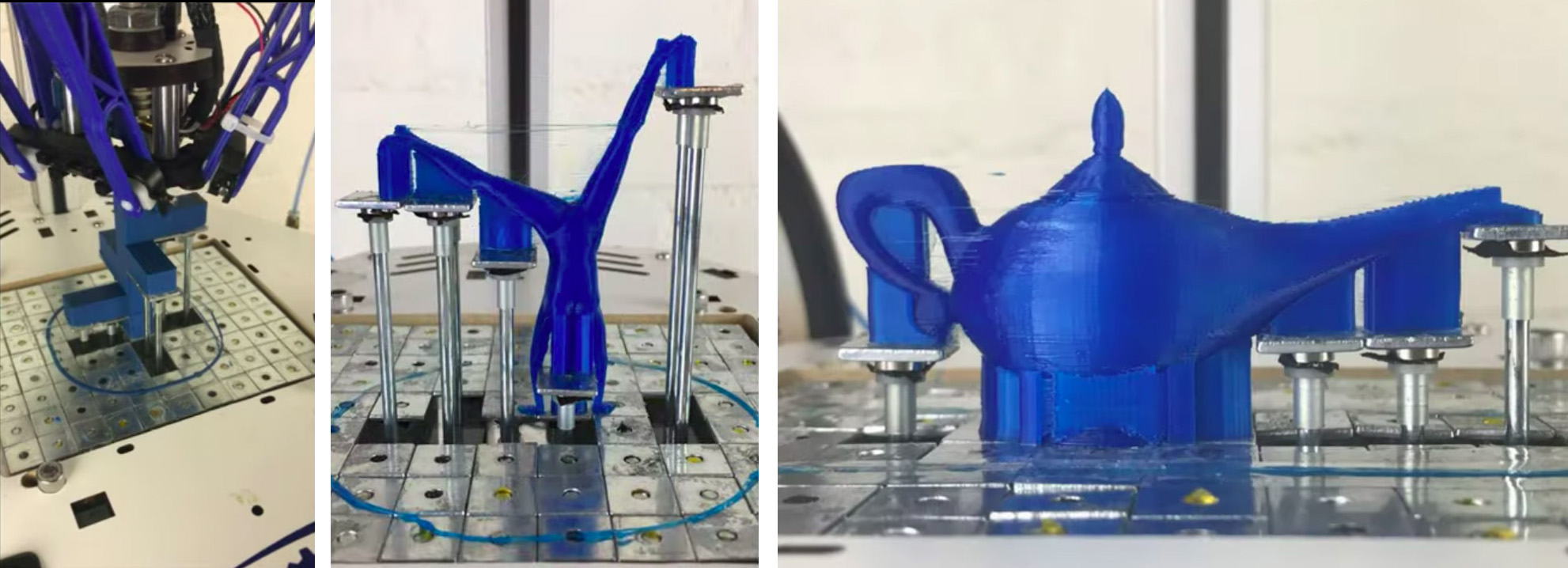
While there have been similar projects in the past, they relied on individual motors, which naturally resulted in higher costs and energy use. With 100 moving pins attached to $10 motors and 25 boards to control something around 100 motors, the machine would easily cost more than $10,000.
The researchers are already examining ways that the technique could be applied to other 3D printers, such as large-scale systems like the Big Area Additive Manufacturing machine from Cincinnati Incorporated, as well as for other technologies.
“People are already building FDM printers for large size car and ship bodies, as well as for consumer products such as furniture. As you can imagine, their building times are really long — we’re talking about a whole day,” Chen said. “So if you can save half of that, your manufacturing time could be reduced to half a day. Using our approach could bring a lot of benefits for this type of 3-D printing.”
Subscribe to Our Email Newsletter
Stay up-to-date on all the latest news from the 3D printing industry and receive information and offers from third party vendors.
Print Services
Upload your 3D Models and get them printed quickly and efficiently.













You May Also Like
3D Printing News Briefs, June 13, 2026: Management Changes, Project Calls, & Wheelchairs
We’ll kick this weekend’s 3D Printing News Briefs off with some advisory board and management changes, and then move on to project call news. We’ll end with some heartwarming stories...
Researchers Combine AI and Bioprinting to Create Tiny Blood Vessel Networks
If 2026 has a theme in bioprinting, it may be blood vessels. Researchers can already print incredibly sophisticated tissues. The harder part is keeping those tissues alive. Without a network...
University of Arkansas Researchers Test Metal 3D Printing in a Mars-Like Atmosphere
If humans eventually establish a long-term presence on Mars, they will face a major manufacturing challenge almost immediately. Tools will break. Parts will wear out. Equipment will need repairs. But...
UT Researchers Use 3D Printing to Develop “Tabletop EUV Lithography” Process
Photolithography, the semiconductor manufacturing process whereby lasers transfer patterns onto chemical layers coating a substrate, is one of the most amazing industrial processes humanity has ever created. It is also...