Mantle Comes out of Stealth with Hybrid Bound Metal 3D Printing Technology

The bound metal printing (BMP) market is starting to heat up as increased attention to the technology brings a growing number of entrants. The latest is a startup called Mantle, which has come out of stealth with a $13 million investment to advance its TrueShape hybrid BMP technology.
TrueShape combines additive manufacturing with subtractive finishing in a single process to produce high-hardness steel parts for the tooling industry. A metal paste is first deposited onto a build plate before milling excess material away and then further depositing more paste. The part is then sintered in a furnace. So far, these materials are limited to either a P20-style tool steel called P2X and an H13 tool steel hardened to greater than 50 Rockwell C.
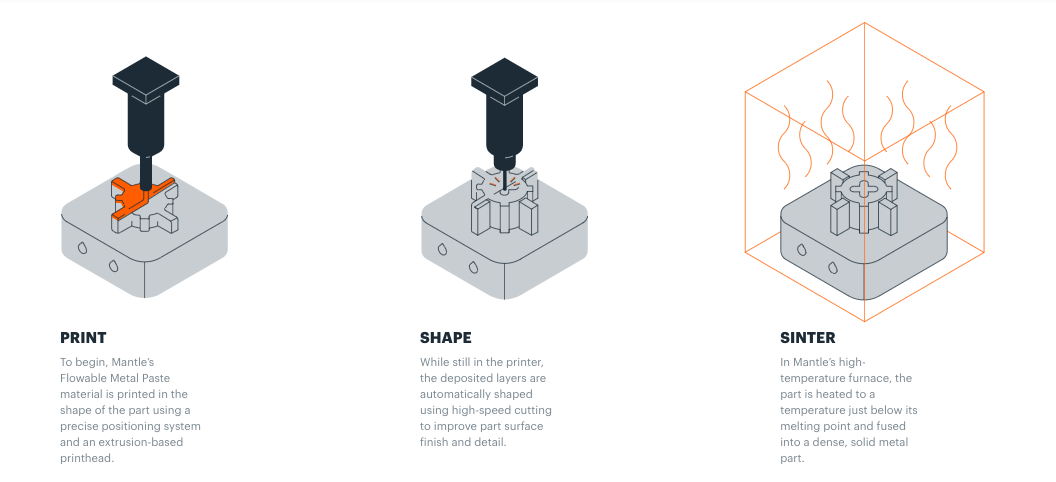
The TrueShape process. Image courtesy of Mantle.
With backing from Foundation Capital, Hypertherm Ventures, Future Shape, 11.2 capital, Plug and Play Ventures, and Corazon Capital, Mantle is targeting the $45 billion tooling market. Whereas typical tool manufacturing requires a long workflow that can take months and cost tens to hundreds of thousands of dollars, 3D printing is capable of producing tools in just days. Mantle claims that it’s possible to cut costs for the manufacture of tooling by at least half.
“Manufacturers require proven part quality and performance. By using Mantle printed tooling, they can continue to use the same high-performance thermoplastics and get parts of equivalent or superior quality in less time and at a lower cost,” said Ted Sorom, CEO and co-founder of Mantle. “We help companies speed their products to market with dramatically faster new product introductions while leveraging their proven mass production expertise.”
A “global appliance manufacturer” has used a tool insert 3D printed using Mantle’s technology to manufacture over 200,000 washing machine parts, according to the startup. This resulted in costs cut by 67 percent and tool production time reduced by 70 percent. The company also noted a “leading medical device manufacturer” that was able to cut lead time for its tool by 80 percent.
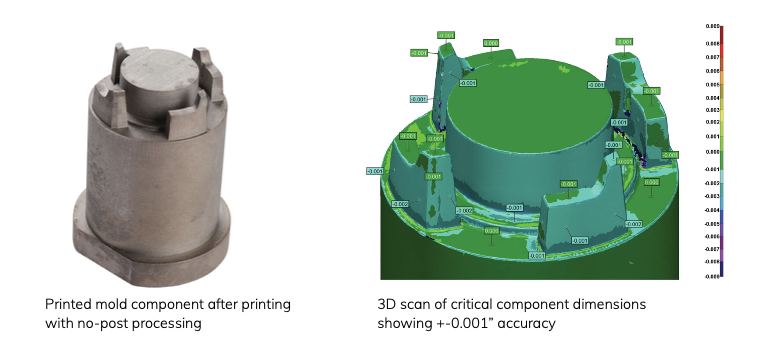
A mold 3D printed with TrueShape used for manufacturing washing machine parts. Image courtesy of Mantle.
“Mantle is taking on the overlooked $45 billion tooling market that is a bottleneck for innovation because it is a slow process that has not changed significantly in 70 years,” said Steve Vassallo, General Partner at Foundation Capital. “Until Mantle, no one has been able to develop tooling tech that is disruptive in either time or cost, let alone both, which made backing Mantle an easy decision for us.”
While tooling is the first industry on Mantle’s roadmap, it is also planning to aim for the $300 billion precision parts market, as well as jigs, fixtures, spare parts and low-volume parts for industrial equipment, and high-volume component manufacturing.
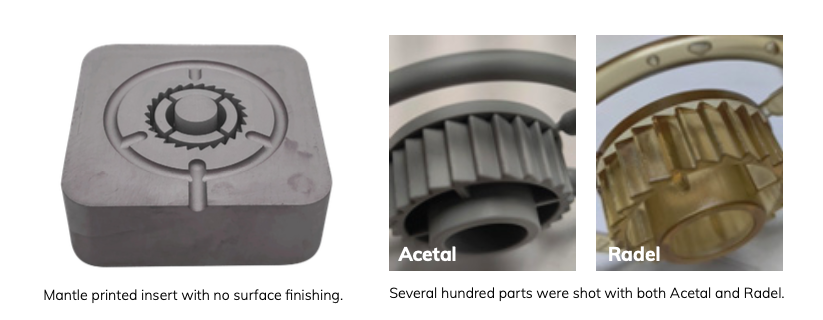
A mold 3D printed using TrueShape for a medical device manufacturer. Image courtesy of Mantle.
Mantle is not the only one aiming to tackle the tooling market. Powder bed fusion systems are increasingly used to produce tooling, as is directed energy deposition. However, if TrueShape is at all similar to other BMP technologies in terms of cost, it may be able to make tools at a much lower cost. We’ll have to see how TrueShape compares to the Metal X from Markforged, the Studio System from Desktop Metal, and the ExOne Metal Designlab. SmarTech Analysis predicts that bound metal technologies are now expected to achieve close to twice the growth rate than the overall metal AM market over the next ten years. With companies like Mantle joining the fray, it’s no surprise why that is the case.
Subscribe to Our Email Newsletter
Stay up-to-date on all the latest news from the 3D printing industry and receive information and offers from third party vendors.
Print Services
Upload your 3D Models and get them printed quickly and efficiently.













You May Also Like
Kickstarter is Testing the Next Wave of Desktop 3D Printing
3D printers are raising serious money again…on Kickstarter, that is. Over the last few months, a new group of 3D printer campaigns has attracted millions of dollars and thousands of...
Stratasys vs. Bambu Lab: What’s Really Behind the $27.6M Patent Verdict?
Editor’s note: This is Part 1 of a two-part series by Xu Fanglei examining the technology and patent issues behind the Stratasys-Bambu Lab dispute. Part 1 looks at the U.S....
Bambu Lab and SUSAN FANG 3D Print for London Fashion Week
At London Fashion Week, some of the more unusual pieces on the runway came from 3D printers. Chinese fashion designer SUSAN FANG presented her Spring/Summer 2027 Air-Illusion collection at the...
Stratasys Wins $27.6M in Patent Case Against Bambu Lab; Bambu Challenges Verdict
Update, September 21, 2026: This article has been updated with a statement from Bambu Lab responding to the verdict, along with additional information about the company’s ongoing patent challenges against...