US Army and Raytheon to Use 3D Systems Metal 3D Printing to Heat-Optimize Munitions

3D Systems (NYSE: DDD) has been chosen by defense contractor Raytheon and the U.S. Army’s central laboratory to help with a design optimization project. To do that, the 3D Systems’ research team will develop a custom printer based off their massive DMP Factory 500.
The printer being used in this project is based off 3D Systems’ DMP Factory 500, notable for its large build area (Image via 3D Systems).
Raytheon Systems is an aerospace and defense manufacturer with a history of developing weaponry for the U.S. military. In the world of additive manufacturing, they’re perhaps best-known for their claim that they could 3D print a guided missile. On this project, they are working with the Army’s Combat Capabilities Development Command (CCDC) laboratory for a more grounded goal: optimizing machine parts.
Topological optimization is a method for developing the best possible design for an item within specific constraints. On this project, that means optimizing “a component relative to an Army modernization product” to transfer heat easily and help the overall system perform better. It hasn’t been announced what said “component” is, but CCDC deputy program manager Brandon McWilliams mentioned that it would allow for “disruptive advancements in munitions.”
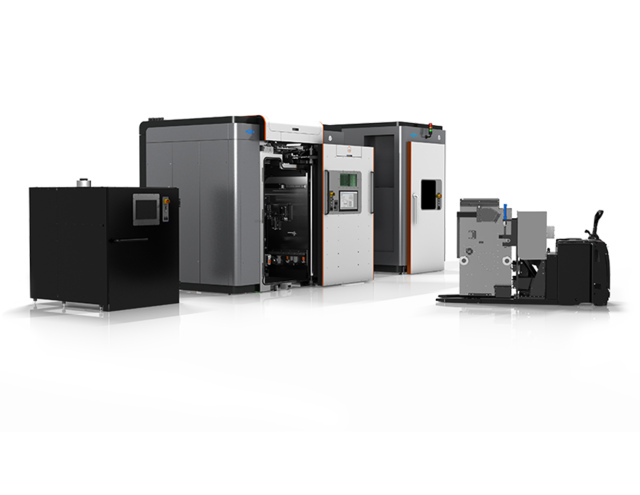
The DMP Factory 500 Metal 3D Printer from 3D Systems. Image courtesy of 3D Systems.
To do that, a team working out of the Penn State Research Laboratory will work with a printer based on the 3D Systems DMP Factory 500. The DMP Factory 500 is what the company calls a large “3D print solution”, or a huge set of printing modules meant to be installed in a factory.
The printer was chosen for its large build volume (500 x 500 x 500 mm), and its ability to make parts across the whole build area without needing to stitch them together. It’s also designed for constant printing, capable of de-powdering parts and recycling the excess for re-use, and has a vacuum chamber to make sure that differences in oxygen content don’t affect batches.
But the team won’t be using the DMP Factory 500 straight out of the box. The 3D Systems team is upgrading it with parts they’re developing for their nine-laser, 1m x 1m x 600mm build volume printer, including coaxial process monitoring and a camera inside the build chamber that gives a view of the process. This new printer was installed at Penn State back in December, and the team will start their work soon. Their mandate will also include research on process modeling, defect detection, more generalized topology optimization, and cyber-physical security.
3D Systems is optimistic about their partnership with Raytheon and the Army; not unreasonable, as President Biden’s pick of a Raytheon board member for his defense secretary suggests that the new administration may have a profitable partnership with them.
“Our work with the Army Research Laboratory is taking 3D Systems’ technology in new directions,” said Chuck Hull, 3D Systems cofounder. “ARL is strengthening its position as a leader in technology innovation to improve the capabilities of the warfighter and we look forward to continuing our collaboration with them.”
Subscribe to Our Email Newsletter
Stay up-to-date on all the latest news from the 3D printing industry and receive information and offers from third party vendors.
Print Services
Upload your 3D Models and get them printed quickly and efficiently.













You May Also Like
The Manufacturing Race Behind the Drone Revolution
We are in the middle of a major manufacturing shift focused on the production speed and payload capacity of uncrewed aerial systems (UAS), or drones. A recent Manufacturing Dive article...
Kickstarter is Testing the Next Wave of Desktop 3D Printing
3D printers are raising serious money again…on Kickstarter, that is. Over the last few months, a new group of 3D printer campaigns has attracted millions of dollars and thousands of...
3D Printing News Briefs, October 1, 2026: Defense, Enclosures, & More
In today’s 3D Printing News Briefs, we’re starting with defense news, first from Massivit and then from AML3D. Then we’ll move on to U.S. manufacturing of a new large-format LPBF...
South Korea’s Lincsolution Lands Hanwha Defense Deal as Hanwha Invests Billions in US
I recently wrote about how the South Korean additive manufacturing (AM) firm Lincsolution is building an aerospace and defense hub, part of the company’s construction of “the largest AM facility in...