First 3D Printed Building Erected in Florida via BOD2 Printer

COBOD may be the fastest growing firm in the additive construction sector. After achieving several milestones in Europe, Africa and Asia in 2020, the Danish firm announced that a U.S. customer has built the first 3D printed building in Florida.
Using the BOD2 3D printer, Printed Farms constructed a 71 m2 (784 ft2) storage unit that was reinforced with rebar, incorporated insulating concrete form, and was examined by a structural engineer. With this smaller project complete, the Wellington, Florida startup will be working toward manufacturing two intercoastal villas in the state, which are in the permitting phase, according to the company. Exactly details about the villas haven’t been announced, but the BOD2 will allow Printed Farms to produce 540 m2 (6,000 ft2) buildings, three stories at 180 m2 (2.000 ft2) each.
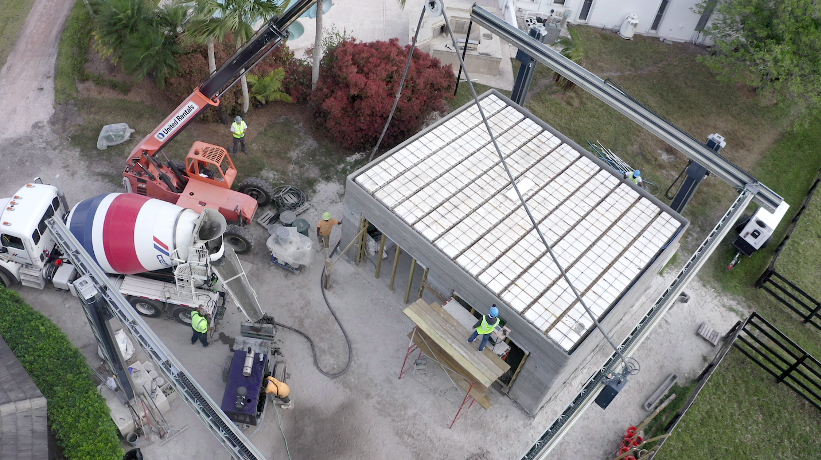
An insulated roof installed onto the 3D printed structure. Image courtesy of COBOD.
Printed Farms has a goal of using 3D printing to make hurricane and flood resistant “green” buildings in Florida. In the past, COBOD has used some recycled concrete for projects, which would be one way that the technology could be more sustainable, as the production of concrete is one of the most carbon intensive processes in the world.
Printed Farms co-founder Fredrik Wannius told 3DPrint.com that the company’s plans for green building is as follows: “We are working with partners that have and/or will develop concrete with a smaller carbon footprint. This will be a part of our integrated building system that will be redefined the coming 2 years.” As for resilient construction, he said, “A 3D printed building is stronger than a conventional building. We are on a mission to prove those claims and also prove that we can build cheaper and faster. By 3D printing inner walls and taking out drywall, you have easier repairs in case of severe flooding.”
As a spin-out of Printhuset with backing from PERI Group , COBOD has been advancing quickly. It claims that, in 2020, orders for the BOD2 system tripled over orders in 2019, despite COVID-19. Now, COBOD says that it will be shipping three more printers to the U.S. this year, presenting a competitive threat to U.S. firms like ICON and Mighty Buildings. It does seem as though the U.S. is at an early demonstrator stage of the additive construction trend than Europe, Asia and the Middle East, where a greater number of functional buildings have been built.
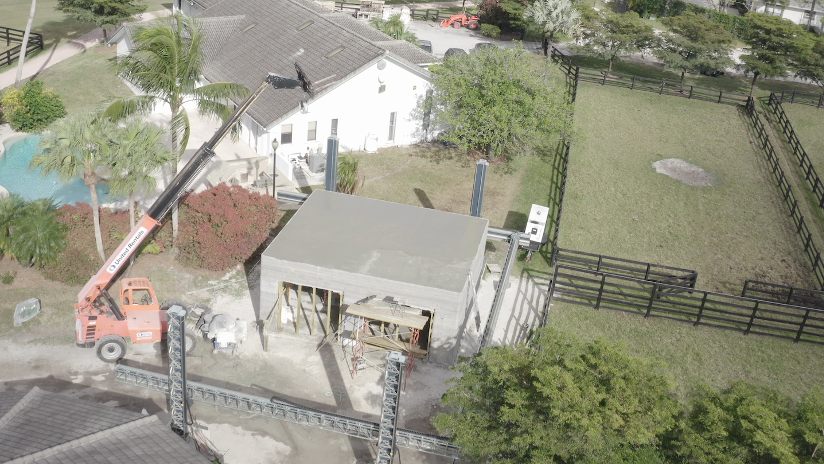
The completed building alongside the BOD2 printer, which measures 15m x 12.5m x 10m (50 x 42 x 33 ft) printer around it. Image courtesy of COBOD.
It also feels as though that is set to change, as hype around the aforementioned U.S. companies has been built up significantly in the past year. Along with the release of the first commercially available 3D printed home in the country, we know that much larger businesses are becoming involved, including the PERI Group, GE, Taisei and Taiheiyo Cement.. The speed with which these buildings spring up suggest that additive construction really is a fast method for erecting concrete structures. The exact impact this will have on the global housing crisis is another matter.
Subscribe to Our Email Newsletter
Stay up-to-date on all the latest news from the 3D printing industry and receive information and offers from third party vendors.
Print Services
Upload your 3D Models and get them printed quickly and efficiently.













You May Also Like
UniFormation S10 Heads to Kickstarter with an Integrated Resin Printing and Post-Processing System
UniFormation will launch its S10 desktop resin 3D printer on Kickstarter on October 22, 2026, with pledges starting at $999. The S10 integrates printing, washing, and drying, allowing a print...
Creality Goes Pro with Sermoon P1S 3D Scanner
From making millions of value-engineered Prusa clones, Creality really has aggressively pivoted to more complex machines. The company has made strides forward in software, and the Ender’s of yore is...
Stratasys Showcases 3D Printed Automotive Applications & New Printer at IMTS 2026
Just ahead of last week’s International Manufacturing Technology Show (IMTS) in Chicago, Stratasys launched the F870, a new large-format, production-grade FDM 3D printing platform designed to drive industrial manufacturing at...
Creality Launches SPARKX i8 on Indiegogo, Bringing Fastest, No-Purge-Waste Printing
Creality announces the launch of the multi-color 3D printer SPARKX i8 on Indiegogo, at an early-bird price of $309 (MSRP $399) starting from Sept. 21. Designed for ultimate user experience,...