
Wabtec and HP Partner on Facility for Railway 3D Printing

From spare aircraft parts to interior décor, nearly entirely 3D printed car prototypes, and train parts that can be printed out easily rather than tracked down years after they may have become almost obsolete, 3D printing has put its stamp on the transportation industry. And while it may allow for better business in terms of cost analysis and the ability to show off flashy prototypes as needed, the benefits are vast for railroad companies in need of parts that may be decades old and extremely difficult to attain later. As the railroad industry continues to embrace the benefits of 3D printing, international businesses like Wabtec are working with other major industry leaders to amp up production of 3D printed parts for the entire rail industry within India—a country acting as the second-largest market for Wabtec, according to the rail equipment supplier.
Wabtec Corporation will now be working with both HP and Redington to open a “center for excellence” in India:
“Wabtec Corporation, in collaboration with HP and Redington, inaugurated Tuesday an Additive Manufacturing Centre focused on accelerating the design and production of integrated 3D-printed components in India. This Centre of Excellence (CoE), named ‘Wabtec India Additive Manufacturing Centre,’ will offer consulting, part identification and production for locomotives, transit entities and Micro, Small, and Medium Enterprises.”
The CoE is actually on-site at an established Wabtec factory in Bengaluru, one of India’s largest cities, and the capital of Karnataka. Currently, Wabtec as the provider of services for both freight and transit rail is also an industry leader in a growing range of solutions for applications in mining, marine science, and other industrial endeavors.
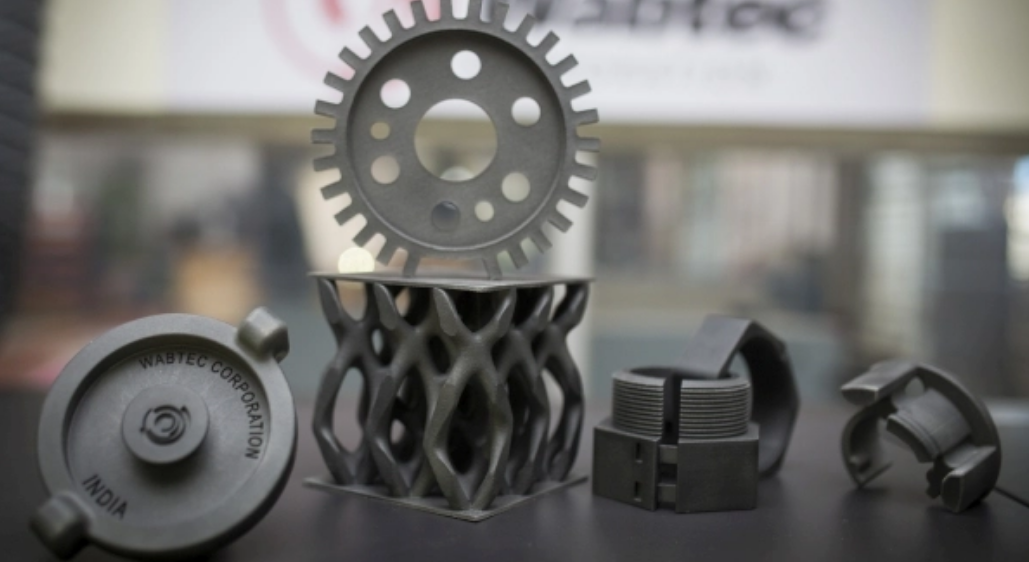
The components that will be 3D printed range from adapters and IOT shield covers for brake controllers to customized dispenser tips and sensor holders
Within the additive manufacturing space, Wabtec plans to use the CoE to further their very ambitious strategy for the design and production of 25,000 industrial parts by 2025. The CoE is solidified by a combination of Wabtec’s experience in industrial manufacturing, HP multi-jet fusion technology, and Redington’s comprehensive supply chain. The CoE will also offer consulting services.
Wabtec recently opened an AM facility in Western Pennsylvania, along with making major headlines upon a merger with GE Transportation a couple of years ago.
As the railway industry continues to embrace 3D printing, companies like Wabtec (already using GE’s metal binder jetting technology) are a perfect example of global corporations enjoying the benefits—from greater affordability, to speed in production, less materials waste—and the ability to manufacture parts quickly, even if they have become obsolete. In working with both HP and Redington, Wabtec will also be producing functional parts like industrial adapters, IoT controlling mechanisms, dispenser tips, sensor holders, and more. Ultimately, they hope their strategy will increase products sourced from India.
[Sources: International Railway Journal; Business Line]Subscribe to Our Email Newsletter
Stay up-to-date on all the latest news from the 3D printing industry and receive information and offers from third party vendors.
Print Services
Upload your 3D Models and get them printed quickly and efficiently.













You May Also Like
Kickstarter is Testing the Next Wave of Desktop 3D Printing
3D printers are raising serious money again…on Kickstarter, that is. Over the last few months, a new group of 3D printer campaigns has attracted millions of dollars and thousands of...
Stratasys vs. Bambu Lab: What’s Really Behind the $27.6M Patent Verdict?
Editor’s note: This is Part 1 of a two-part series by Xu Fanglei examining the technology and patent issues behind the Stratasys-Bambu Lab dispute. Part 1 looks at the U.S....
Bambu Lab and SUSAN FANG 3D Print for London Fashion Week
At London Fashion Week, some of the more unusual pieces on the runway came from 3D printers. Chinese fashion designer SUSAN FANG presented her Spring/Summer 2027 Air-Illusion collection at the...
Stratasys Wins $27.6M in Patent Case Against Bambu Lab; Bambu Challenges Verdict
Update, September 21, 2026: This article has been updated with a statement from Bambu Lab responding to the verdict, along with additional information about the company’s ongoing patent challenges against...
























































