BASF Acquires Industrial XSTRAND 3D Printing Filaments from Owens Corning


Last fall, Germany-headquartered BASF 3D Printing Solutions (B3DPS), a 100% subsidiary of BASF New Business GmbH, introduced its new corporate brand presence, Forward AM, to the 3D printing industry during formnext 2019. B3DPS provides service solutions and a wide variety of materials for the additive manufacturing (AM) value chain under this brand, which is ultimately working to propel industrial scalability in the additive manufacturing industry.
The materials that Forward AM currently offers include Ultrasint powders for powder bed fusion (PBF) printing, several Ultrafuse filaments ranging from standard and flexible to support and metal, and Ultracur3D photopolymers. Now, Forward AM is expanding its AM materials portfolio with the announcement that it has acquired the high-performance XSTRAND Business Line from global building and industrial glass fiber-reinforced composites leader Owens Corning.
“Through the acquisition of the Owens Corning XSTRAND business, we are able to serve our customers with new and innovative filaments for 3D printing,” stated François Minec, the Managing Director for BASF 3D Printing Solutions, in a press release sent to 3DPrint.com. “By adding these high-performing materials, Forward AM now offers one of the broadest product ranges in the entire Additive Manufacturing industry, with expert solutions tailored to all industrial customer needs.”
The acquisition was effective as of August 6th, 2020, with a scope that “does not envisage the transfer of any personnel” but does include transferring the brand itself, and all of its important intellectual property (IP), to BASF’s Forward AM brand.
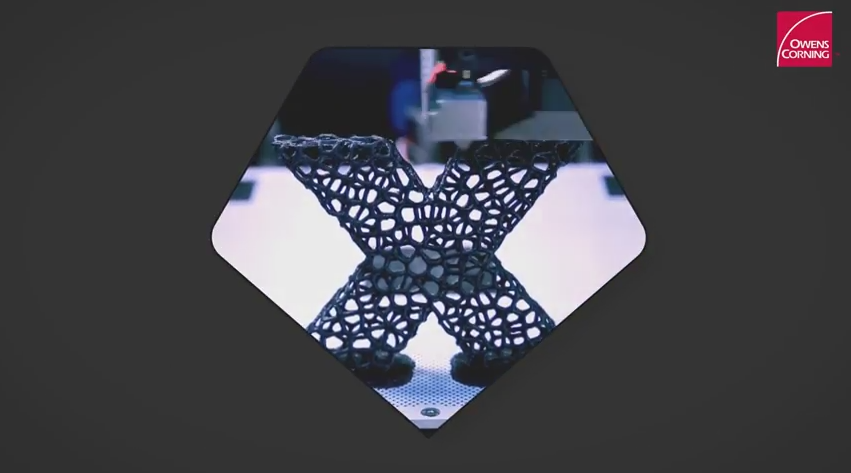
The XSTRAND line of materials is made up of three separate, 30% glass fiber-reinforced filaments that Owens Corning developed: a polyamide, a polypropylene, and a polycarbonate. They are:
- XSTRAND GF30-PA6, featuring extreme durability and a large operational temperature range
- XSTRAND GF30-PP, with superior strength, chemical and UV resistance, and low moisture absorption
- XSTRAND GF30-PC, with high heat deflection temperature and dimensional stability
Parts and components that are 3D printed using glass fiber-reinforced filaments like the XSTRAND line have high strength and ridigity, and it also enables easy printing and handling as well, so they can be used for very demanding industrial AM applications, such as industrial tooling and fixtures, transportation, automotive, electronics and small appliances, and engineering.
The XSTRAND filaments have excellent mechanical properties, due to the integrated glass fiber which reinforce them. Because of this, Forward AM says the materials are able to perform better than the standard polymer filaments you find on the market.
“BASF’s capability will enable the further acceleration of XSTRAND products and support future growth of the composites industry. Owens Corning will continue its collaboration with BASF as we transition XSTRAND® to them,” said Dr. Christopher Skinner, the Vice President of Strategic Marketing, Composites, for Owens Corning.
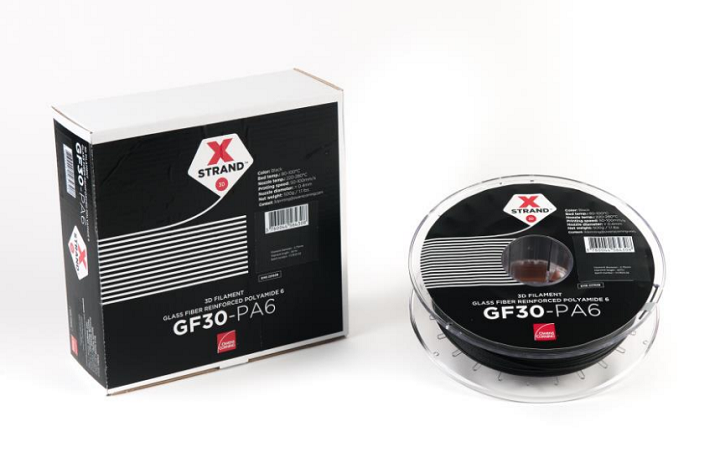
One of the XSTRAND filaments: GF30-PA6 filament for 3D printing is a reinforced material specifically designed to be compatible with any standard Fused Filament Fabrication (FFF) 3D printer. (Image courtesy of Owens Corning)
By acquiring this advanced AM material line, Forward AM will continue to grow its portfolio, further solidifying its place in the 3D printing industry as a top materials and service provider.
(Source: Forward AM / Images: Owens Corning)
Subscribe to Our Email Newsletter
Stay up-to-date on all the latest news from the 3D printing industry and receive information and offers from third party vendors.
Print Services
Upload your 3D Models and get them printed quickly and efficiently.













You May Also Like
Creality Marks 12 Years with KliTek and AI-Powered Ecosystem Expansion
For 12 years, Creality has advanced accessible 3D printing technologies, enabling global users to turn ideas into tangible creations. What began as a desktop 3D printer manufacturer has evolved into...
Asia AM Watch: Creality Launches $177M Hong Kong IPO as HKEX Trading Debut Nears
Creality has formally launched its Hong Kong initial public offering (IPO), marking one of the biggest public market moves by a 3D printing company in 2026 and offering a new...
How AtomForm’s 12-Nozzle System Cuts Multi-Color FDM Transition Waste by Up to 90%
Pull up the print stats on multi-color FDM jobs. The number that stings isn’t time; it’s material efficiency. On six-color models, single-nozzle systems consume significant filament during transition flushing, expelling...
3D Printed Weapons Keep Showing Up in Crime
In the past few weeks, activity around 3D printed weapons in the U.S. has increased across several fronts. States including California, Colorado, New York, and Washington are moving forward with...