Functional Scaled F1 Gearbox Designed and 3D Printed by Amateur Engineer

Ever wondered if it’s possible to 3D print a complete, scaled, working replica of a Formula 1 gearbox? Well, an amateur 3D printing enthusiast has done just that, and released videos of his design and working model (seen below) on his YouTube channel: Indeterminate Design.
While some have learned a new language, musical instrument, or software during the isolation resulting from the COVID-19 pandemic, this 3D printing enthusiast pursued a different hobby. The user behind Indeterminate Design, who calls himself an “amateur engineer”, had only modelled once before in CAD before deciding to design and build a functioning Formula 1 gearbox, just from pictures and rule-book dimensions. In his five-part video series, he covers the design and assembly of the motors, electronics and electronic shifting, software and control, and 3D-printing of the F1 steering wheel with wirelessly connected paddle shifters.
It wasn’t easy at all. He has been painstakingly developing the design, with detailed planning and hundreds of revisions, for over six months. In fact, it took him over 200 hours, with multiple failures, to 3D print a single working F1 gearbox shift barrel. Technical details and specifications are highly secretive, precise and customized in F1, so this effort to make an accurate, working sequential F1 gearbox independently by an amateur is all the more remarkable. The tight tolerances involved, the lack of detailed design information, the complex assembly, the tiny spaces to work within (1,000 horsepower, 15,000 RPMs all controlled and managed within 180mm) altogether make it an incredible individual achievement.
In fact, this could very possibly draw the attention of major Formula 1 teams and the FIA. Formula 1 has long adopted 3D printing technology, as far back as 1998, to test, iterate and modify designs, fixtures or prototypes (largely in FDM/SLA), and produce final parts (in SLS/DMLS) to gain even the slightest edge over competition in each unique race. However, due to the highly specialised, exclusive and secretive nature of technical work in Formula 1 teams, such designs and models are not available to the general public or amateur enthusiasts. That could be changing by 2021, as the FIA has announced the use of additive manufacturing to determine the design, rules, and regulations of its 2021 cars.
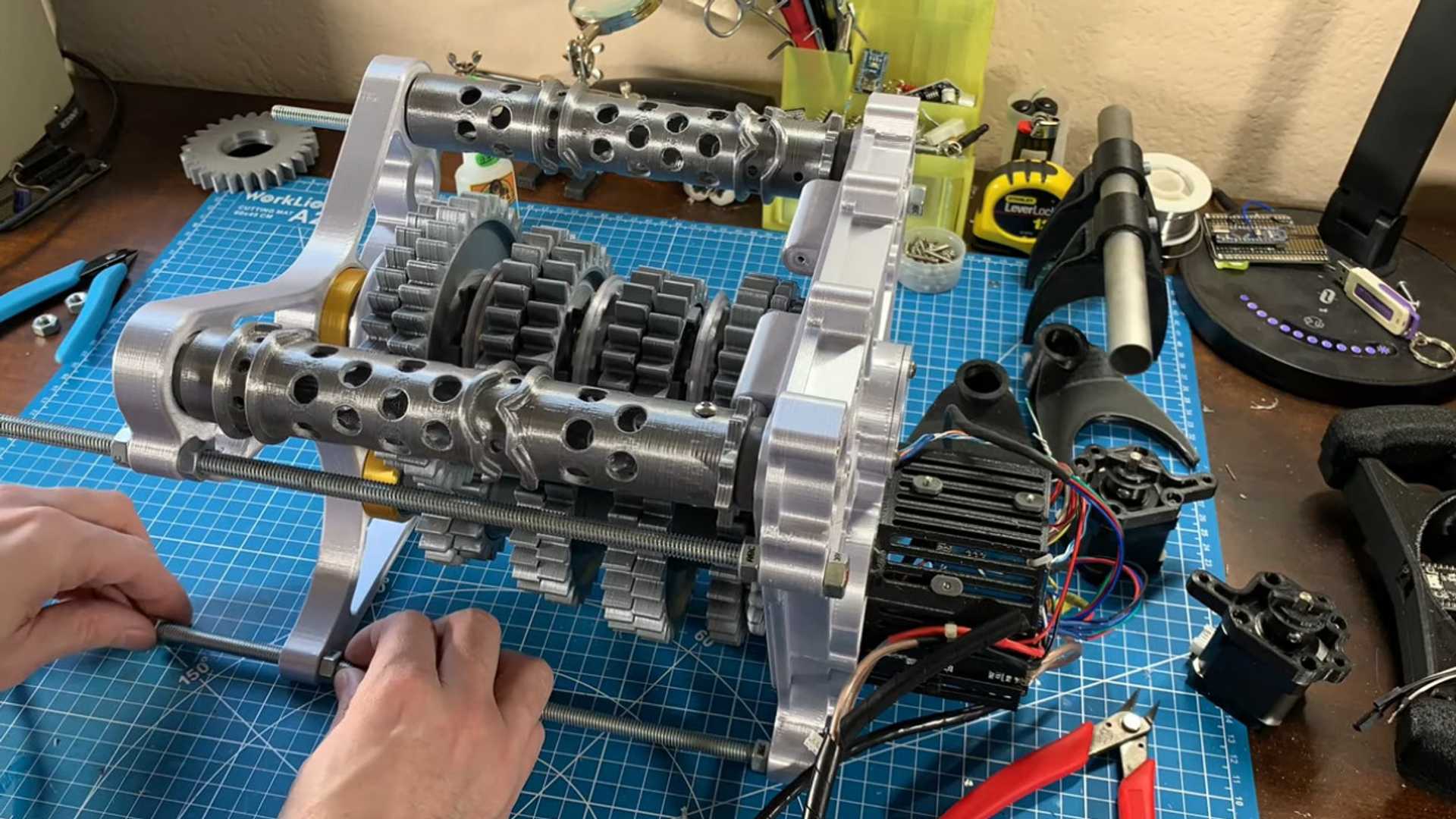
What is really interesting about this F1 gearbox is that while it isn’t an exact replica, it is a combination of different F1 gearbox designs, and the gears change precisely with accurate paddle shifters. Based on the 2009-2014 Xtrac style gearbox, the model was 3D printed using a desktop printer in silk-style PLA for a more realistic look and is currently only made for display purposes. The author will look to use stronger materials to test the functional aspects of the model, and believes his transmission design and materials bring distinct advantages
“It’s much different than the gearbox in your road car. The biggest difference between this and other paddle shifting racing gearboxes is the unbelievable level of optimisation of design/materials and the shift speeds. It can shift so fast that it can actually be in two gears at once for a very brief moment.”
He has shared details of his wonderful work on reddit, the design and 3D print files on GitHub, as well each of his videos on YouTube.
Subscribe to Our Email Newsletter
Stay up-to-date on all the latest news from the 3D printing industry and receive information and offers from third party vendors.
Print Services
Upload your 3D Models and get them printed quickly and efficiently.













You May Also Like
The Manufacturing Race Behind the Drone Revolution
We are in the middle of a major manufacturing shift focused on the production speed and payload capacity of uncrewed aerial systems (UAS), or drones. A recent Manufacturing Dive article...
ADDMAN to Buy Up to $10.8M in Nickel 718 Powder from 6K Additive Over 30 Months
After years of buildup, we’re finally starting to see what the US metal additive manufacturing (AM) market could look like at scale. To be sure, it’s still not quite there,...
Metal AM in a Multipolar World, Part 2: How PBF and DED Could Change by 2035
The first decades of PBF development were heavily shaped by machine capability: more power, more lasers, larger build volumes, better recoating, and improved process monitoring. These developments will continue, but...
Advanced Manufacturing at IMTS 2026: 3D Printing and AI and Drones, Oh My!
Last week’s International Manufacturing Technology Snow (IMTS) in Chicago welcomed over 90,000 attendees to the jungle that is McCormick Place. With over 1.17 million square feet of exhibit space, and...