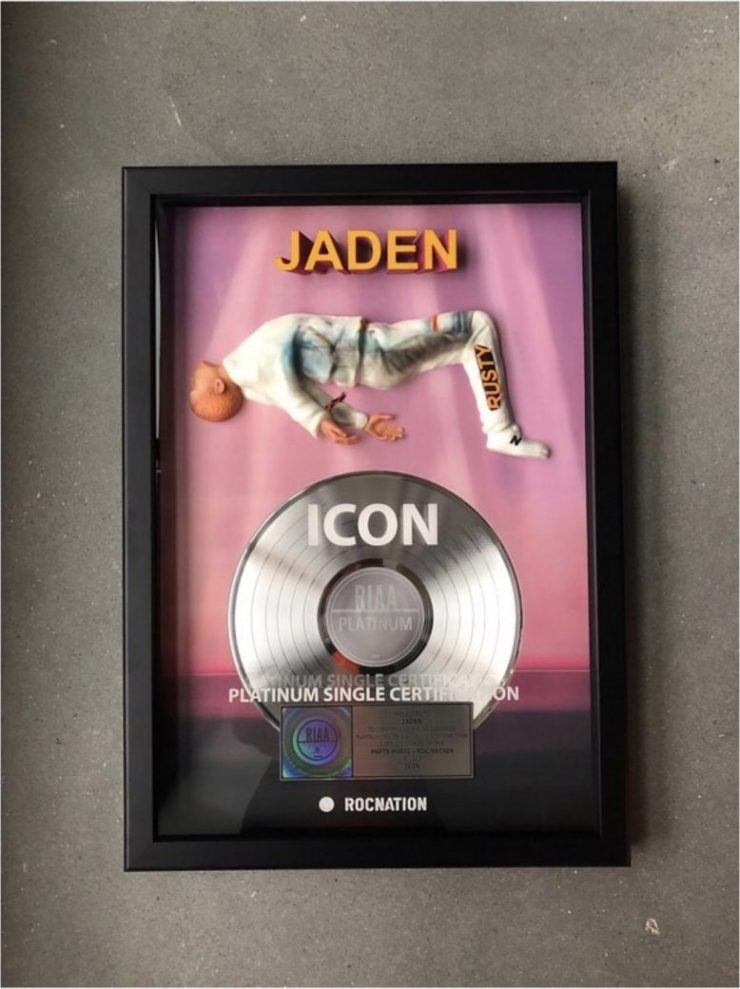
Roc Nation & Makelab 3D Print Plaque for Jaden’s Smith’s ‘Icon,’ Now Platinum


Jaden Smith has evolved into so much more than just a prince of Hollywood royalty, “raised by the power of Will.” In his own right, he is a fashion visionary, an artist, a prolific actor, and a fervent environmentalist. Not surprisingly, Jaden Smith is also a talented vocalist, recently receiving RIAA Platinum Certification for “Icon.”
When record label Roc Nation wanted to celebrate Smith’s achievement with a plaque, they sought a technique and materials that would represent the artist’s dedication to sustainability. Turning to the progressive technology of 3D printing, they began working with Makelab, headquartered in Brooklyn.

Photo credit: ICON music video.
Makelab has made itself known for its commitment to sustainability, as well as the advancement of 3D printing in many applications. A wide range of software, hardware, and materials are both accessible and affordable today for nearly any project, whether or not users seek biocompatibility, improved mechanical properties, functionality for industrial parts, art installations, and so much more. For this plaque, Makelab chose ColorJet Printing and sandstone.
“3D printing’s strength is mass customization, which is an oxymoron. Because typically, mass customization is a financial and logistical nightmare,” Perla said in a recent interview. “Being that the entertainment and music industry moves so quickly, it’s a perfect match!”
Perla explained that, while 3D printing may revolve around mass customization, one of the greatest benefits is the reduction in wasted materials. What is not used can often be recycled and re-used within the additive manufacturing process, and many research projects today involve such practices—whether recycling powder into filament, allowing for circular chemical recycling of PLA, or comparing the performance of virgin and recycled materials.

Christina Perla and Manny Mota, co-founders of 3D printing startup Makelab
Production is usually faster than traditional methods and, best of all, more affordable for one-off items. This piece took 15 hours to print and would generally cost between $2,000 to $2,500.
Eli Velez, Roc Nation’s Creative Consultant, oversaw the project with the goal of inspiring others with the use of new technology, materials, and techniques. Velez also wants others to focus on their environmental footprint, especially considering the surprising amount of ‘unsustainability’ that arises from the music business in terms of merchandise and touring.
“To me, this project represents the democratization of knowledge through the merging of two industries. Hopefully, other kids will see this and feel inspired to go out there and start making something or learning a new skill set,” he said. “This is for anyone sitting in their house trying to figure out how to get their ideas out…Google is your north star. Let your curiosity lead you.”
What do you think of this news? Let us know your thoughts! Join the discussion of this and other 3D printing topics at 3DPrintBoard.com.
[Source / Images: The Rising]Subscribe to Our Email Newsletter
Stay up-to-date on all the latest news from the 3D printing industry and receive information and offers from third party vendors.
Print Services
Upload your 3D Models and get them printed quickly and efficiently.













You May Also Like
50,000 Orders and Counting: EPlus3D & Chinese AM Services Provider Are Scaling Liquid Cooling Solutions for AI Servers
An under-appreciated story driving the additive manufacturing (AM) industry this year has been the divergence between what’s driving the market in China and what’s driving it everywhere else. Let’s start...
Seven Trends Reveal What’s Next for 3D Printing at TCT Shenzhen 2026
TCT Shenzhen 2026 opened on October 14 in Hall 15 of the Shenzhen World Exhibition & Convention Center in Bao’an, and ran through October 16. The event brought together equipment...
With Increased Aerospace & Defense Focus, CORE Industrial Partners Buys More Manufacturing Firms
Private equity’s march into manufacturing continues with CORE Industrial Partners’ latest acquisitions. CORE purchased Fathom a few years ago, and later bought 3DXTECH LLC, Triton 3D LLC, and Gearbox3D. It...
Can India’s AM Push Help Make it a Viable Supplement to China?
Diversifying manufacturing supply chains to locales outside of China has nothing to do with actually cultivating “substitutes” to the Chinese economy. The real stakes are these: China is an irreplaceable...