3D Printing News Briefs: May 5th, 2020


We’re talking about materials and business in 3D Printing News Briefs today. DyeMansion has launched a color line for grey Multi Jet Fusion parts, and NanoAL was named a 2020 Edison Awards Gold Winner for its Addalloy product family. Finally, 3ntr is expanding its presence.
DyeMansion Introduces Vibrant Color Line for Grey MJF Parts
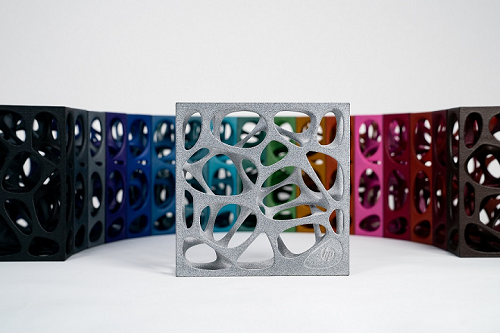 Munich-based DyeMansion offers 3D printed plastics users a full color selection courtesy of its DeepDye Coloring process, but these choices have been limited to dark shades for plastic parts with a grey base material. But the post-processing experts have been developing a new color palette, and are now excited to launch the first vibrant color line for grey Polyamide (PA) 12 parts 3D printed with HP’s Multi Jet Fusion technology. The new line features 17 colors, ranging from black and grey to rich blue, refreshing green, lively pink, and strong red tones, and opens many new applications for 3D printed PA12 products, including in the automotive and consumer goods sectors.
“In order to achieve strong colors even on parts with grey base material with immediate effect, we have redefined our process and developed a special recipe,” explained DyeMansion’s Co-Founder and CTO Philipp Kramer. “The handling remains easy for our customers, because no DM60 hardware or software adjustments are necessary to use the new colors.”
The color line won’t be commercially available until July, but DyeMansion has begun a beta program for selected customers who own both an HP Jet Fusion 4200 or 5200 system and a DyeMansion Powershot S and DM60. DyeMansion will be hosting a webinar series focused on its new colors, and the first was held this morning for APAC and Europe regions. A webinar for viewers from the US and Canada will be held next Thursday, May 14th, at 11 am EST.
NanoAL’s Addalloy Powder Wins Gold Edison Award
 Materials research and technology company NanoAL LLC, a subsidiary of Braidy Industries, has announced that its proprietary Addalloy Aluminum Powder won a Gold Edison Award in the 3D Printing Enhancements Category. The Edison Awards have long recognized the best in innovators and innovation, and a panel of over 3,000 top business executives from around the world chose Addalloy Aluminum Powder as the 2020 Gold award winner. The high-strength product family was developed for laser powder bed fusion (LPBF) and selective laser melting (SLM) 3D printing, and the alloys are designed without complex powder blends or costly rare earth elements, allowing users to easily create advanced microstructures for less money.
“Our unique alloy compositions take advantage of the powder atomization and SLM printing processes to create advanced microstructures with non-traditional nanoprecipitate strengthening mechanisms which greatly enhance the performance of 3D printed aluminum components,” NanoAL Application Engineer Jose Burgos told 3DPrint.com. “The current product line includes Addalloy 5T for structural components, Addalloy 7S for ultra-strong lightweighting applications, and Addalloy HX for thermal management. Unlike other next-generation aluminum powders on the market, these alloys are designed without expensive rare earth elements or complicated powder blends which makes them cost effective and easy to use.”
3ntr Expanding Network to Support the Industry
 Industrial 3D printer manufacturer 3ntr, headquartered in Italy, has been busily contributing to national health needs, collaborating with Shapemode, HTA, and Master Solution to produce health systems and 3D print respirators for hospitals in northern Italy. But even during these trying times, the company is looking to the future with new opportunities and challenges. In order to support the manufacturing industry on a global scale, 3ntr is expanding its presence, opening to the Russian market and being renewed in Spain, to reach a total of 19 countries, while also offering its important services in Italy during the coronavirus crisis.
“3ntr has an international DNA and an incredibly versatile industrial character, capable of reading market signals and translating them into quality products, this is the company’s value proposition,” stated Emanuele D’Addario, Global Channel Manager, 3ntr. “The basis of 3ntr’s proposal is the product: simple, robust, technological, reliable and evolvable, it is designed to disrupt technological obsolescence and represents a concrete investment to support the industry.”
The company’s 3D printers will remain available to all research centers and hospitals that make a request. Additionally, 3ntr is continuing to offer its workstations to the project folding@home as part of medical research.
Discuss these stories and other 3D printing topics at 3DPrintBoard.com or share your thoughts in the Facebook comments below.
Subscribe to Our Email Newsletter
Stay up-to-date on all the latest news from the 3D printing industry and receive information and offers from third party vendors.
Print Services
Upload your 3D Models and get them printed quickly and efficiently.












You May Also Like
3DPOD 302: Digital Inventory for AM with Mikhail Gladkikh, Würth Additive Group
Mikhail Gladkikh has worked in oil and gas for many years. With this background, we obviously talk about energy market turbulence and the adoption of AM in oil and gas....
Spectrum Filaments Gets Investment: How They Could Win in Filament
Spectrum Filaments is a long-time high-quality filament supplier based in Poland. With good tolerances, roundness, and consistency coupled with affordable pricing, the firm has been a mainstay for makers, industrial...
NX Atomics and Sciaky Collaborating to 3D Print Nuclear Components
For decades, the nuclear industry has quietly experimented with and implemented additive. Bouyed by the likes of ORNL, companies such as Westinghouse have 3D printed components serially. We have an...
Incodema3D Buys 14 Metal EOS Systems, Now One of the World’s Largest Metal 3D Printer Operators
Recently, a majority stake of 3D printing service bureau Incodema3D was purchased by AFM Capital. Under new ownership, the Freeville, New York company is now using its cash-rich parent for...